Filling the Gap Fairly
Sam says: "Jo won't come to the party on Thursday. She has an exam on Friday." In the last lesson we saw that most arguments leave a reason unsaid. What is the missing reason here? Two friends could fill the gap in two very different ways.
Two ways to fill the gap
Here is Sam's argument:
Jo has an exam on Friday.
So Jo won't come to the party on Thursday.
Pretend the reason is true and imagine Jo at the party anyway. That is easy to imagine, so a reason is missing. Here are two ways to fill it.
Way one "Nobody who has an exam the next day ever goes to a party." With that reason, the conclusion follows. But the reason is clearly false: plenty of people go out the night before an exam.
Way two "Jo usually stays at home to study the night before an exam." With this reason the conclusion doesn't follow for certain, but it becomes very likely. And it may well be true: Sam knows Jo.
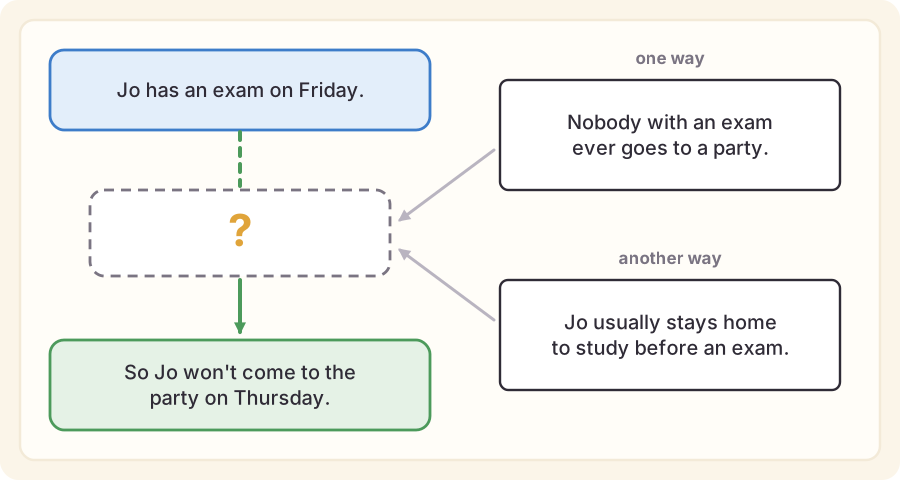
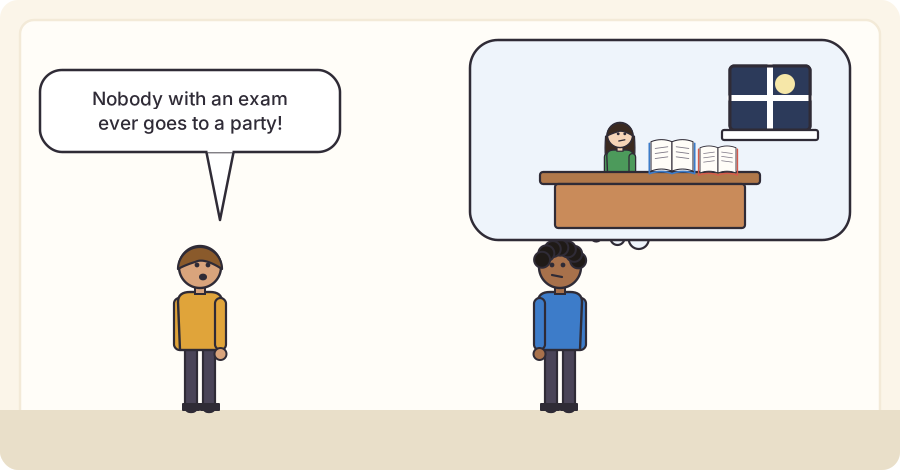
If you fill the gap with way one, you can say "That's silly, people go to parties before exams all the time!" and feel that you have won. But you haven't answered Sam at all. You have answered an argument that Sam never made.
The fair way
In Level 1 we met the principle of charity: understand someone's argument in its best version before you judge it. Here is what charity means for missing reasons. Choose the missing reason that:
- makes the argument work - with it, the conclusion follows, or at least becomes likely;
- the speaker most likely believes - think of what this person knows;
- is most likely true - if two reasons would both do the job, pick the more believable one.
Way two passes all three tests. Way one fails the third one badly.
When even the fair version fails
Sometimes the fairest missing reason is still false. "Mr Diaz is a doctor, so he must be rich" needs something like "doctors are usually rich", and even that is doubtful. Then you have found a real weakness, and you can say so honestly: "I think your argument needs this reason, and I'm not sure it's true."
That sentence is much more useful than "You're wrong!" It tells the other person exactly where you disagree.
Try it at home
- "The shop will be busy - it's Saturday." Write one unfair and one fair missing reason.
- Next time you disagree with someone, try saying: "Your argument needs this reason..." and check that they agree that is what they meant.
Words to know
- filling the gap fairly - choosing the missing reason that makes the argument work, that the speaker believes, and that is most likely true
Big idea
A missing reason can be filled in many ways. Fill it the way the speaker most likely meant. If you fill it with something silly, you only beat an argument nobody made.