Most and Nearly All
Kemi's little brother has a new soft toy, a bird called Pingu. "Pingu can fly," he says. "Most birds can fly, and Pingu is a bird." Kemi turns the label over. Pingu is a penguin.
"Most" is not "all"
Compare two arguments:
All birds have feathers.
Pingu is a bird.
So Pingu has feathers.
Most birds can fly.
Pingu is a bird.
So Pingu can fly.
The first is valid: if its reasons are true, its conclusion must be. The second is not. Draw it with circles: "most birds can fly" puts most of the bird circle inside the circle of fliers, but not all. Pingu's dot could be in the part that is left out.
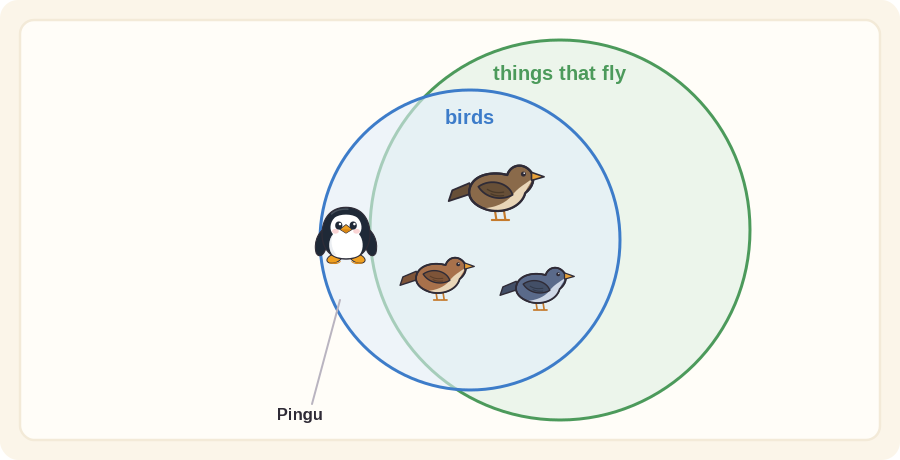
In Level 1 we met arguments whose conclusions are only likely, not certain: learning from examples, or induction. An argument from "most" is the same kind. It can't be valid, but it can be strong (its conclusion is very likely if its reasons are true) or weak (only a little likely).
What makes it strong or weak
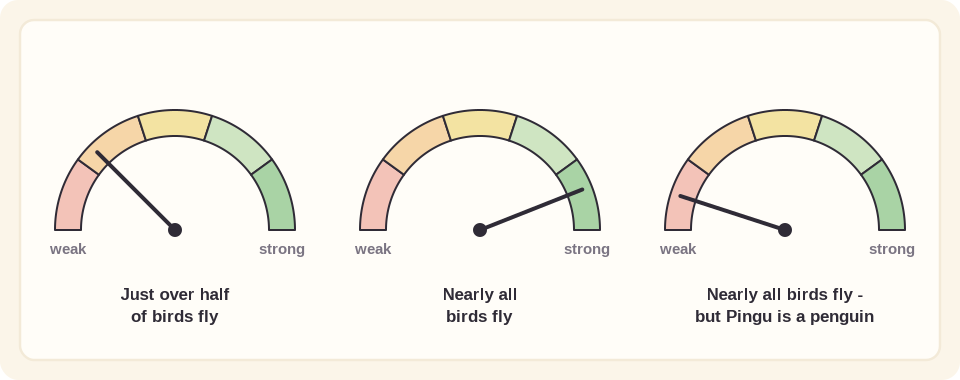
How many "most" is. "Nearly all" makes a strong argument; "a bit more than half" makes a weak one. "Nearly all the shops close on the holiday, so the baker's will be closed" is fairly safe. "Just over half the class walk to school, so Ahmed walks" is little better than a coin toss.
What else you know. Even with "nearly all", one more fact can change everything. Nearly all birds can fly. But once you know Pingu is a penguin, the argument becomes useless, because you know Pingu is in the part that can't. A strong argument from "most" always asks: is there anything else I know about this one?
A trap: most and most
Here is a mistake that even careful people make:
Most pupils in the class like pizza.
Most pupils in the class like football.
So most pupils like both.
It sounds right but doesn't follow. Suppose there are 10 pupils, 6 like pizza and 6 like football. The two groups could share as few as 2 pupils. Draw it and you'll see: two big circles can each cover most of the class and still overlap only a little.
Try it at home
- "Most shops are open on Saturday, so the shoe shop will be open." Strong or weak? What could you find out that would change your answer?
- In a class of 20, 12 have a cat and 12 have a dog. What is the smallest number that could have both?
Words to know
- strong (argument) - its conclusion is very likely if its reasons are true
- weak (argument) - its reasons make the conclusion only a little likely
Big idea
An argument from "most" is never valid, but it can be strong. It is stronger when "most" means nearly all, and it breaks as soon as you know something that puts this case among the exceptions.