Going Round in a Circle
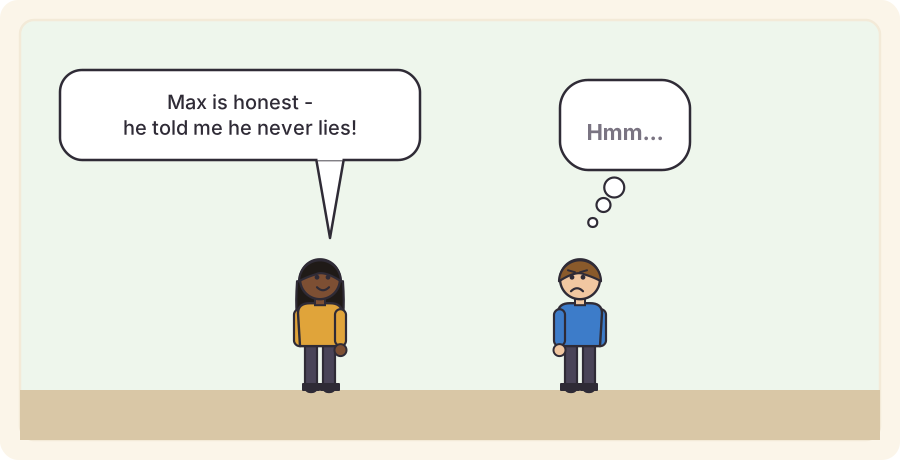
Zara and Theo are talking about a new boy in their class.
"Max is completely honest," says Zara.
"How do you know?" asks Theo.
"Because he told me he never lies."
"But how do you know he wasn't lying when he said that?"
"Because Max is honest!"
The reason that is the conclusion
Set Zara's argument out with its hidden reason (the missing reason from the start of this course):
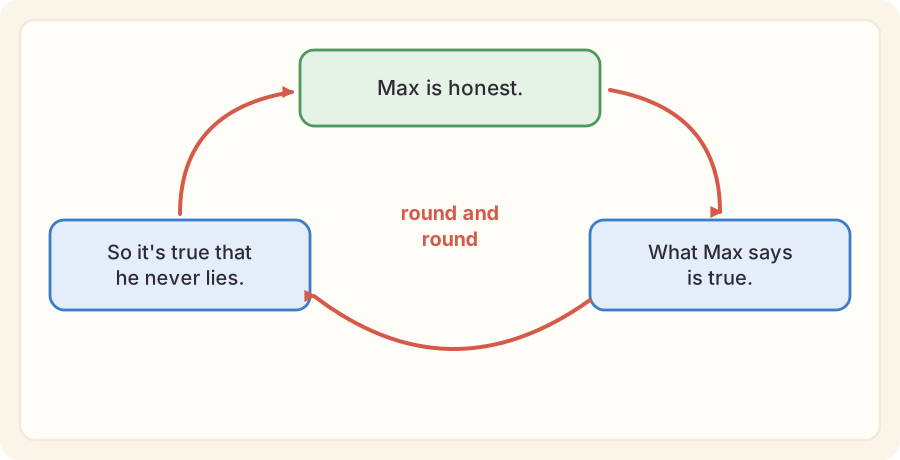
Max says he never lies.
Whatever Max says is true, because Max is honest.
So Max is honest.
The conclusion, "Max is honest", is also one of the reasons. Zara is using the thing she wants to prove to prove it. The argument goes round in a circle.
This is called circular reasoning. Its older name is begging the question: the argument "begs" (asks you to grant) the very question that is being argued about.
On an argument map, circular reasoning is easy to see: an arrow comes out of the conclusion and goes back up into the reasons.
Why it proves nothing
Here is the strange thing: a circular argument is valid. If "Max is honest" is true, then "Max is honest" is true! You can't imagine the reasons true and the conclusion false.
But it is useless. An argument is supposed to give reasons that someone could accept before they accept the conclusion. If Theo already believed Max was honest, he wouldn't have asked. A circular argument asks him to believe the conclusion first, in order to believe the conclusion.
Circles in disguise
The circle is usually hidden by using different words for the same idea:
- "This book is the best in the world because no other book is as good as it." ("The best" and "no other book is as good" say the same thing.)
- "I'm right because I'm never wrong."
- "You can trust this website: everything on it is true." (How would you know that, except from the website?)
To catch it, ask of each reason: would anyone who doubts the conclusion accept this reason? If the reason is just the conclusion in other words, the answer is no.
Try it at home
- Which of these is circular? (a) "It's illegal because it's against the law." (b) "It's illegal because a law passed last year forbids it."
- A friend says: "Pineapple on pizza is disgusting, because it tastes horrible." Is that a reason, or the same claim again?
Words to know
- circular reasoning (begging the question) - using the conclusion, or the same idea in other words, as a reason for itself
Big idea
An argument that uses its own conclusion as a reason goes round in a circle. It may be valid, but it can never convince someone who doubts the conclusion, which is the whole point of an argument.