Objections and Replies
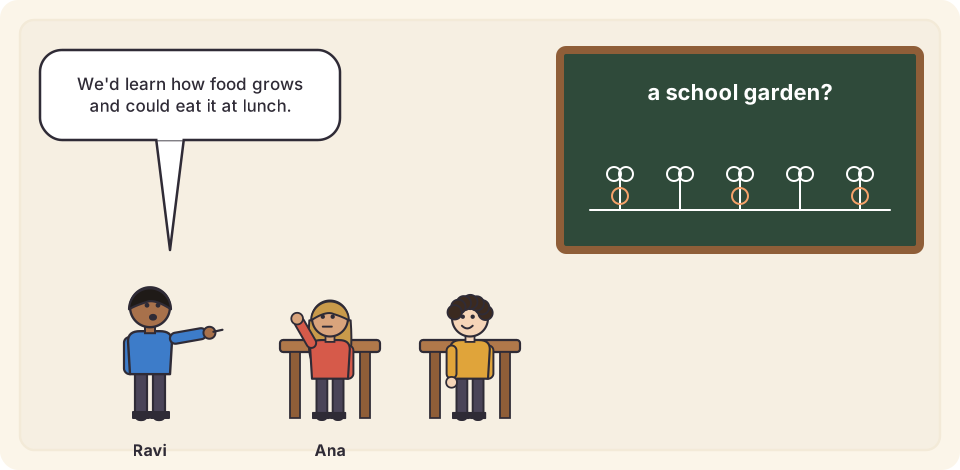
Class 6B is deciding whether to ask the head teacher for a vegetable garden in the school yard. Ravi stands up: "We should have a garden. We'd learn how food grows, and we could eat what we grow at lunch."
Ana puts up her hand. "But who will water it in the summer holidays? The plants will all die."
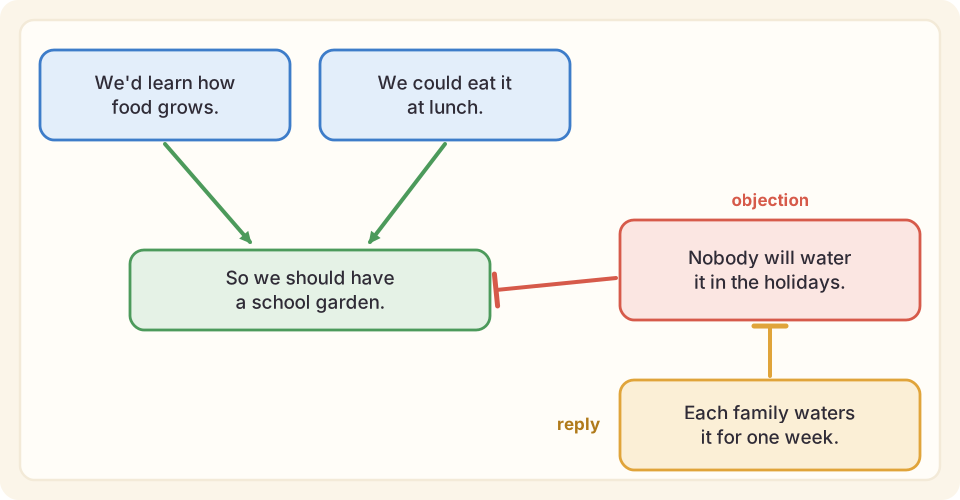
Ravi thinks for a moment. "We could make a list. Each family waters it for one week."
Objections
Ana didn't just say "no". She gave a reason to doubt Ravi's conclusion: if nobody waters the garden in the holidays, it will die, and the work will be wasted. A reason like that is called an objection.
An objection can attack an argument in two different ways:
- it can say a reason is false ("we can't eat it at lunch, the kitchen won't allow it");
- or it can say the reasons don't support the conclusion well enough, often because something important was left out (Ana's: even if we'd learn a lot, the garden won't survive the holidays).
These are the two questions about every argument from Level 1: are the reasons true, and do they support the conclusion?
Replies
Ravi then answered Ana's objection with a plan. An answer to an objection is a reply. A good reply does one of three things:
- shows the objection is false ("actually the caretaker works all summer and has said he'll water it");
- shows it doesn't matter much ("even if some plants die, we'll have learned a lot by then");
- changes the plan so the objection no longer applies (a watering list).
On an argument map, an objection is a red box with a line that ends in a bar, pointing at what it attacks. A reply is a box that attacks the objection the same way.
Why objections are a gift
It is tempting to treat an objection as an attack on you. But an objection does you a favour. Either you can answer it, and your argument becomes stronger and more convincing, or you can't, and you have just found out your idea needed changing before it failed for real.
That is why careful thinkers look for objections to their own arguments before anyone else does. Ask yourself: what would someone who disagrees say? And remember charity from Filling the Gap Fairly: object to the strongest version of the other person's argument, not a straw man.
Try it at home
- Think of one objection to: "Everyone in our family should walk to school instead of going by car."
- Write a reply to your objection. Which of the three kinds of reply is it?
- Pick something you believe. Write the best objection you can to it.
Words to know
- objection - a reason to doubt an argument: that a reason is false, or that the reasons don't support the conclusion
- reply - an answer to an objection: it is false, it doesn't matter much, or the plan changes to meet it
Big idea
Real arguments are a conversation of reasons, objections and replies. Every objection either makes an argument stronger, once it is answered, or shows that it needs to change.