When Scientists Agree
How old is the Earth? About 4.5 billion years. You can't check that yourself - you would need years of study, laboratories and rocks from around the world, and even from the Moon. So why should you believe it?
Many kinds of evidence
The age doesn't come from one measurement, or one scientist. It comes from many different kinds of evidence, collected by different people in different ways. Rocks from meteorites, which are leftovers from when the planets formed, come out at about 4.5 billion years. The oldest tiny crystals found on Earth, in Australia, are about 4.4 billion years old. Rocks brought back from the Moon are about 4.5 billion years old too.
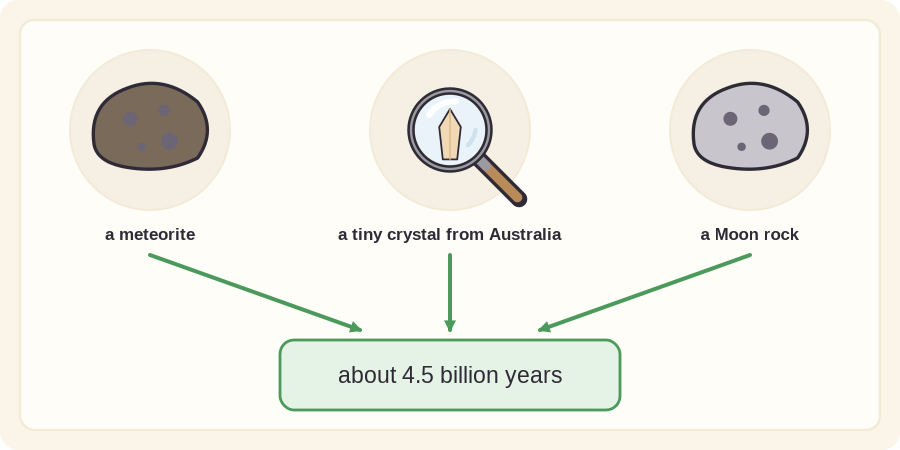
They all point to the same answer. So nearly all the scientists who study the Earth's age agree on it. When nearly all the experts in a field agree on something, because the evidence points that way, it is called a scientific consensus (say it "con-SEN-sus").
Not a vote
A consensus isn't a vote, and it isn't people agreeing to be friendly. Scientists are rewarded for proving each other wrong: the scientist who overturned a well-known result would become famous. So a consensus is what is left standing after many people have tried hard to knock it down. If you have read Knowledge Level 1, this is the same as independent sources: many people who checked for themselves, not one person repeated many times.
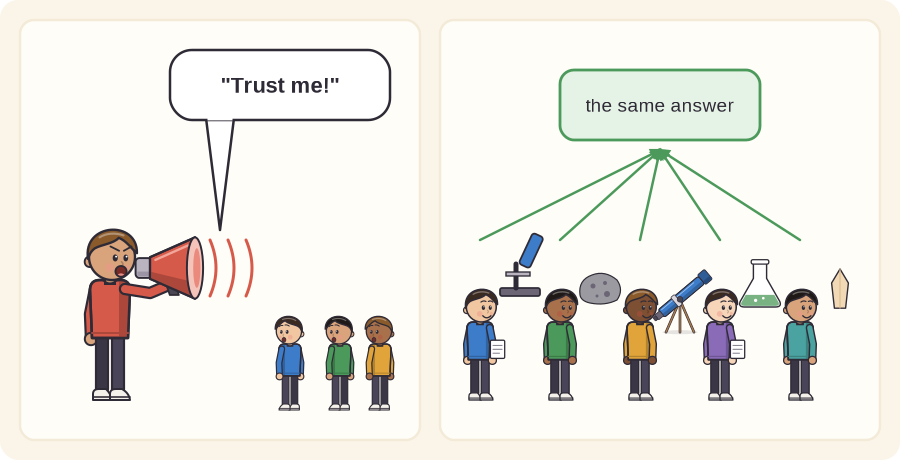
That is also why one loud voice against a consensus isn't the same as half the scientists disagreeing. The question is not how loud or confident someone is, but what the evidence of the whole field says.
The best bet, not the last word
A consensus can be wrong, and it can change - the next module tells how. But when it changes, it changes because of new evidence that convinces the experts, not because someone shouts. For someone who isn't an expert, the consensus of the experts is almost always the best bet available.
Try it at home
- Think of a fact about the world you believe but have never checked yourself (how far away the Sun is, what the Moon is made of).
- Write down who found it out, and whether you think many people checked it in different ways.
- What would make you change your mind about it?
Words to know
- scientific consensus - nearly all the experts in a field agreeing on something, because many kinds of evidence point the same way
Big idea
A scientific consensus is when nearly all the experts agree because many independent kinds of evidence point the same way. It isn't a vote, and it can change - but it is the best bet for someone who can't check for themselves.