A Map Is Not the Place
Look at a map of a city's metro. The lines are straight or bent at neat angles, in bright colours. The stations are spaced out evenly. In the real city, the tunnels curve and wander, some stations are a few hundred metres apart and others several kilometres, and none of the tunnels is red or green. The map is "wrong" almost everywhere. Yet millions of people use it every day to get where they are going. How can something so wrong be so useful?
Leaving things out on purpose
The metro map leaves out nearly everything about the real tunnels: their shape, their length, the streets above. It keeps only what a passenger needs - which line goes to which station, and where to change.
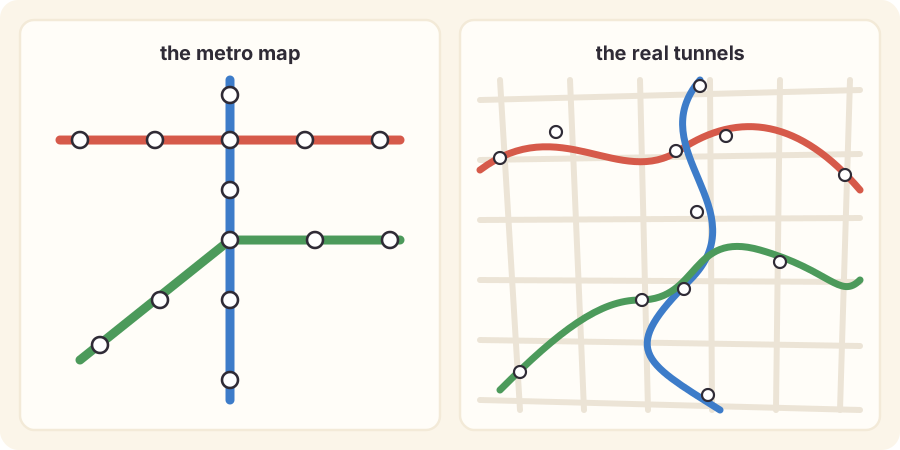
A simpler version of something real, which keeps what matters for a purpose and leaves the rest out, is called a model. Scientists use models all the time: a globe is a model of the Earth, a drawing of an atom is a model of an atom, and a weather forecast comes from a model of the air, worked out on a computer.
Too big and too close
A model of the Solar System on a classroom ceiling shows the planets in order around the Sun. It is useful, but it is badly wrong in one way: the sizes and distances. To fit in a room, the planets are drawn far too big and far too close.
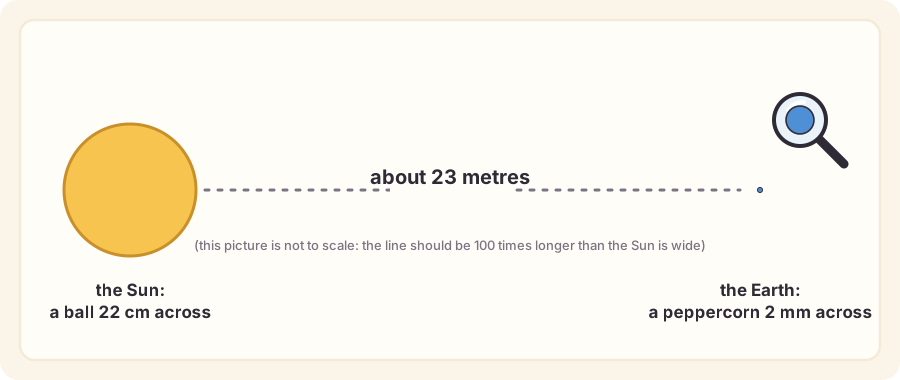
If the Earth were a peppercorn, about 2 millimetres across, the Sun would be a ball about 22 centimetres across - and about 23 metres away. A model that showed that would need a sports field, not a ceiling. So the classroom model leaves out the distances on purpose, to show the order clearly. The scale of a model is how its sizes compare with the real thing.
Useful for some questions
A model is not judged by being exact - no model is. It is judged by whether it is good for what you want to know. The metro map is excellent for "which train do I take?" and useless for "how long is the walk between these two stations?" The statistician George Box put it this way: "All models are wrong, but some are useful." So the question to ask of a model is: what is it good for, and what does it leave out?
Try it at home
- Draw a map of the way from your home to a shop or a school, with only what someone would need to find the way.
- Write down three things your map leaves out on purpose.
- Name a question your map would be useless for.
Words to know
- model - a simpler version of something real, which keeps what matters for a purpose and leaves the rest out
- scale - how the sizes in a model compare with the real thing
Big idea
A model is a simpler version of something real. It leaves things out on purpose, so it is never exact - but a good model is useful for what it was made for. Ask what it is good for, and what it leaves out.