Keeping What Worked
After finding Neptune, the mathematician Urbain Le Verrier, from the Predicting the Unseen lesson, turned to the planet closest to the Sun, Mercury. In 1859 he found that Mercury's path was slowly turning round the Sun, a tiny bit more each year than Newton's theory said it should. The same trick had worked once before, so he predicted another unseen planet, even closer to the Sun, pulling on Mercury. People called it Vulcan, and astronomers searched for it for decades. What did they find?
The planet that wasn't there
They found nothing. Vulcan didn't exist. This time, the problem wasn't a missing planet. It was the theory.
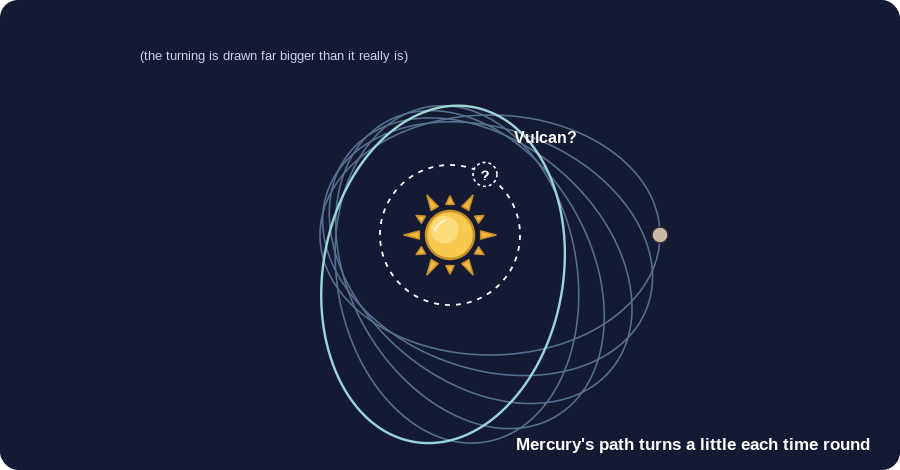
In 1915, Albert Einstein put forward a new theory of gravity. Without any new planet, it worked out exactly how much Mercury's path should turn - and the answer matched what Le Verrier had measured. Then, in 1919, it passed a new test: it predicted how much starlight passing close to the Sun would bend, and that was measured during an eclipse of the Sun.
Newton wasn't thrown away
So was Newton simply wrong? Not quite. For almost everything - a ball thrown in a park, a bridge, the Moon going round the Earth - Newton's theory and Einstein's give the same answer, so close that nobody could measure the difference. When astronauts flew to the Moon in 1969, their paths were worked out with Newton's theory. Einstein's theory is needed where gravity is very strong, as close to the Sun, or where clocks need to be extremely exact: the satellites that tell your phone where it is have to allow for it.
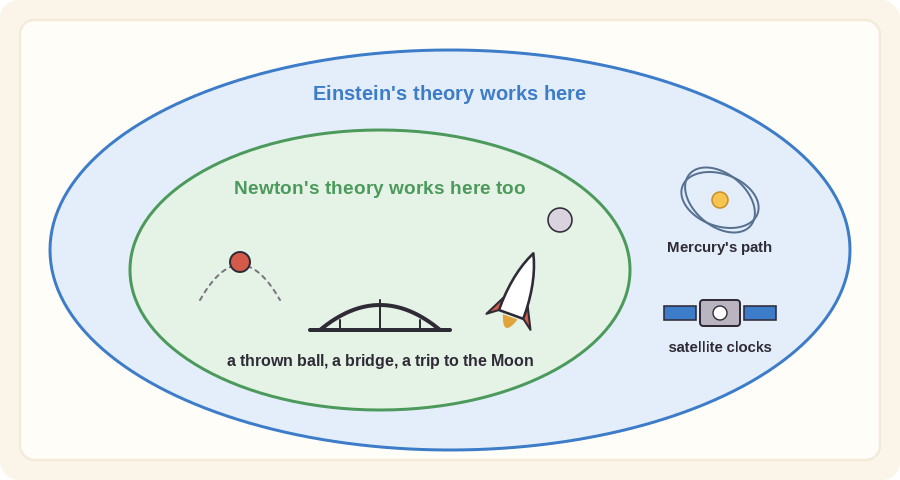
The new theory keeps everything the old one got right, and fixes the places where it went wrong. That is called refining a theory: making it better rather than throwing it away.
Most changes look like this
Big changes like Copernicus's, which we saw in The Sun in the Middle, are rare. Most of the time science changes its mind like this: a well-tested theory keeps working where it was tested, and a better one stretches further. And notice what happened with Le Verrier: the same reasoning that found Neptune failed for Mercury. Nobody could know in advance which it would be. Only testing could tell.
Try it at home
- Think of something you learned when you were younger that you now know more about ("plants need water" became "plants need water, light and the right soil").
- Write down what the first idea got right, and what the newer one adds.
- Was the first idea wrong, or just not the whole story?
Words to know
- refine (a theory) - to make it better, keeping what it got right and fixing where it went wrong
Big idea
A new theory usually keeps what the old one got right and fixes where it went wrong. Newton's gravity still sends rockets to the Moon - and Einstein's explains what Newton's couldn't.