Let the World Decide
Drop a heavy stone and a light stone at the same moment. Which lands first? For nearly 2,000 years, many learned people answered: the heavy one, of course. The Greek thinker Aristotle had written that heavier things fall faster, and it sounds sensible - a stone falls faster than a leaf. Some said a stone ten times heavier would fall ten times faster. Clever people could argue about it for ever. How do you settle it?
Arguing is not enough
You could argue from what seems sensible, or from what a famous thinker wrote. But the question is about the world: what happens when two stones fall. So the way to settle it is to make it happen, and watch.
Two balls from a tower
In 1586, in the town of Delft in the Netherlands, the engineer Simon Stevin and his friend Jan Cornets de Groot did just that. They took two lead balls, one ten times heavier than the other, and let them go together from the top of a church tower, about 10 metres up, onto a wooden board below. If the heavy ball fell ten times faster, there would be two bangs, far apart. They heard what sounded like a single bang: the two balls landed together.
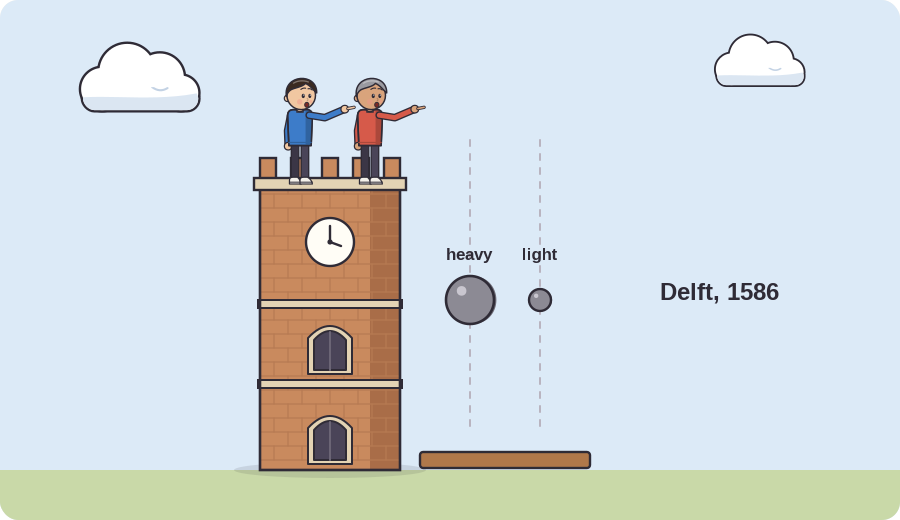
(A famous story says Galileo did the same from the Leaning Tower of Pisa. Nobody knows if he really did, but he did many careful tests with falling and rolling balls, and found the same.)
Setting up a situation on purpose, to see whether a prediction comes true, is called an experiment, or a test. What happens is the result. Stevin's result went against a claim that great thinkers had believed for centuries - and the result won. In science, the world decides, not the person who made the claim.
The science loop
Now we have all four steps. You observe something; you think of a hypothesis; you work out a prediction; you test it with an experiment. The result is a new observation - which may start the loop again.
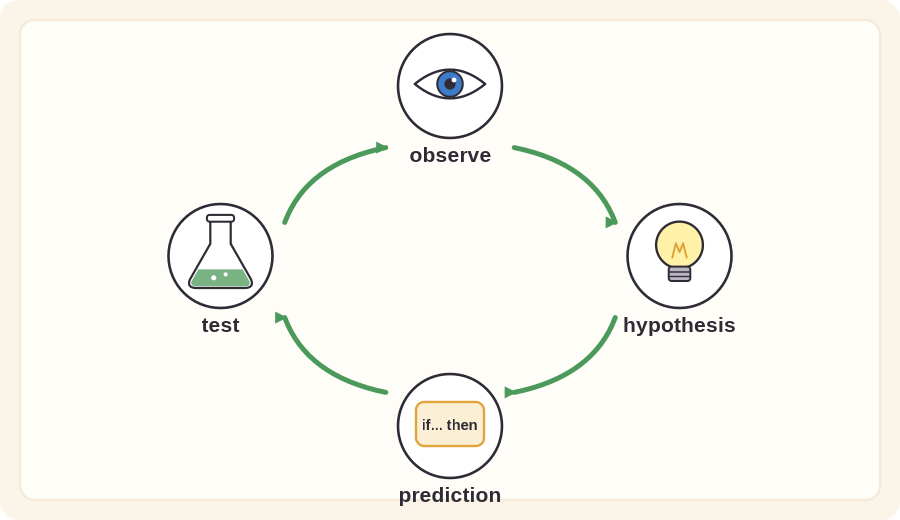
What about the leaf? A leaf really does fall more slowly than a stone, because the air pushes against it - a new observation, and a new question for the loop.
Try it at home
- Take two balls of different weights but similar size (a tennis ball and a ball of rolled-up socks, say). Write your prediction first.
- Stand on a chair, hold one in each hand at the same height and let go together. Ask someone to watch where they land, or listen.
- Do it five times. Write down each result. Did the world agree with your prediction?
Words to know
- experiment (or test) - setting up a situation on purpose to see whether a prediction comes true
- result - what happens in an experiment
Big idea
In science, a claim about the world is settled by the world. An experiment sets up a situation on purpose and watches what happens - and the result decides, however famous the person who said otherwise.