Compared With What?
A school gives a new reading app to 30 children for one term. At the start of the term the children take a reading test; at the end they take another. All 30 read better at the end. The company that makes the app is delighted: "The app works!" Does it?
Better than what?
The children did get better. But children who are going to school get better at reading during a term anyway - they read in lessons, at home, on signs. The real question isn't "did they get better?" but "did they get better than they would have without the app?"
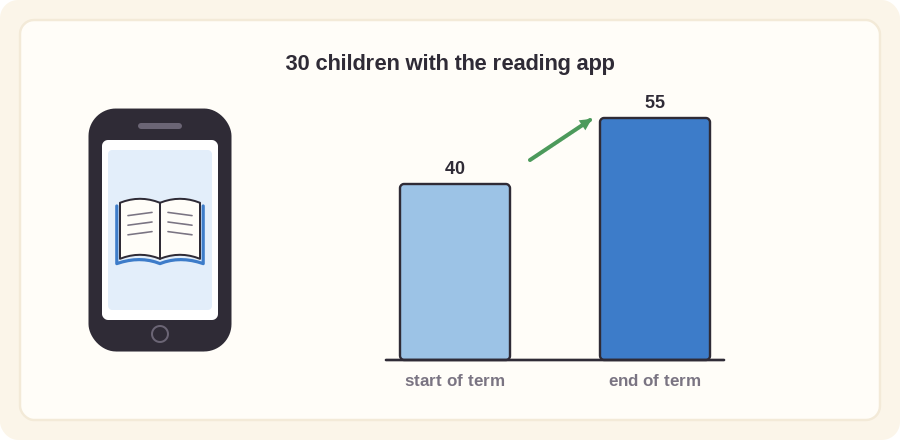
The rise on its own can't answer that. It needs something to compare with.
A group without it
So the next year, the school does it differently. One group of children gets the app. Another group, of the same age, in the same school, in the same term, doesn't. Everything else is the same: the lessons, the teachers, the tests. The group that doesn't get the thing being tested is called the control group.
At the end, both groups have got better - by almost exactly the same amount.
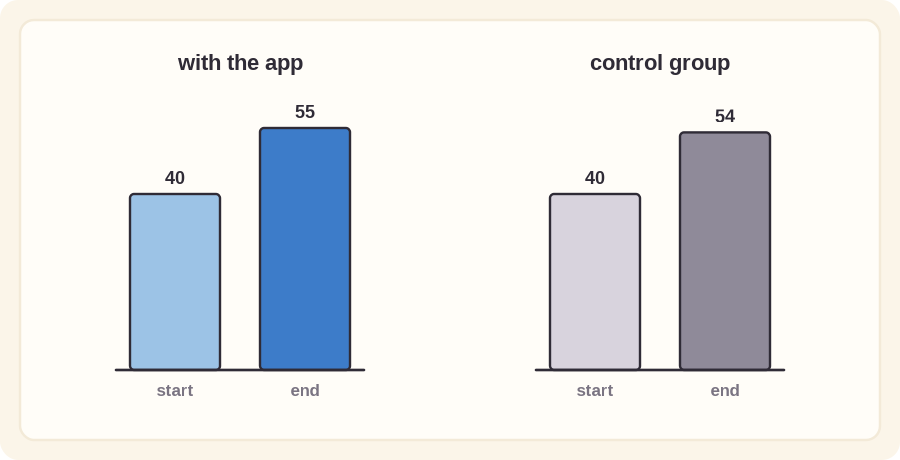
So the app added almost nothing. Most of the rise would have happened anyway. The control group showed what "anyway" looked like. This is the fair test from the One Change at a Time lesson, used on people: the one change is the app, and the control group is everything kept the same.
"It got better" is not enough
Many things get better on their own: children's reading, a stiff neck, a quiet shop after the holidays. So when someone says "I did X and then things got better", the first question is: compared with what? What would have happened without X?
Try it at home
- Think of a claim like "I did this, and then that got better" - from an advert, a friend, or yourself.
- Ask: what would have happened without it? Would it have got better anyway?
- Plan a test with a control group: who would get the thing, who wouldn't, and what would you keep the same?
Words to know
- control group - the group in a test that doesn't get the thing being tested, to show what would have happened anyway
- compare - to look at two things side by side to see how they differ
Big idea
"it got better" proves little, because many things get better on their own. A control group, the same in every way but without the thing being tested, shows what would have happened anyway.