Checking Each Other's Work
Maya has written a story for a competition. She has read it through three times and found nothing wrong. Then her friend reads it, and in two minutes points out a mistake: the dog is called Biscuit on page one and Button on page three. Why could her friend see something Maya had missed three times?
Fresh eyes
When you have made something yourself, you read what you meant, not what is there. Someone else doesn't know what you meant, so they see what is really on the page. They also know things you don't, and ask questions you didn't think of.
Scientists know this too. Before a piece of science is published, it is usually checked by other scientists who work in the same field. Someone who works in the same field as you is called a peer, so this checking is called peer review.
How it works
A scientist writes up their work - the question, the method, the results and what they think the results mean - and sends it to a journal, a magazine for science. The journal's editor sends it to two or three other experts. They read it carefully and send back their questions and doubts. The scientist may have to answer them, do more tests, or change what they claim. Only then is the work published - or, if it doesn't hold up, it is turned down.
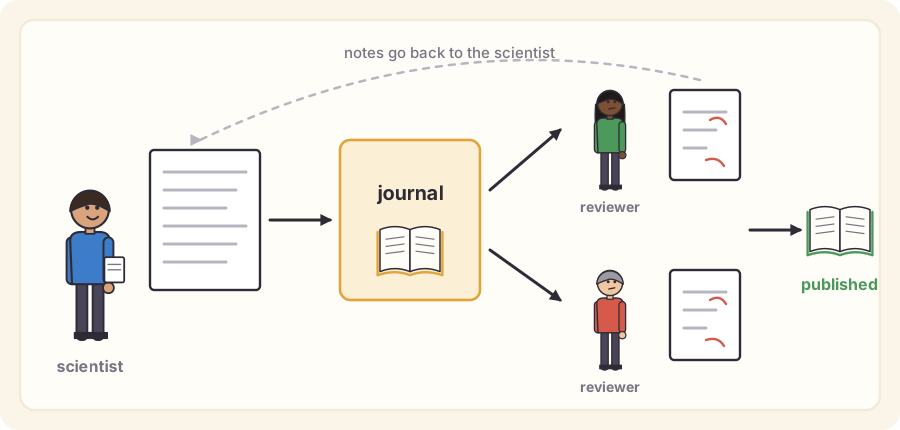
The first science journals began in 1665. Sending work to outside experts before publishing it became usual much later, in the 1900s.
What reviewers ask
Reviewers ask the questions this course has been about. Was there a control group? Who chose who went in which group? Did the people measuring know which was which? How many were tested? Is there a simpler explanation?
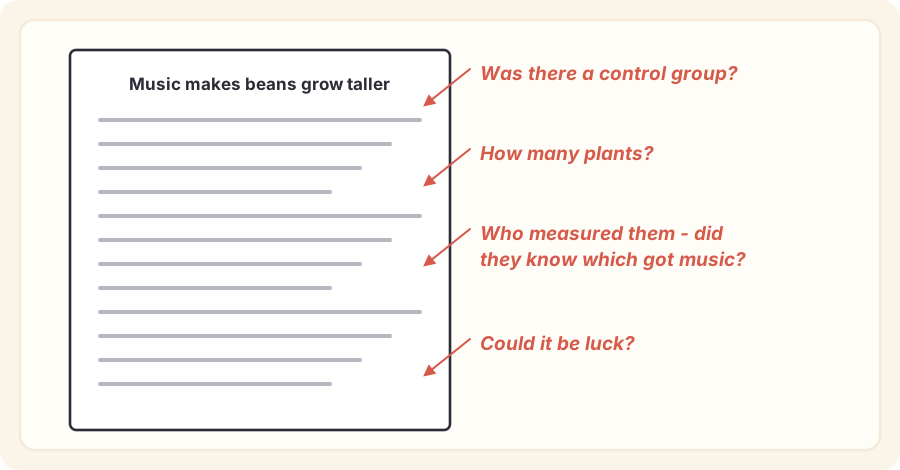
Not a guarantee
Peer review catches many mistakes, but not all of them. Reviewers read the report; they usually don't repeat the experiment. So a published result can still be wrong, and the replication from the Do It Again lesson is still needed. Peer review is a first check, not the last one.
Try it at home
- Write a short report of one of your tests: the question, the method, the result and what you think it means.
- Give it to someone and ask them to find three questions or doubts.
- Answer each one. Did you have to change anything you claimed?
Words to know
- peer - someone who works in the same field as you
- peer review - other experts checking a piece of science before it is published
- journal - a magazine where scientists publish their work
Big idea
It is hard to see your own mistakes. In peer review, other experts check a piece of science before it is published. It catches many mistakes, but not all - so replication is still needed.