The Sun in the Middle
Stand outside for a day and watch. The Sun rises in the east, crosses the sky and sets in the west. At night the stars wheel slowly overhead. The ground under your feet feels perfectly still. For many centuries, most people who studied the sky concluded the obvious: the Earth stands still in the middle, and the Sun, the Moon, the planets and the stars all go round it. How could such a big idea ever change?
Two pictures of the sky
In 1543, a Polish astronomer, Nicolaus Copernicus, published a book with a different picture. The Sun is in the middle. The Earth is a planet like the others, going round the Sun once a year and spinning once a day - which is why the Sun seems to cross the sky.
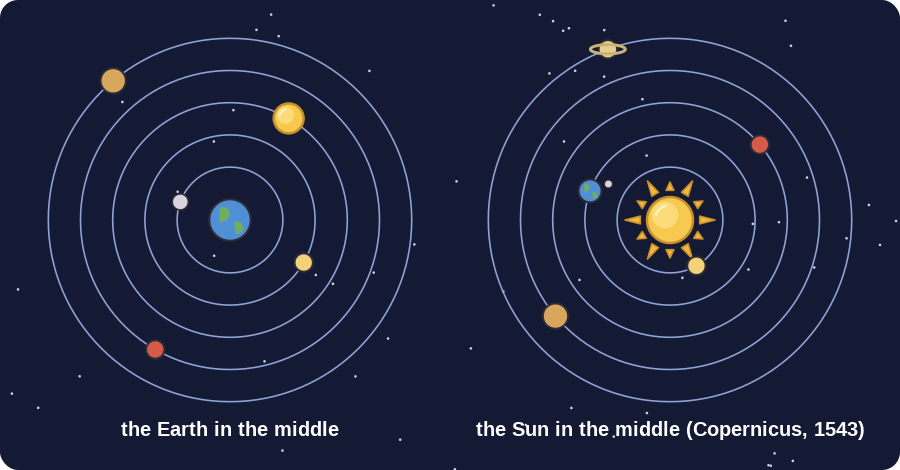
At first, few people were convinced. The new picture didn't predict the planets' positions much better than the old one. And it asked people to believe something that went against what they felt every day: that the ground is rushing through space.
The evidence builds up
Then the evidence started to come. In 1609 Johannes Kepler showed that if the planets go round the Sun in paths shaped like stretched circles, called ellipses, the predictions became far more accurate than any before. In 1610 Galileo Galilei turned a telescope to the sky. He saw four moons going round Jupiter - so not everything goes round the Earth. And he saw Venus go through phases, from a thin crescent to almost full, like the Moon, which fits Venus going round the Sun.
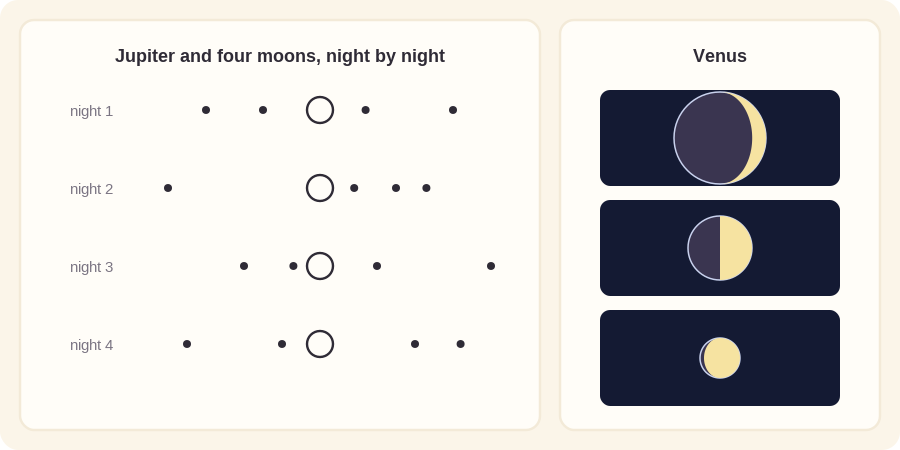
Over the next hundred years, more and more of those who studied the sky were convinced, and by the early 1700s the Sun-centred picture was the consensus.
Slow, for good reasons
It took well over a century. That can seem slow, but there were good reasons. The old picture had worked well enough for a long time. The new one needed new evidence, and the evidence took time to collect - telescopes had to be invented first. If you have read Knowledge Level 1, this is updating a belief: changing it as much as the evidence calls for, and no more. Science changed its biggest idea not because one person said so, but because, step by step, the evidence became too strong to ignore.
Try it at home
- Watch the Sun cross the sky, or the Moon over a few hours. Write down where it is at three times.
- Write down why it looks as if the Sun goes round the Earth.
- Then write down one piece of evidence from this lesson that it doesn't.
Words to know
- ellipse - a stretched circle, the shape of a planet's path around the Sun
- phases - the changing shapes of the lit part of the Moon or Venus, from crescent to full
Big idea
Science can change even its biggest ideas. The Earth stopped being the centre of everything not because someone said so, but because, over more than a century, the evidence became too strong to ignore.