If It Is True, Then...
Zara has three hypotheses about her bean plant: it grows towards the light, or towards the warmth of the radiator, or towards the fresh air from the window. In the A Guess You Can Test lesson we saw that each of them could be checked. But how? You can't look at "grows towards the light" directly. What do you look at instead?
From a guess to a prediction
The trick is to ask: if this hypothesis is true, then what should happen? Zara thinks about the light hypothesis. If the plant really grows towards the light, then if she turns the pot round, so the plant leans away from the window, it should slowly bend back towards the window over the next few days.
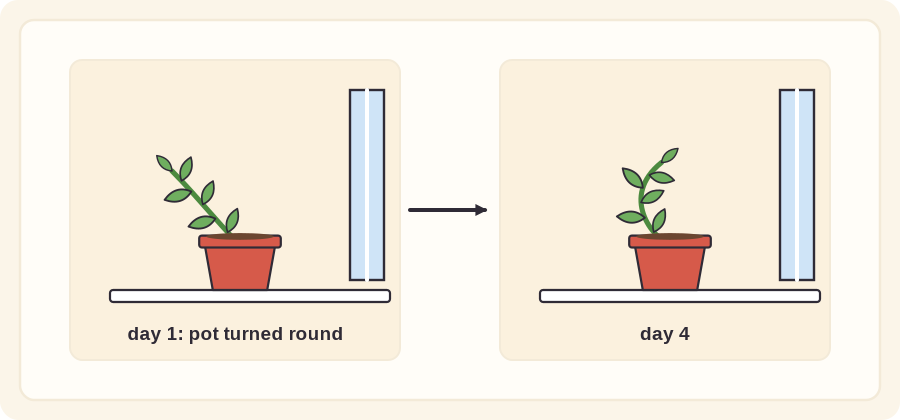
A statement of what you should see if a hypothesis is true is called a prediction. "If the plant grows towards the light, then after I turn the pot it will bend back towards the window" is a prediction. (If you have read Logic Level 1, you will recognise the "if ... then" shape.)
Different guesses, different predictions
There is a problem. The window lets in light and has the radiator under it. If the plant bends back towards the window, that fits the light hypothesis - but it fits the warmth hypothesis just as well.
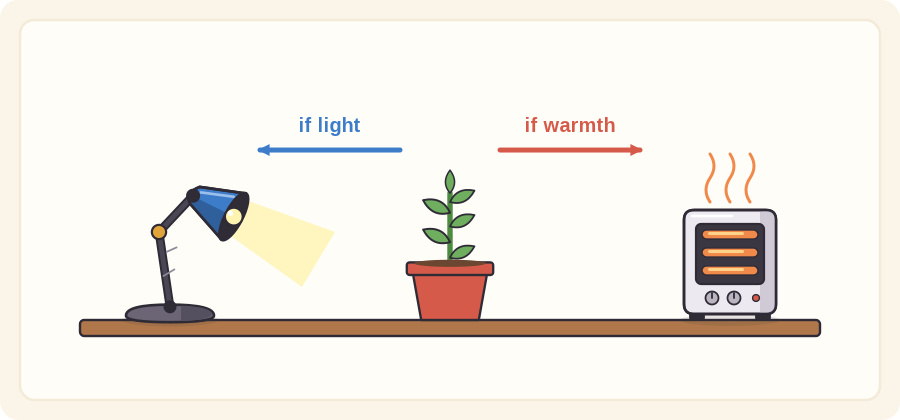
To tell two hypotheses apart, you need a situation where they predict different things. So Zara thinks of one: put the plant in a room with a lamp on one side and a heater on the other. If it grows towards light, it will lean to the lamp. If it grows towards warmth, it will lean to the heater.
Say it before you look
A prediction has to be made before you look. After you have seen what happened, it is always easy to find a way your idea "fitted" it. Said before, the prediction can come true or fail - and that is what makes it a real check. Zara writes her prediction in her notebook, with the date, before she sets up the lamp and the heater.
Try it at home
- Take one of your hypotheses from the last lesson.
- Write: "If this is true, then ..." and finish the sentence with something you could see or measure.
- Is there another hypothesis that predicts the same thing? If so, look for a situation where the two would predict different things.
Words to know
- prediction - what you should see if a hypothesis is true, said before you look
- if ... then - the shape of a prediction: if the hypothesis is true, then this will happen
Big idea
You check a hypothesis through its predictions: "if it is true, then this should happen". To choose between two hypotheses, find a situation where they predict different things - and say the prediction before you look.