What Science Can't Answer
A town has a piece of empty land, and the town council has to decide what to do with it: build a park, or build a car park? The council asks scientists for help. They count how many cars look for parking each day. They measure the traffic and the air. They find out how many children live nearby with nowhere to play. Can the scientists now tell the council which is better?
Two kinds of question
Some questions are about what is, or what would happen: How many cars park here each day? How many children would use a park? Would the traffic get worse? These are questions of fact, and science can help answer them with observations, measurements and tests.
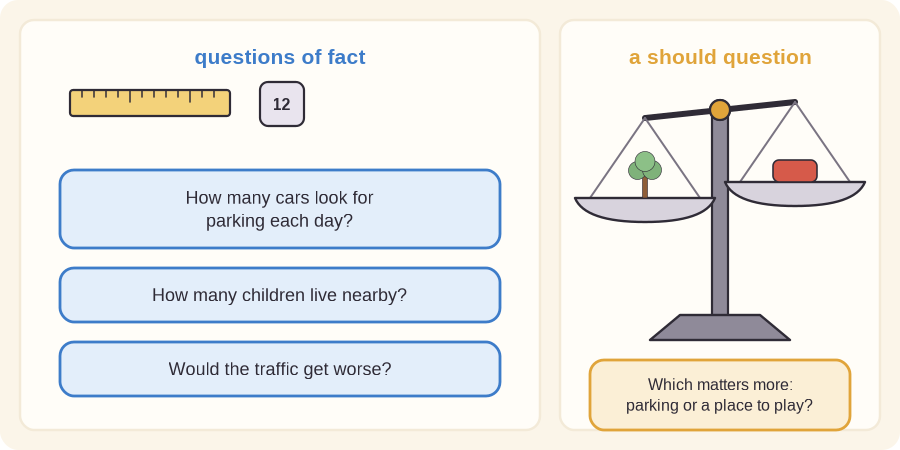
But "Which should we build?" is a different kind of question. It is about what we should do. To answer it, you also need to know what people care about: is it more important that drivers can park, or that children can play? What we care about, and how much, are our values.
The facts still help
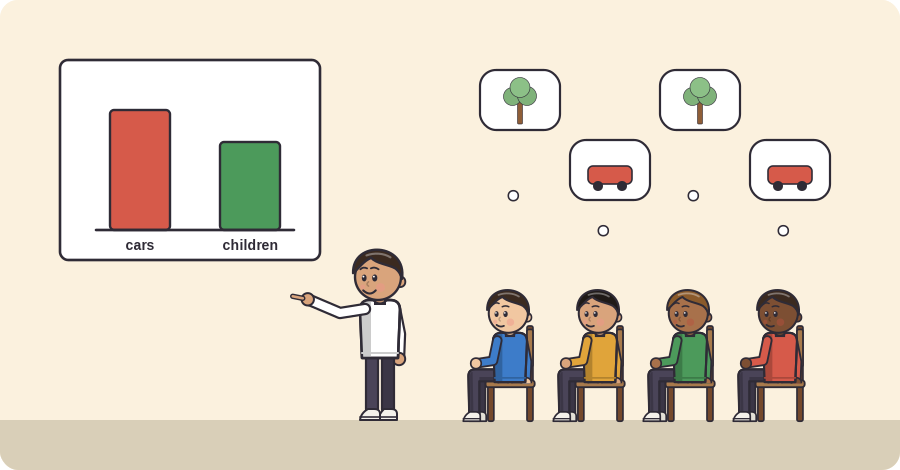
That doesn't make science useless here - far from it. Without the facts, people might argue from guesses: "nobody would use a park", "there is plenty of parking". The facts can show those guesses to be wrong. Knowing the facts makes the choice a better one. But the facts alone don't make the choice. People still have to weigh what they care about.
Other questions like it
Many questions need more than science. "Is this song beautiful?" "Is it fair to give everyone the same, or to give more to those who need more?" "What makes a good friend?" Science can tell us a lot about each of them - what music most people enjoy, what happens when things are shared in different ways - but not everything. Some of them belong to other parts of philosophy, which ask how to think well about what is good, fair and beautiful.
Knowing where science stops is part of thinking clearly. It keeps you from asking science for what it can't give - and from ignoring what it can.
Try it at home
- Write down five questions you have been asked or have wondered about recently.
- For each, write "fact", "should" or "both".
- For one "both" question, write down which parts science could help with, and which need you to decide what you care about.
Words to know
- question of fact - a question about what is, or what would happen, which observations and tests can help answer
- values - what we care about, and how much
- should question - a question about what we ought to do, which needs values as well as facts
Big idea
Science answers questions about what is and what would happen. Questions about what we should do also need values. The facts make the choice better, but they don't make it for us.