Try It Many Times
Back in the school hall, Nadia's fair test from the One Change at a Time lesson is ready. She throws the pointed plane once: 6 metres. She throws the blunt plane once: 5 metres. "So pointed is better," says Leo. But Nadia isn't sure. Throw the same plane twice and it never flies exactly the same distance. Is one metre a real difference, or just luck?
One try can be luck
Every throw is a little different: the push, the angle, a tiny draught. So one plane can beat the other on one throw by luck. To see if the difference is real, Nadia throws each plane ten times, the same way, and marks where each one lands.
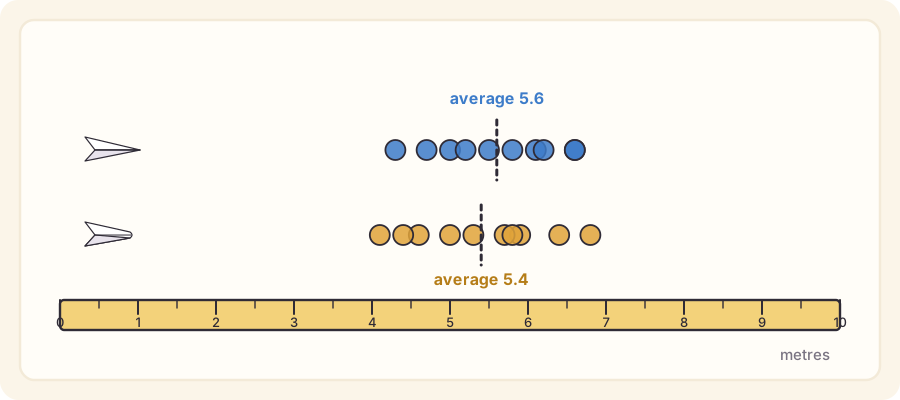
The dots overlap. Sometimes the blunt plane flew farther, sometimes the pointed one did. On average - all ten distances added up and divided by ten - the pointed plane flew 5.6 metres and the blunt one 5.4. The difference in her first try was mostly luck.
Why many tries help
Luck goes both ways. With one try, a lucky throw can decide everything. With many tries, the lucky throws and the unlucky ones tend to even out, and what is left is the real difference - if there is one.
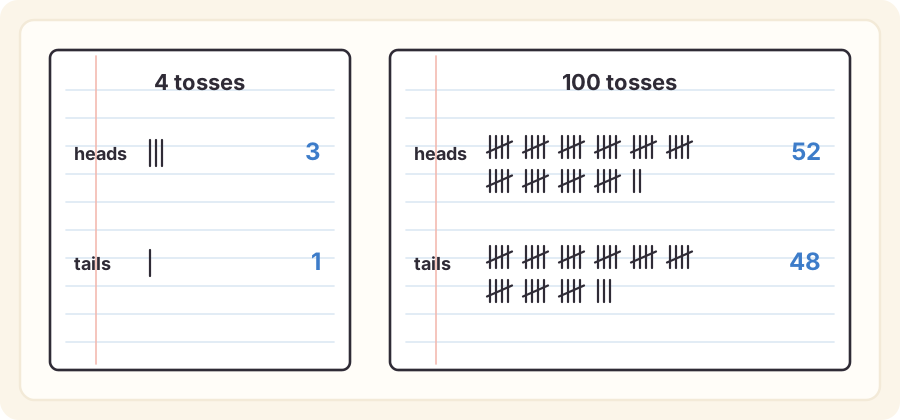
A fair coin shows the same thing. Toss it 4 times and getting 3 heads is common. Toss it 100 times and you will almost always get close to 50 heads. The things a test is done on - the throws, the plants, the children - are called the sample, and how many there are is the sample size. The bigger the sample size, the less luck can fool you.
(If you have read Logic Level 1, this is the same lesson as "too few examples", used for tests.)
How many is enough?
There is no single number. A small difference needs many tries to show; a huge difference shows even in a few. That is why scientists say how many they tested, and are careful with results from only a handful.
Try it at home
- Take the two paper planes from before and throw each one ten times, the same way. Write down every distance.
- Work out the average for each plane.
- Compare: does the result of the first throw alone agree with the averages?
Words to know
- sample - the things or people a test is done on
- sample size - how many things or people are in the sample
- average - all the results added up and divided by how many there are
Big idea
One try can be luck. Test many times: with a bigger sample, the lucky and unlucky results even out and the real difference, if there is one, shows through.