One Change at a Time
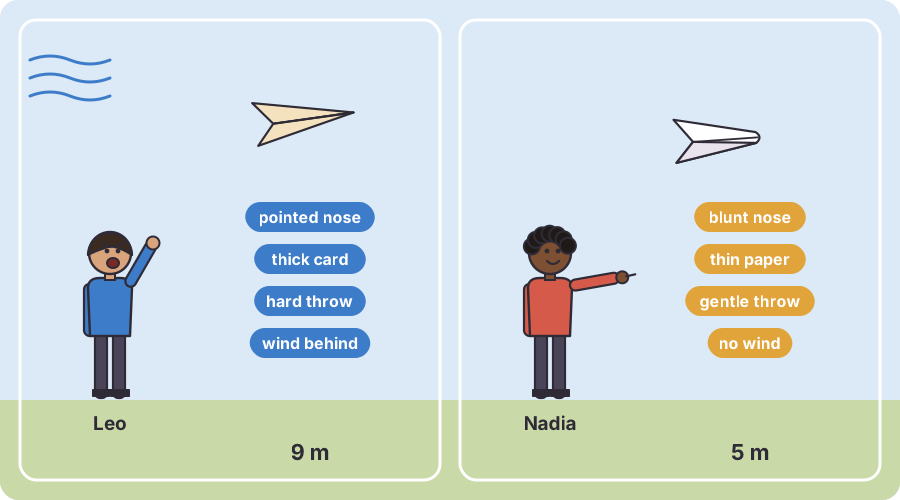
Leo and Nadia hold a paper plane contest in the park. Leo's plane has a long pointed nose; Nadia's has a blunt, folded-back nose. Leo's flies 9 metres and Nadia's only 5. "Pointed noses fly farther," says Leo. But Leo's plane is made of thick card and Nadia's of thin paper. Leo threw his hard, with the wind behind him; Nadia threw hers gently, a few minutes later, when the wind had changed. So what made Leo's plane fly farther?
Too many changes
The two planes were different in at least five ways: the nose, the paper, the thrower, how hard they were thrown, and the wind. Any one of these could explain the difference - or several of them together. The contest can't tell which.
In the Let the World Decide lesson we saw that an experiment lets the world answer a question. But the world can only give a clear answer to a clear question.
Change one thing
So Nadia sets up a better test, indoors in the school hall, where there is no wind. She folds two planes from the same kind of paper, the same size, in the same way - except for the nose: one pointed, one blunt. The same person throws both, from the same line, with the same gentle push.
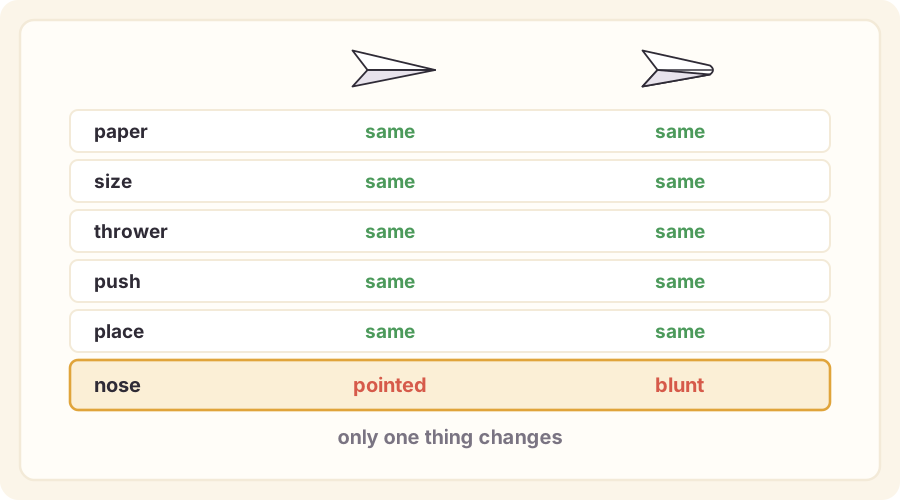
Now, if one plane flies farther, there is only one thing that can explain it: the nose. A test where you change only one thing, and keep everything else the same, is called a fair test.
The things in a test that could change - the paper, the thrower, the nose, the distance flown - are called variables. In a fair test you choose one variable to change on purpose, keep the others the same, and measure what happens (here, the distance flown).
Why it matters
A fair test is how you find out what one thing does. Gardeners use it to see if a plant food helps (same plants, same soil, same water, food or no food). Cooks use it without knowing the name: same cake recipe, only the oven temperature changed. Whenever two things are compared, ask: what else was different?
Try it at home
- Fold two paper planes that are the same in every way but one: the nose, the wing size, or a paper clip on the front.
- Write down everything you will keep the same, and your prediction.
- Throw each one in the same way, in the same place, and measure how far it flies. (Keep the results - the lesson after next will need them.)
Words to know
- fair test - a test where only one thing is changed and everything else is kept the same
- variable - anything in a test that could change
- measure - to find out how much, how far or how long, with a number
Big idea
To find out what one thing does, change only that one thing and keep everything else the same. If many things change at once, the result can't tell you which one made the difference.