Do It Again
Lina tells her class some exciting news. She grew two bean plants for a month, and played music to one of them every day. The one with music grew 4 centimetres taller! The class decides to find out for themselves. Each of ten children grows two bean plants in the same way, with the same soil and the same water, and plays music to one of them. A month later, they measure. What will they find?
One result is not enough
Lina did nothing wrong. But a single result can come from many things besides the one being tested: luck (one bean was simply a stronger seed), a small mistake in measuring, or something special about her room. In the Try It Many Times lesson we saw that one try can be luck.
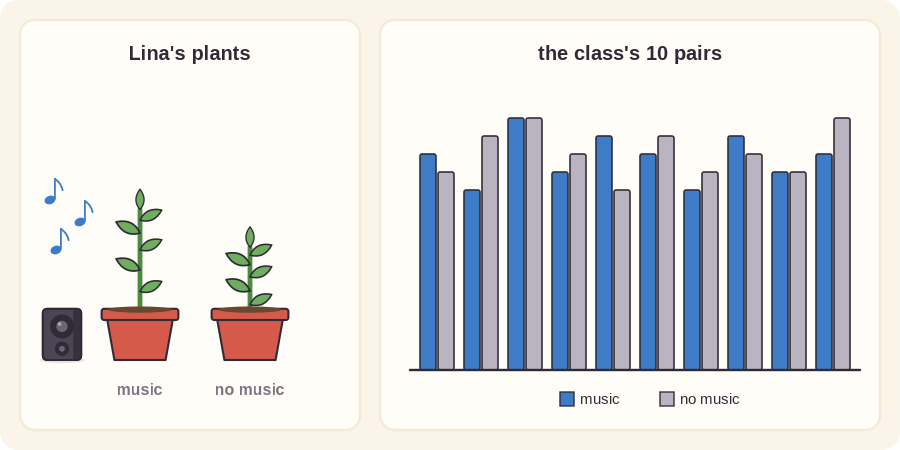
The class's results show no pattern: in some pairs the plant with music grew taller, in others the plant without. Lina's result didn't come again.
Doing it again
When other people do the same test again, in the same way, to see if they get the same result, it is called replication (to replicate a result is to get it again). A result that is replicated many times, by different people in different places, can be trusted far more than a result seen once.
A real example
In March 1989, two chemists in the United States, Martin Fleischmann and Stanley Pons, announced that they had made "cold fusion": a lot of energy, from a small jar of water and metal at room temperature. If it were true, it could change the world. Within weeks, laboratories around the world tried to replicate it.
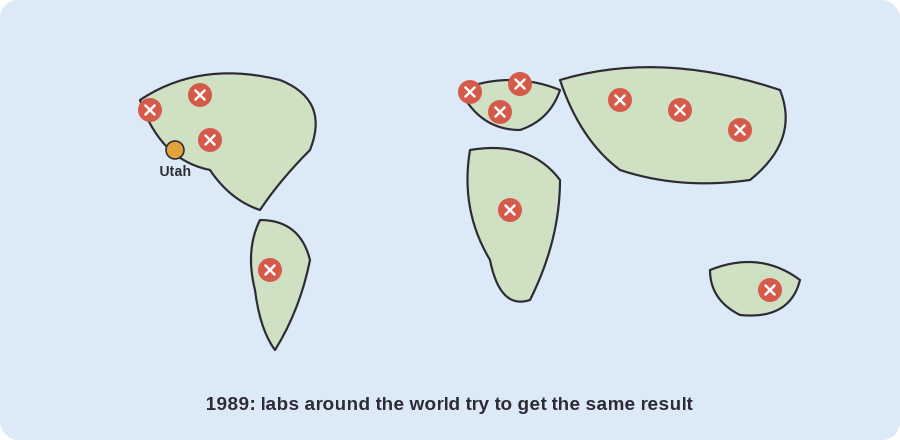
Nearly all of them failed to get the result. By the end of 1989, most scientists had concluded that cold fusion hadn't been shown. Nobody needed to prove the first two chemists dishonest. The result simply didn't come again.
Say how you did it
For others to replicate a test, they need to know exactly how it was done: the seeds, the soil, the music, how loud, for how long, how it was measured. That is why scientists write down their method - the steps of their test - in enough detail for anyone to follow it. A result that nobody can repeat, because nobody knows how it was done, can't earn trust.
Try it at home
- Pick a result you got yourself in an earlier lesson (the planes, the falling balls, the cups of water).
- Write down your method so carefully that someone else could follow it.
- Ask a friend or someone at home to do it from your notes. Did they get the same result?
Words to know
- replication - other people doing the same test again, in the same way, to see if they get the same result
- replicate - to get a result again by doing the same test
- method - the steps of a test, written down so others can follow them
Big idea
One result isn't enough. A finding earns trust when other people, following the same method, get the same result again - and loses it when they can't, like cold fusion in 1989.