Could It Be Proved Wrong?
At a fair, a fortune teller looks at Teo's hand and says: "Something important will happen to you soon." A week later, Teo gets a good mark in a test. "She was right!" he says. On the same day, the weather forecast says: "Rain here tomorrow, between 2 and 4 in the afternoon." Which of the two claims told Teo more?
A claim that can't lose
Think about what could have happened to Teo in that week. A good mark, a bad mark, a new friend, a lost key, a cold, a birthday party. Every one of them would count as "something important". There is nothing that could happen that would show the fortune teller to be wrong.
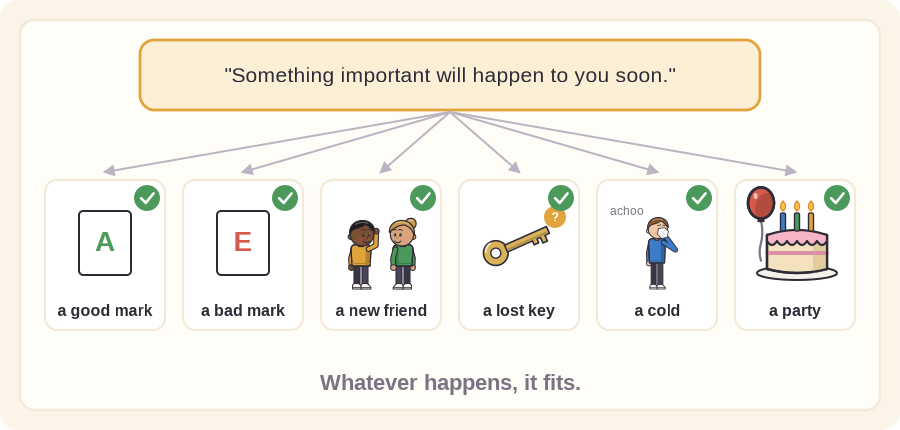
That sounds like a strength, but it is a weakness. A claim that fits whatever happens tells you nothing about what will happen.
A claim that takes a risk
The forecast is different. It names a place, a day and two hours. If tomorrow is dry all afternoon, the forecast was wrong, and everyone can see it.
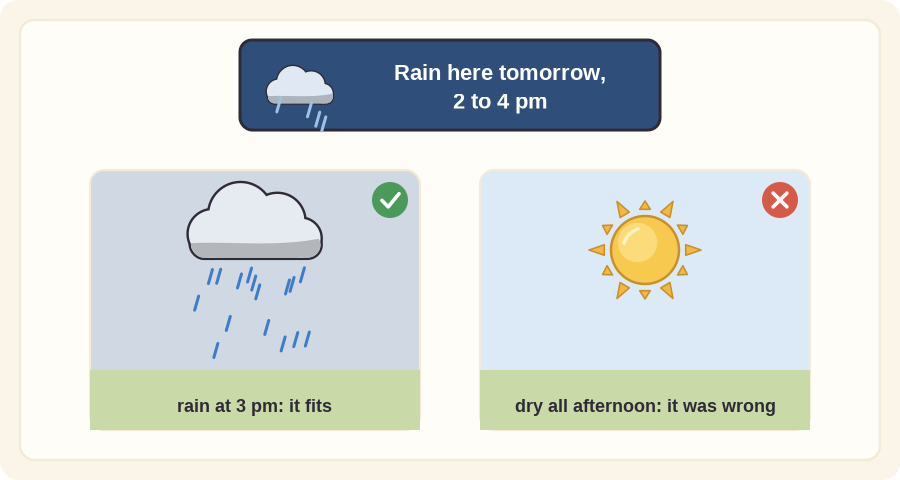
A claim that some result could show to be false is called falsifiable ("able to be proved false"). Falsifiable doesn't mean false. The forecast may well be right. It means the claim takes a risk: it says something definite enough that the world could say no.
Why scientists like risky claims
The philosopher Karl Popper made this idea famous in the 1930s. He said that what makes a claim scientific is not that it fits everything, but that it could fail a test - and hasn't. Each test a risky claim passes is evidence for it, because it could have failed. A claim that can't fail can't pass a test either.
So when you hear a claim, ask: what would show this to be wrong? If the answer is "nothing could", the claim isn't telling you much. The predictions in the If It Is True, Then... lesson were falsifiable: "the plant will bend back towards the window" could easily have failed.
Try it at home
- Collect three claims from adverts, sayings or friends ("this cream makes you look younger", "things happen for a reason", "this team will win on Saturday").
- For each, write: what would show it to be wrong?
- Which ones could be wrong, and which fit anything that happens?
Words to know
- falsifiable - able to be shown false by some result; a claim that takes a risk
Big idea
A claim that fits whatever happens tells you nothing. A falsifiable claim says something definite enough that the world could show it wrong - and every test it passes counts, because it could have failed.