Predicting the Unseen
In 1781 astronomers found a new planet, Uranus, far beyond Saturn. Over the next sixty years they watched it carefully - and something was wrong. Uranus wasn't quite where Isaac Newton's theory of gravity said it should be. Sometimes it ran a little ahead, sometimes a little behind. Was Newton's theory wrong? Or was something out there that nobody had seen?
A strange pull
Newton's theory says every planet pulls on every other. The astronomers had already allowed for the pulls of Jupiter and Saturn. One hypothesis was that there was another planet, farther out still, pulling Uranus forwards and backwards as they passed.
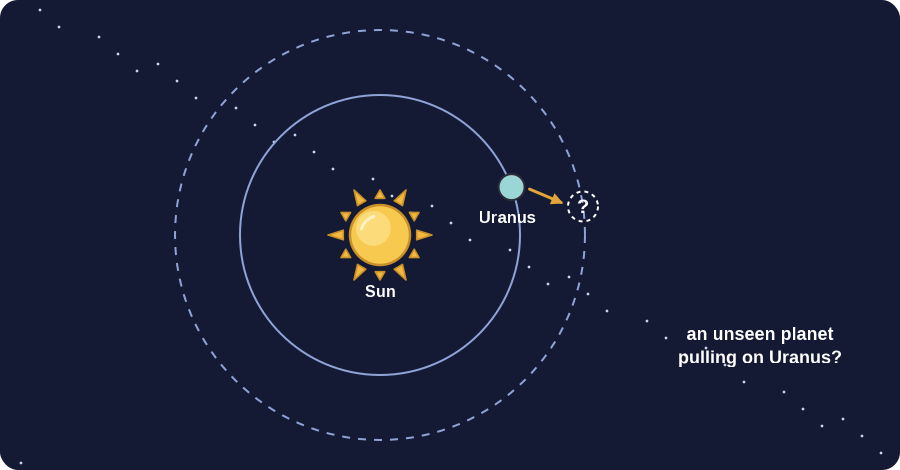
A French mathematician, Urbain Le Verrier, took the hypothesis seriously. Using Newton's theory, he worked out where the unseen planet would have to be to pull Uranus in just the way that had been seen. (In England, John Couch Adams was doing the same work at about the same time.)
Where the calculation said
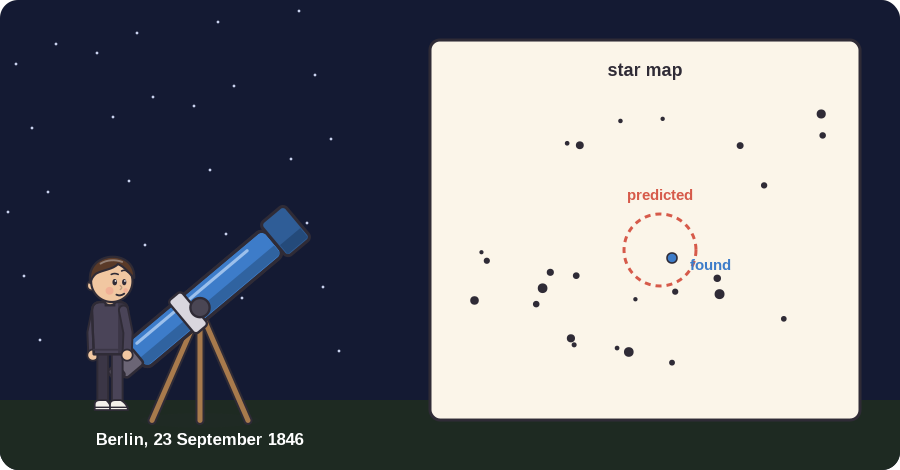
In September 1846, Le Verrier sent his prediction to Johann Galle, an astronomer in Berlin. On the night of 23 September, Galle pointed his telescope at that part of the sky and compared what he saw with a star map. Within an hour he found a "star" that wasn't on the map. It was the new planet, Neptune, within about one degree of where Le Verrier had said - about the width of two full Moons in the sky.
Why this counts so much
Explaining something you already know is useful, but it is also easier: you can adjust your explanation until it fits. Predicting something nobody has seen is far harder. The prediction could easily have failed - the sky could have been empty there. In the Could It Be Proved Wrong? lesson we saw that a claim that takes a risk and passes counts for a lot. A prediction of something new is the biggest risk of all, and Neptune made Newton's theory more trusted than ever.
Other theories have passed tests like this too: a theory of chemistry predicted elements nobody had found, and they were found; a theory of the Universe predicted a faint glow left over from its beginning, and it was found.
Try it at home
- On a clear night, find the Moon. Hold your little finger at arm's length over it: your finger is about one degree wide, about two Moons side by side. That is the size of Le Verrier's miss.
- Write down a prediction that would surprise you if it came true - about the weather, your plants, a game.
- Write down why a surprising prediction that comes true is better evidence than an expected one.
Words to know
- new prediction - a prediction of something nobody has seen yet, the strongest kind of test for a theory
- orbit - the path of a planet around the Sun
Big idea
The strongest test of a theory is a prediction of something nobody has seen yet. Newton's theory predicted where an unseen planet should be - and in 1846 Neptune was found there.