The Simplest Explanation
Nur wakes up at night. Her bedroom light won't come on. She looks out of the window: the street lights are off, and so are all the lights in the houses opposite. Here are two explanations. One: there is a power cut in the area. Two: every light bulb in the street broke at the same moment. Both fit what Nur sees. Which should she believe?
How much has to be true?
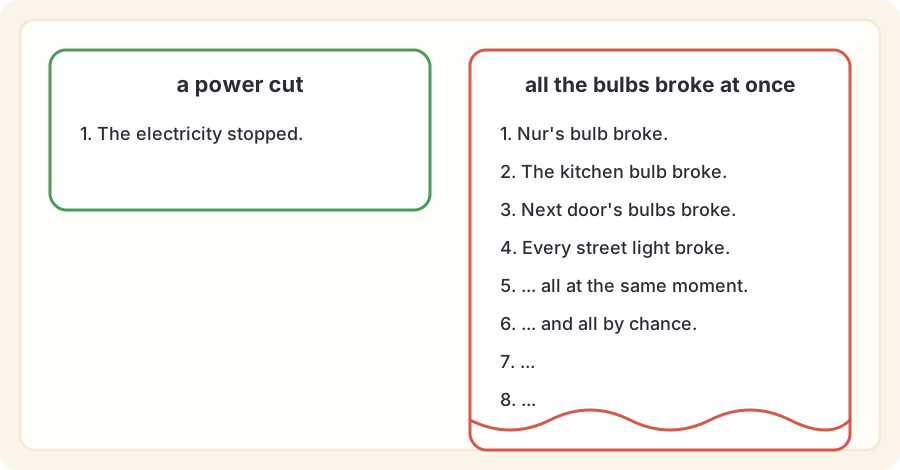
Count what each explanation needs. The power cut needs one thing to have happened: the electricity stopped coming to the street. The broken bulbs need hundreds of separate things: every bulb in every house and every street light, each one breaking, all at the same moment, and by chance.
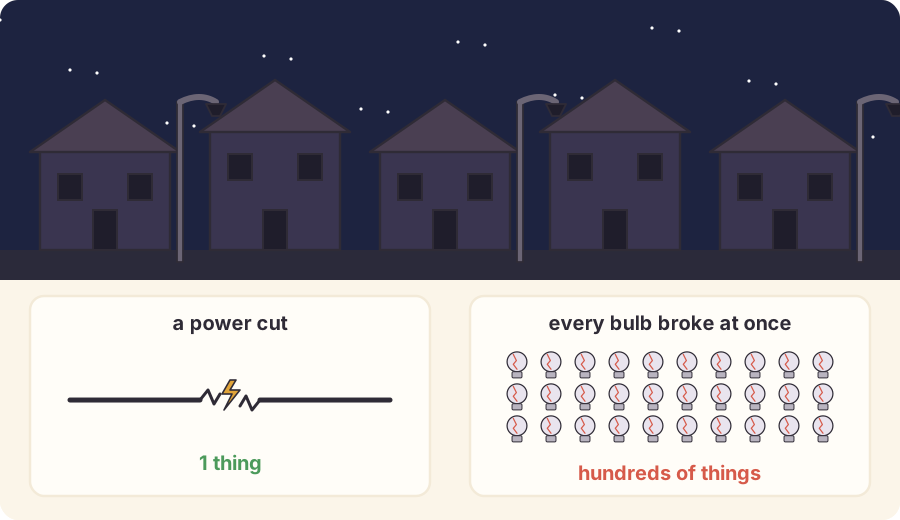
The things an explanation needs to be true, which we haven't checked, are called its assumptions. When two explanations fit the facts equally well, start with the one that needs fewer assumptions - the simplest explanation.
Occam's razor
This rule of thumb is often called Occam's razor, after William of Ockham, an English thinker of the 1300s. A razor cuts things away: here, the extra assumptions that aren't needed. (In the An Excuse for Everything lesson, every excuse Rosa added to her dragon was one more assumption.)
A rule of thumb, not a proof
The simplest explanation isn't always true. Sometimes the world really is complicated. Occam's razor tells you which explanation to try first, not which one is right. Then you test it, as always. Nur can check: if it's a power cut, the fridge will be off too, and the electricity company may have a message about it. If the fridge is humming, she needs another explanation.
So the razor is where finding out starts, and the test is where it ends.
Try it at home
- Next time something puzzling happens (a strange noise, a missing sock), write down two or three explanations.
- For each, list what would have to be true for it to be right.
- Start with the shortest list. How could you test it?
Words to know
- assumption - something an explanation needs to be true, which hasn't been checked
- simplest explanation - the one that needs the fewest assumptions
- Occam's razor - the rule of thumb: start with the simplest explanation that fits the facts
Big idea
When two explanations fit the facts, start with the one that needs fewer things to be true. It is the best place to start, not a proof - test it, and be ready to need a more complicated one.