Thinking Like a Scientist
Months have passed. Zara's bean plant, from the first lesson, has grown tall and has beans on it. Her notebook is full: observations, three hypotheses, predictions, a lamp-and-heater test (the plant leaned to the lamp), notes from her friends who tried it too. She has found out that plants grow towards light. But she has learned something bigger than that. What?
A way of finding out
Zara has learned a way of finding out that works for almost any question about the world. It isn't a list of facts. It is a set of habits.
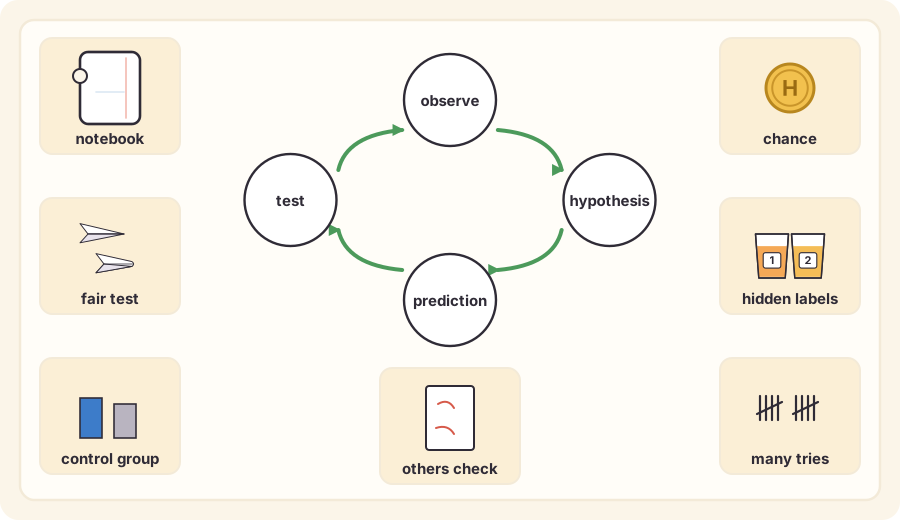
- Be curious and look carefully. Notice things, and write them down.
- Guess in a way you can test. Make a hypothesis that could turn out wrong, and say what it predicts before you look.
- Test fairly. Change one thing at a time; compare with a control group; let chance choose the groups; hide the labels; try many times.
- Prefer explanations that take risks and explain many things, and start with the simplest - but test it.
- Share and check. Write down your method, let others check it and try it again.
- Change your mind when the evidence calls for it, as much as it calls for and no more.
Not fooling yourself
In 1974 the physicist Richard Feynman gave a talk to students finishing their studies. He told them: "The first principle is that you must not fool yourself - and you are the easiest person to fool."
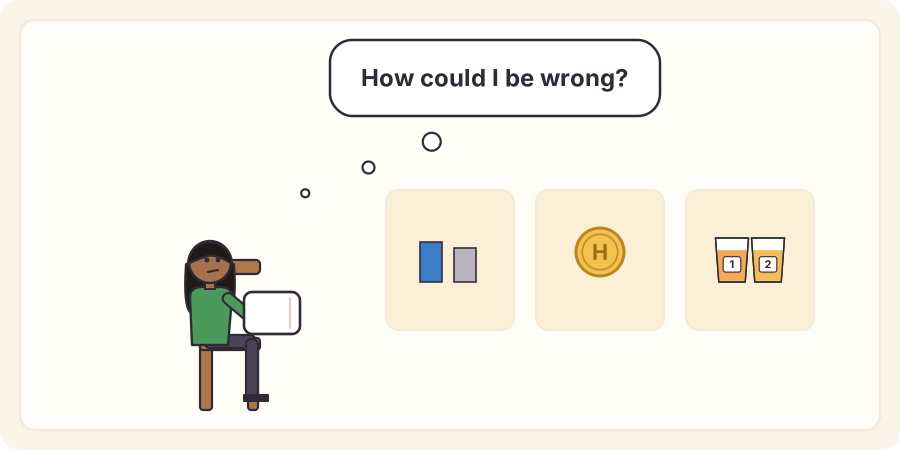
Every tool in this course is a way of not fooling yourself. The control group stops you fooling yourself that "it got better" means "it worked". Random groups stop you choosing the keenest without noticing. Blind tests stop your expectations from changing the result, as with Clever Hans. Replication stops one lucky result from fooling everyone.
Anyone can do it
You don't need a laboratory or a white coat. You need a question, a notebook, and the habit of asking "how could I find out?" - and then "how could I be wrong?" Kitchens, gardens, parks and playgrounds are all places to do science. And now you know how.
Try it at home
- Choose a question about the world you would really like to answer (which bread goes mouldy first, which seeds grow fastest, which way your cat sleeps).
- Plan the whole loop in your notebook: observations, a hypothesis, a prediction, a fair test with a control, how many tries.
- Do it. Then ask someone to check your method and try it again.
Words to know
- scientific attitude - the habits of finding out: curiosity, careful testing, sharing your work, changing your mind, and not fooling yourself
Big idea
Science is a way of finding out that anyone can use: look carefully, guess in ways you can test, test fairly, share your work and change your mind. Above all, don't fool yourself - you are the easiest person to fool.