A Theory Is Not a Guess
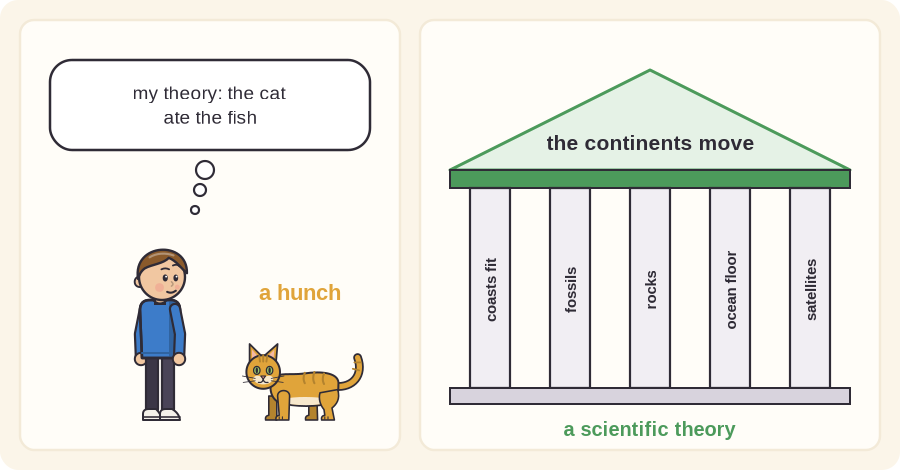
Ali reads that the continents are slowly moving: Africa and South America were once joined. "That's just a theory," he says. In everyday talk, "theory" often means a hunch: "My theory is that the cat ate the fish." Is that what scientists mean when they talk about the theory that continents move?
Two meanings of "theory"
In everyday talk, a theory is a guess, often with little behind it. Scientists use the word very differently. In science, a theory is an explanation of many facts that has been tested again and again and is supported by many different kinds of evidence. It is closer to "our best and most tested explanation" than to "a guess".
The moving continents
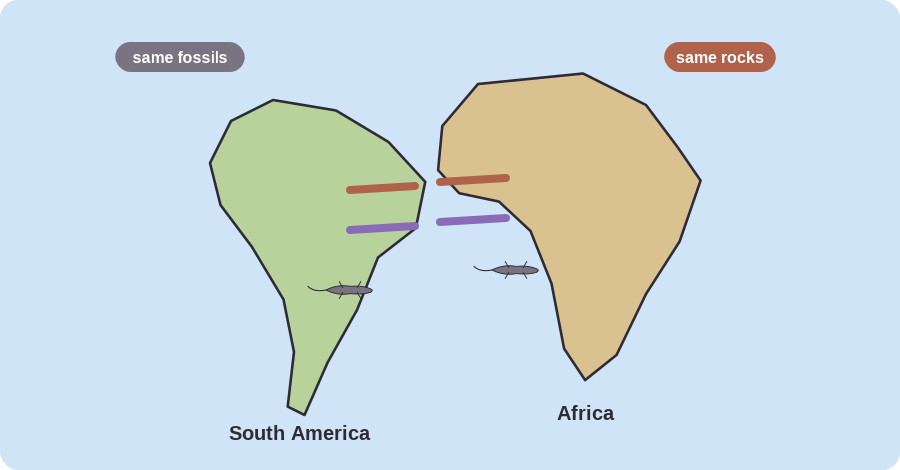
In 1912 a German scientist, Alfred Wegener, put forward the idea that the continents move. He had noticed three things. The coasts of South America and Africa fit together like puzzle pieces. Fossils of the same small reptile, Mesosaurus, are found in both, though it couldn't have swum across an ocean. And rocks of the same kind and age lie on both sides.
Most scientists at the time didn't accept it: nobody could explain how continents could move. Wegener's idea was still a hypothesis. Then, from the 1950s and 1960s, new evidence came in: from the floor of the oceans, from the pattern of earthquakes and volcanoes, from the magnetism frozen into rocks. Today, satellites measure the continents moving a few centimetres a year, about as fast as your fingernails grow. With all that evidence, and an explanation of how it happens, the idea became a scientific theory.
A theory doesn't "become a fact"
People sometimes think a theory turns into a fact once it is proved. That isn't how it works. Facts are what we observe: the coasts fit, the fossils match, the satellites measure the movement. A theory is the explanation that ties the facts together. A theory never stops being a theory. It just becomes better and better supported - and, like everything in science, could still be changed by new evidence, as the last module will show.
Try it at home
- Listen for the word "theory" this week - in talk, on TV, online.
- Each time, write down which meaning it has: a hunch, or a well-tested explanation.
- For one well-tested theory you know (that the Earth goes round the Sun, say), list two different kinds of evidence for it.
Words to know
- theory (in science) - a well-tested explanation of many facts, supported by many different kinds of evidence
- hunch - a guess with little evidence behind it (what "theory" often means in everyday talk)
Big idea
In science, a theory isn't a guess. It is an explanation that has been tested many times and is held up by many kinds of evidence - like the theory that the continents move.