Looking Carefully
Zara has a bean plant in a pot on her bedroom windowsill. She waters it every morning and has looked at it a hundred times. But one Saturday she really looks, and she notices something new: the plant is not standing straight. Its stem and its leaves all lean towards the window. Had it always done that? She has no idea. What is the difference between seeing something and observing it?
Seeing and observing
We see things all day without noticing them. To observe is to look at something carefully and on purpose, to find out what it is really like. What you notice when you observe is called an observation: "the stem leans towards the window" is an observation.
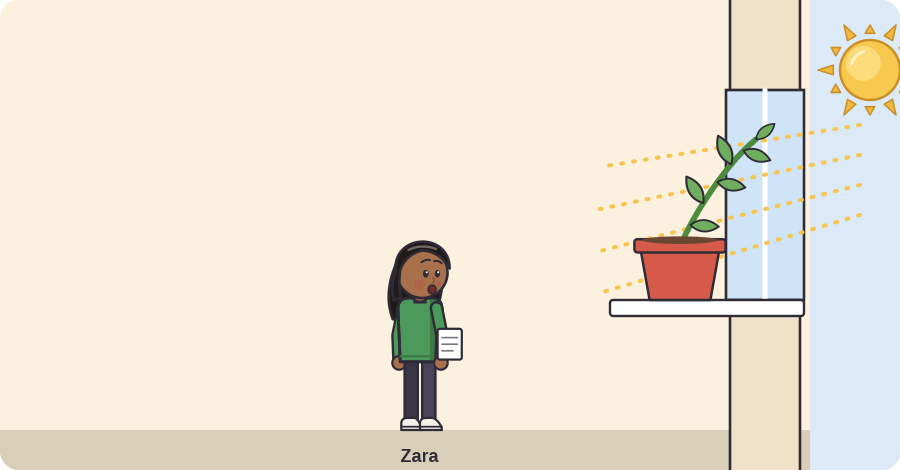
Observing is where science starts. Before anyone can explain something, they have to notice it - and notice it carefully enough that they could describe it to someone who wasn't there.
Write it down
Zara opens her notebook. She writes the date and the time, and draws the plant. She doesn't write "it leans a lot". She holds a ruler beside the pot and writes: "The top of the stem is about 3 cm nearer the window than the bottom." The next morning she does the same again, and the morning after.
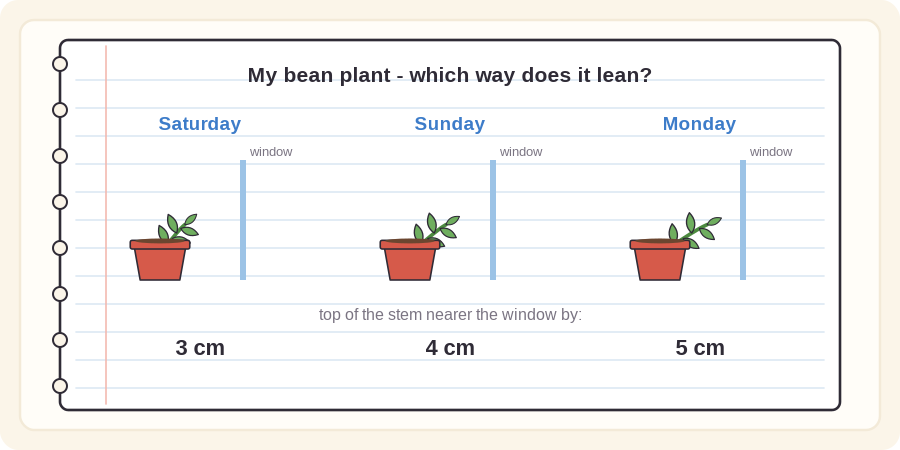
Writing it down matters. Memory changes, and it is easy to remember what you expected instead of what you saw. A note made at the time stays the same. Measuring and counting help too: "about 3 cm" can be checked, and compared with tomorrow, in a way that "a lot" can't.
What you saw and what you think
Zara is tempted to write "the plant wants the light". But she didn't see the plant wanting anything. She saw it leaning. "It wants the light" is an idea about why it leans - and it might be right or wrong.
A careful observer keeps these two apart: first what was seen, then, separately, ideas about what it means. If you have read Knowledge Level 1, you know that our eyes can fool us. Careful observation is how science protects itself: look again, measure, write it down, and ask someone else to look too.
Try it at home
- Choose something you see every day: a plant, a tree outside, the sky at the same time each evening.
- Observe it for five minutes, on purpose. Write down the date, the time and everything you notice. Measure or count something if you can.
- Do it again on three more days. Then read your notes: did you notice anything you had never noticed before?
Words to know
- observe - to look at something carefully and on purpose, to find out what it is like
- observation - something you notice when you observe, written down as plainly as you can
- record - to write down an observation at the time, with the date
Big idea
Science starts with observing - looking carefully, on purpose. Write down what you see at the time, measure it if you can, and keep what you saw apart from your ideas about why.