Catching a Mistake
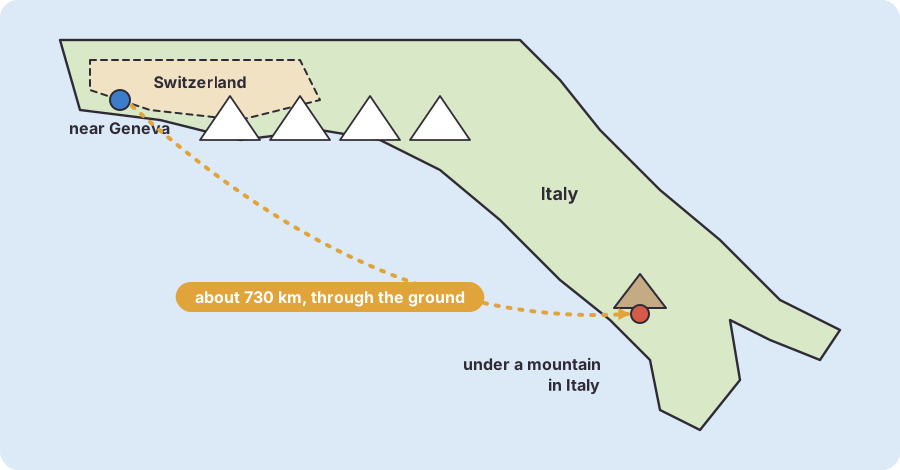
In September 2011, scientists working on an experiment called OPERA made an astonishing announcement. They had sent beams of tiny particles, called neutrinos, from a laboratory near Geneva, in Switzerland, through the ground to a laboratory under a mountain in Italy, about 730 kilometres away. The particles seemed to arrive about 60 billionths of a second too early - faster than light. That would break one of the best-tested ideas in all of physics: that nothing goes faster than light. Had they found something new?
What they did
The OPERA scientists didn't say "we have broken physics". They said: we have checked everything we can think of for months, and we can't find a mistake. Please help us find one.
They were following a rule that Knowledge Level 1 also teaches: big claims need big evidence. A mistake in the timing was far more likely than a crack in one of the best-tested ideas in science.
The loose cable
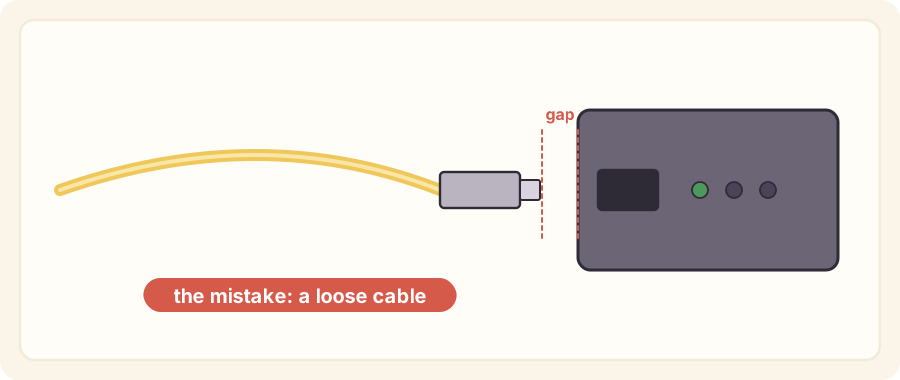
In February 2012 they found it. A cable carrying the timing signal - a thin glass cable that carries light, called a fibre-optic cable - hadn't been plugged in properly. That small fault changed the timing. Soon after, another experiment in the same laboratory in Italy, called ICARUS, measured the same kind of particles and found them arriving just when light would.
The particles hadn't gone faster than light. The mistake was found, said openly, and corrected.
How science corrects itself
Scientists are people. They make mistakes, like everyone. What makes science different is not that scientists don't make mistakes, but that science has ways of catching them: careful checking by the people who did the work, peer review, the replication from the Do It Again lesson, and big evidence for big claims. When a result is wrong, these catch it sooner or later.
This is a strength, not a weakness. A way of finding out that can find its own mistakes gets closer to the truth over time.
Try it at home
- Think of a time you found a mistake in something you had done: a sum, a recipe, a plan. How did you find it?
- Write down what would have helped you find it sooner: checking again, asking someone else, testing it.
- Next time you finish something important, use one of those before you call it done.
Words to know
- correct (a mistake) - to find it and put it right
- self-correcting - able to find and put right its own mistakes, as science does over time
Big idea
Scientists make mistakes like everyone else. Science catches them
- by checking, peer review, replication and asking big evidence for big claims - and puts them right openly. That is why it gets closer to the truth over time.