A Guess You Can Test
Zara's notebook shows it clearly: every day, her bean plant leans a little more towards the window. In the Looking Carefully lesson she learned to keep what she saw apart from her ideas about why. Now it is time for the ideas. Why does the plant lean? And what makes an idea about it a good place to start?
Many possible answers
Zara thinks of three ideas. Maybe the plant grows towards the light coming through the window. Maybe it grows towards the warmth of the radiator under the window. Or maybe it grows towards the fresh air coming in at the gap under the window frame.
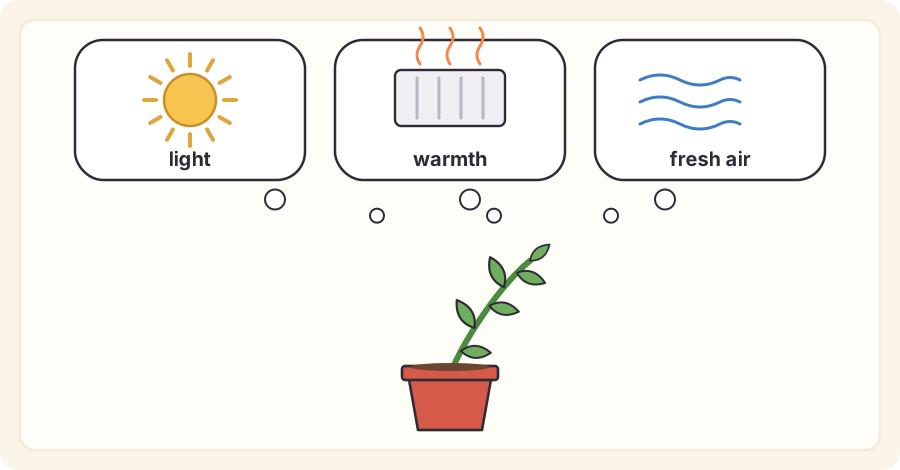
Each of these is a possible answer to her question. None of them is known to be true yet. Each one is a guess - but a special kind of guess.
A guess you can test
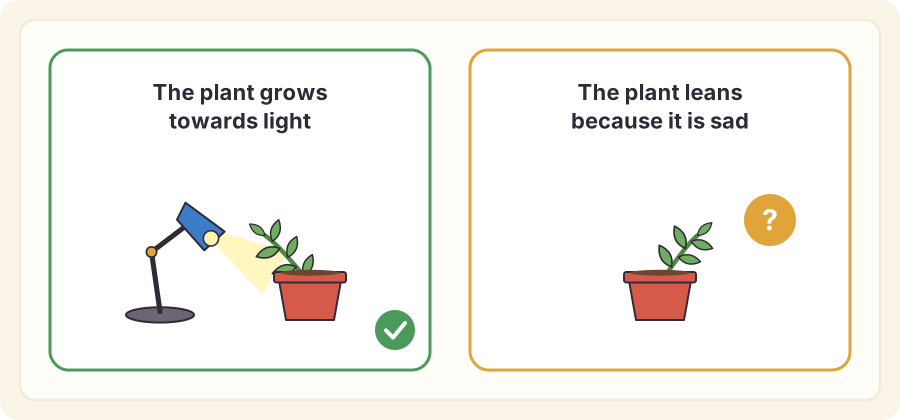
Zara could have guessed "the plant leans because it is sad". But how would she ever find out if that were true? Nothing she could look at would tell her.
Her three ideas are different. Each one could be checked: she could move the light, switch off the radiator, or close the gap. The world could show each of them to be right or wrong. A possible answer to a question about the world, that the world could show to be right or wrong, is called a hypothesis (say it "hy-POTH-uh-sis"; more than one are hypotheses).
A starting point, not an answer
A hypothesis isn't a wild guess. Zara's come from what she observed: the plant leans towards the window, so the idea is about something that comes from the window. But a hypothesis isn't an answer either. It is where the finding out starts.
Most hypotheses turn out to be wrong, and that is fine. A wrong hypothesis that is checked and thrown away still teaches you something: one possible answer is gone. Scientists often start with several hypotheses, as Zara did, and let the checking decide between them. How to check one is the question of the next lesson.
Try it at home
- Look at your notes from the last lesson and pick one thing you noticed.
- Write down "Why?" and then three different possible answers.
- For each one, write how you could check it. If you can't think of any way, it isn't a hypothesis yet - try to change it until you can.
Words to know
- hypothesis - a possible answer to a question about the world, which the world could show to be right or wrong (plural: hypotheses)
- testable - able to be checked against the world
Big idea
A hypothesis is a guess about the world that you could check. It comes from what you observed, it is a starting point rather than an answer, and it is fine for it to turn out wrong.