Toss a Coin to Choose
The school with the reading app from the Compared With What? lesson tries once more. This time the teacher asks: "Who would like to use the app?" Twenty children put up their hands; they get the app, and the rest are the control group. At the end of the term, the app group has improved much more. Has the app worked this time?
Who chose matters
Think about who put their hands up. Children who love reading are more likely to want a reading app. They are also the children who read the most at home, so they were likely to improve more anyway - with or without the app.
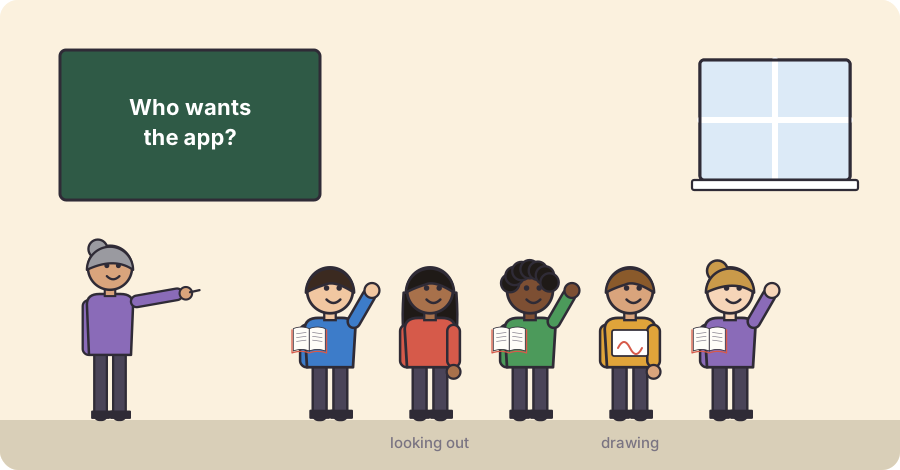
So the two groups were different before the test started. The difference at the end could come from the app - or from the kind of children who chose it. The test can't tell which. (If you have read Logic Level 1: this is a third thing that causes both, here the love of reading.)
Let chance choose
The fix is surprising: don't let anyone choose. Not the children, and not the teacher, who might pick the keenest without meaning to. Instead, toss a coin for each child: heads, the app; tails, the control group.
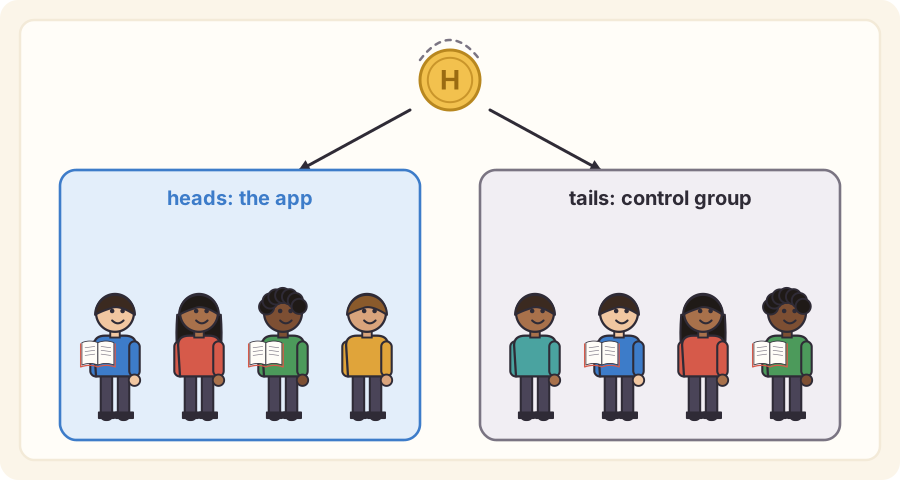
A coin doesn't know who loves reading. So the keen readers end up spread across both groups, about half in each - and so do the tall and the short, the tired and the lively, and every other difference, even the ones nobody thought of. Choosing by chance like this is called random assignment: "random" means decided by chance, with no pattern.
Why chance is fair
With random groups, the two groups are alike at the start in every way except the app. So if the app group improves more, the app is the likely reason - or chance, which the next lesson but one deals with. Scientists use the same idea when they test a new crop, a new teaching method or a new medicine: let chance decide who gets what.
Try it at home
- Take your two paper planes, or two kinds of seed, and ten turns or ten pots.
- Toss a coin for each turn or pot to decide which one it gets.
- Write down why letting the coin choose is fairer than choosing yourself.
Words to know
- random - decided by chance, with no pattern
- random assignment - using chance, like a coin toss, to decide who goes in which group
Big idea
If people choose their own group, the groups can be different from the start. Letting chance decide makes the groups alike in every way - even ways nobody thought of - except the one thing being tested.