What You Remember
Zara and her brother Kian are looking at photos from Kian's eighth birthday. "That was the chocolate cake," says Zara. "No," says Kian, "it was strawberry. I remember the pink icing." They both feel completely sure. They were both there. How can two people remember the same day differently?
Memory keeps what you perceived
Most of what you know, you are not perceiving right now. You know what you had for breakfast, the way to your school, and your friend's face, even with your eyes closed. You know them because you saw them once, and you remember them. Memory keeps what your senses took in, so you can still use it later.
That makes memory the second place knowledge comes from. Remembering something you saw is a good reason to believe it - most of the time.
Memory rebuilds
But memory is not like a video you can play back exactly. Each time you remember something, your mind builds it again from pieces: some from the day itself, some from what you know about birthdays in general, some from later stories and photos. Usually the pieces fit. Sometimes the wrong piece fills a gap, and you remember something that never happened.
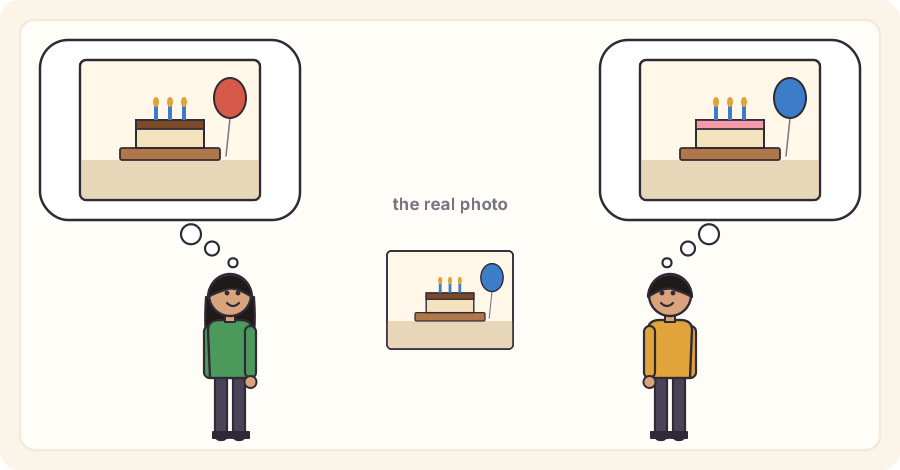
The hardest part is this: a wrong memory feels exactly like a right one. Kian's pink icing is as clear to him as the real cake is to Zara. How sure you feel tells you very little about whether a memory is right - the same lesson as Sam's keys in the What Is a Belief? lesson.
How memory fades
Memories also change with time. Yesterday's dinner is clear. What you ate on a Tuesday a year ago is gone, unless something made it special. Older memories have had more time to lose pieces and gain new ones.
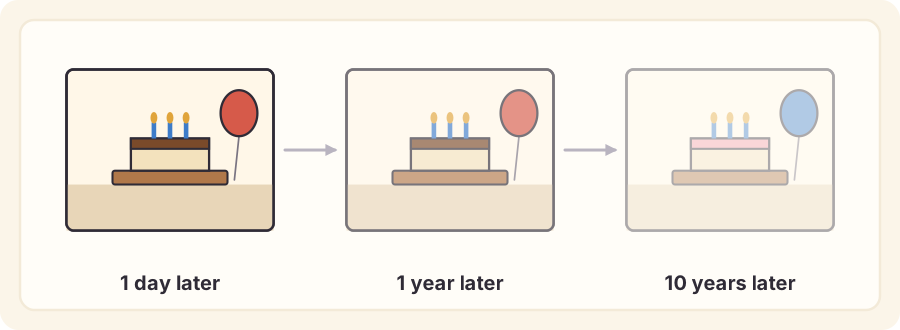
So memory gives the best reasons when:
- it is recent;
- you paid attention at the time;
- it fits with other things - photos, notes, what others remember.
For anything that matters - a date, a promise, a phone number - don't rely on memory alone. Write it down. A note made at the time doesn't rebuild itself.
Try it at home
- With someone in your family, each write down what you remember of the same day - a trip, a meal, a party - before you talk about it.
- Compare. Where do your memories differ?
- Is there a photo, a message or a note from that day? Who was right?
Words to know
- memory - keeping what you once perceived, so you can use it later
- false memory - remembering something that didn't happen, or not the way it happened
Big idea
Memory keeps what your senses took in, so it is a source of knowledge. But memory rebuilds things each time, and a wrong memory can feel just as sure as a right one. For things that matter, check against a note or a photo made at the time.