Knowing Without Being Certain
You know your best friend's name. You know where you live. You know that water is wet. But the Could You Be Wrong About Everything? lesson showed that you can't be certain of any of them - you might, in some very strange way, be dreaming. So do you know them or not?
Too high a bar
Imagine that "knowing" meant "being certain" - so sure that there is no way at all you could be wrong. Then you would know almost nothing. Not your friend's name, not your address, not that the Sun will rise. Even scientists would know nothing about the stars or the dinosaurs.
That can't be right. You do know your friend's name. If someone asked "do you know her name?" and you said "no", you would be saying something false.
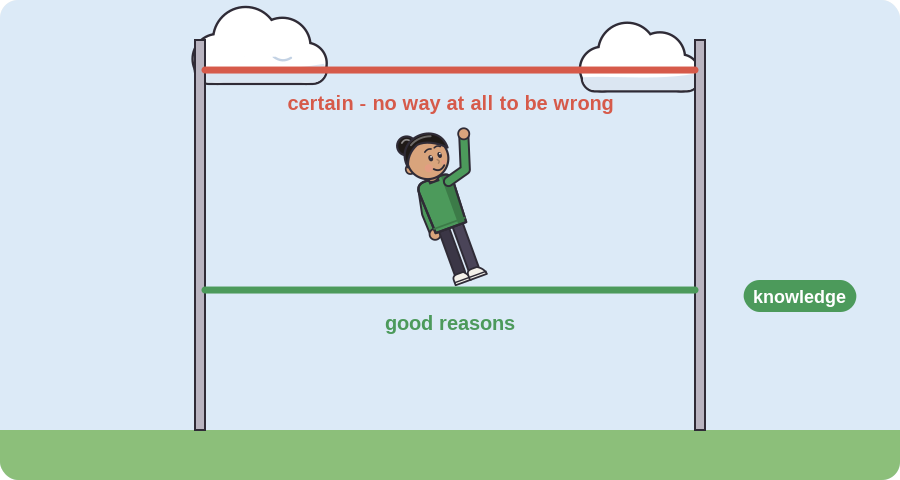
So most philosophers today say the bar for knowledge is lower than certainty. You know something when you believe it, it is true, and your reasons are good - the three legs from the Good Reasons lesson. Good reasons don't have to rule out every strange possibility. They have to rule out the real ones. Knowing without being certain like this has a name: fallibilism - from fallible, which means "able to be wrong".
Ready to be wrong
Fallibilism says two things together:
- you can know things, with good reasons, without being certain;
- and you could still be wrong, so you stay ready to find out that you were.
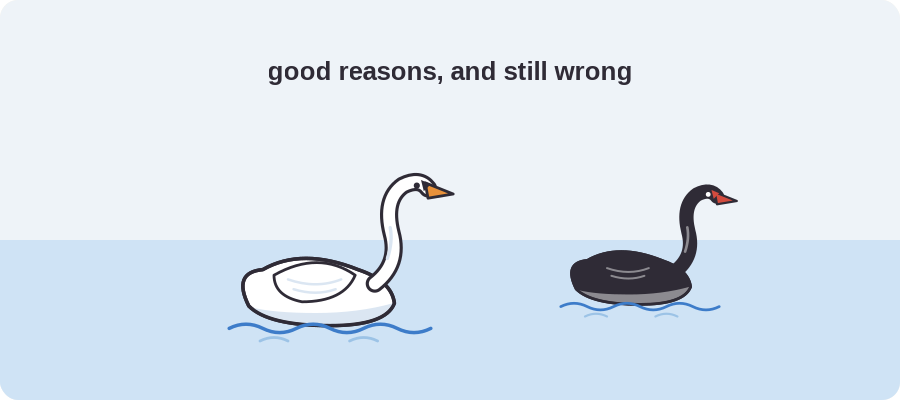
The black swans are a good example. For hundreds of years, people in Europe had very good reasons to believe all swans were white: thousands of white swans and not one black one. Then, in 1697, sailors found black swans in Australia. The people of Europe weren't foolish. They had good reasons. They were also wrong. A fallibilist says: that can happen to anyone, about anything - so hold your beliefs firmly enough to act on them, and loosely enough to change them.
What this means for you
You don't need certainty to cross the road, trust a friend or do your homework. You need good reasons. And when someone shows you a black swan - evidence that you were wrong - you can say "I see, I was wrong", without feeling that you never knew anything. The Changing Your Mind lesson comes back to this.
Try it at home
- Write down three things you know but aren't certain of.
- For each, write the good reasons you have.
- What would have to happen to show you were wrong? Is that likely?
Words to know
- fallible - able to be wrong
- fallibilism - the idea that we can know things with good reasons, without being certain, and still be wrong
Big idea
If knowledge needed certainty, we would know almost nothing. You can know something when your reasons are good, even though you could still be wrong. Hold beliefs firmly enough to act on them, and loosely enough to change them.