When Your Eyes Fool You
Put a pencil in a glass of water and look at it from the side. The pencil looks broken, bent at the place where it goes into the water. Pull it out: it is perfectly straight. Put it back: bent again. Your eyes are working well, the light is good, and you are looking closely. So why do your eyes get it wrong?
When the senses fool you
In the Seeing for Yourself lesson we saw that the senses work best close up, in good conditions. The pencil shows that even then they can fool you. When your senses tell you something that isn't so, it is called an illusion.
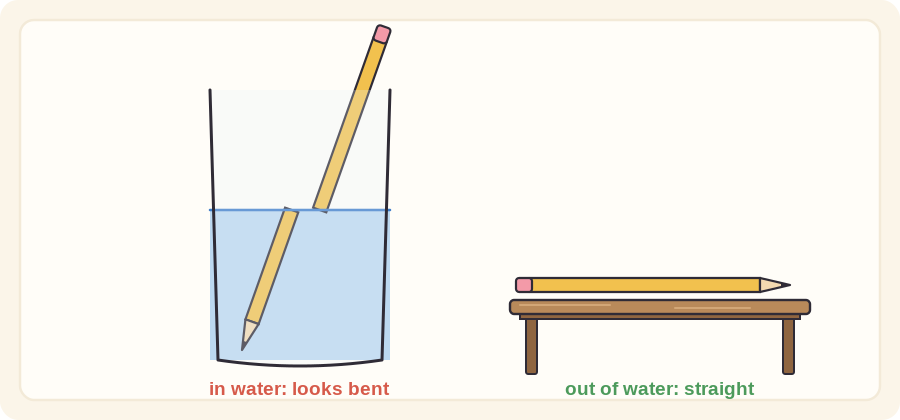
The pencil looks bent because light changes direction when it passes from water into air. Your eyes see the light, and the light really has been bent. But your eyes take it as the pencil being bent. Knowing why doesn't help, either: you can know the pencil is straight and it still looks bent.
More illusions
Illusions happen to everyone, with every sense:
- On a hot day, a dry road far ahead seems to have a puddle on it. It is a mirage: hot air near the road bends the light from the sky.
- Look at the two lines in the picture below. Which one is longer?
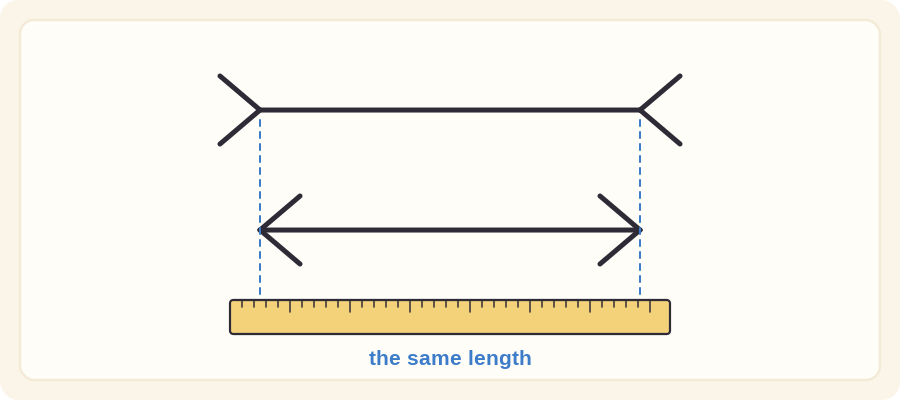
The two lines are the same length. Almost everyone sees the top one as longer. This one was drawn by a German scientist, Franz Müller-Lyer, in 1889, and it still fools people today.
Catching an illusion
If your senses can fool you, how can you trust them at all? The answer is that an illusion can usually be caught by checking in another way:
- another sense: run your finger down the pencil in the water - it feels straight;
- a tool: lay a ruler along the two lines;
- another look: walk up the road, and the puddle is never there;
- another person: ask someone else what they see (though illusions often fool them too).
Most of the time your senses are right, and one look is enough. An illusion is a reason to check when something matters, or when something seems strange - not a reason to stop trusting your eyes.
Try it at home
- Try the pencil in a glass of water. Check it with your finger.
- Draw the two lines with their arrowheads, then measure them.
- Look out for an illusion this week - a mirage, a sound that seems to come from the wrong side, a shadow that looks like an animal. How did you check?
Words to know
- illusion - when your senses tell you something that isn't so
- mirage - an illusion of water on a hot road, made by hot air bending light
Big idea
Even in good conditions, your senses can fool you - that is an illusion. You can usually catch one by checking in another way: another sense, a tool, another look. Illusions are a reason to check, not a reason to stop trusting your senses.