Checking What You Read
A post appears on Jonas's phone. It has a picture of a huge wave crashing over a city, and it says: "TSUNAMI hits the coast today! Share before it's deleted!" It already has 50,000 shares. Jonas's thumb moves to the share button. Should he press it?
Stop before you share
Posts, messages and videos travel fast, and anyone can make one. Some are true, some are mistakes, and some are made up on purpose to be shared. Being shared 50,000 times doesn't make a post true - 50,000 people sharing one post is one source, as the Two Sources or One? lesson showed.
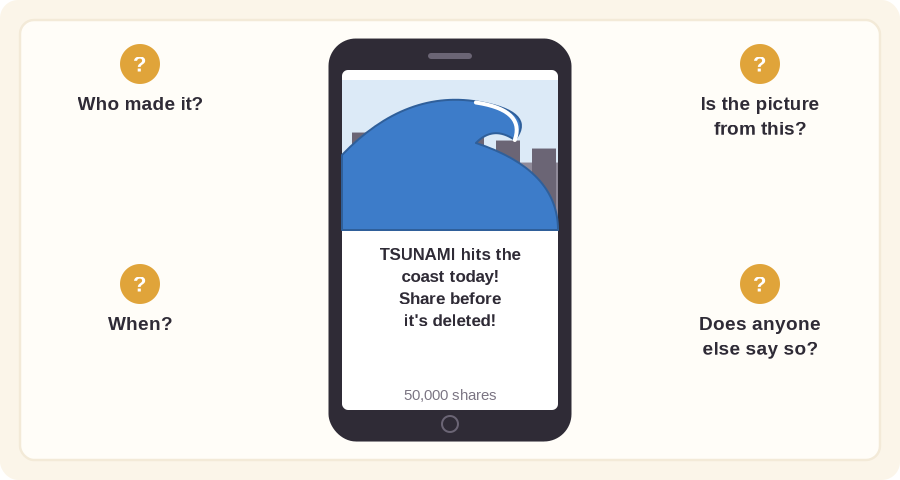
So before believing a post, stop and check. Here are four questions.
Four questions
1. Who made it? Is it from a known news service, the weather office or the city - a reliable source, as in the Who Should You Believe? lesson? Or from an account nobody knows? "Share before it's deleted" is a sign that someone wants you to hurry instead of think.
2. When was it made? Old news is often shared as if it were new. A real storm from ten years ago can look like today's.
3. Is the picture really from this? Pictures are easy to take from one event and put on another. Jonas can search for the picture and find out where it first appeared. This one turns out to be a still from a film.
4. Does anyone else say so? This is the most useful question. A real tsunami would be on every news site, the weather office would warn people, and the city would tell people what to do. If none of them say anything, the post is almost certainly false.
Look somewhere else
The fourth question has a simple habit behind it: leave the post and look somewhere else. Don't read the post again more carefully - it will only tell you what it wants to. Open a new page and search for the news from reliable, independent sources.
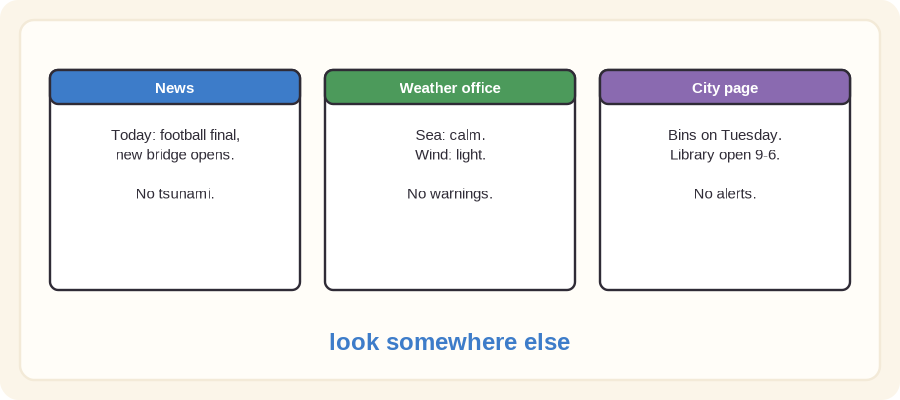
Jonas checks. The weather office says the sea is calm. No news site mentions a tsunami. He doesn't share the post, and he tells the friend who sent it.
Try it at home
- Find a post or a message that someone shared with you this week.
- Ask the four questions about it.
- Look somewhere else: does any reliable, independent source say the same?
Words to know
- checking a source - finding out who made something, when, and whether other reliable sources agree
- looking somewhere else - checking a claim by leaving it and searching other sources, instead of reading it again
Big idea
Before believing or sharing a post, ask who made it, when, whether the picture is really from it, and whether anyone else says so. The best habit is to leave the post and look somewhere else: a real event is reported by many reliable sources.