Good Reasons
It is Sunday morning, and Nadia and her brother Ben both believe the bakery on the corner is open. Nadia believes it because she walked past ten minutes ago and saw the lights on and the sign on the door turned to "Open". Ben believes it because he is hungry, really hopes it is open, and has a good feeling about it. They are both right: the bakery is open. Who knew?
Three legs
In the A Lucky Guess lesson we saw that knowledge needs three things: you believe it, it is true, and you have good reasons for it. Think of them as the three legs of a stool. Take any one away and the stool falls over.
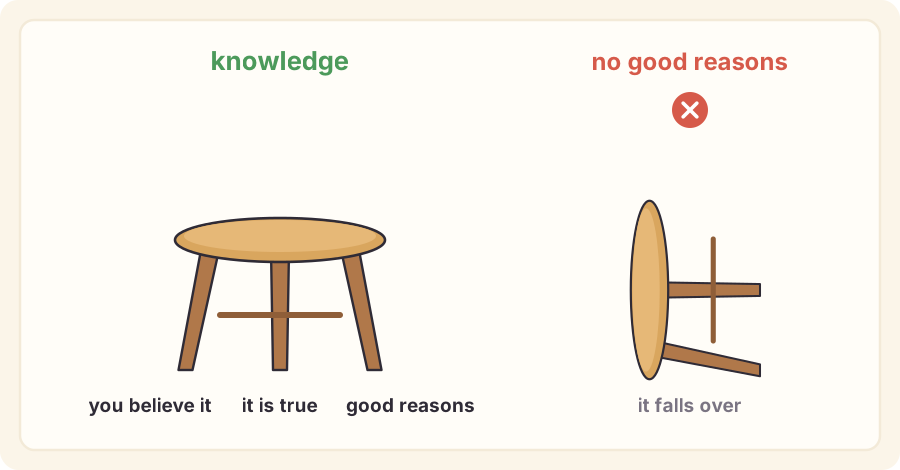
Nadia and Ben both have the first two legs. They both believe the bakery is open, and it is. Only Nadia has the third. Ben's stool is missing a leg - he was right, but he didn't know.
What makes a reason good
Nadia's reason is good because it connects her belief to the truth. She saw the lights and the sign because the bakery was open. If it had been closed, she would have seen a dark window and a "Closed" sign, and she would have believed something else.
Ben's reasons connect to nothing. He would have been just as hungry, just as hopeful, and just as cheerful if the bakery had been closed. His reasons would have made him believe it was open either way.
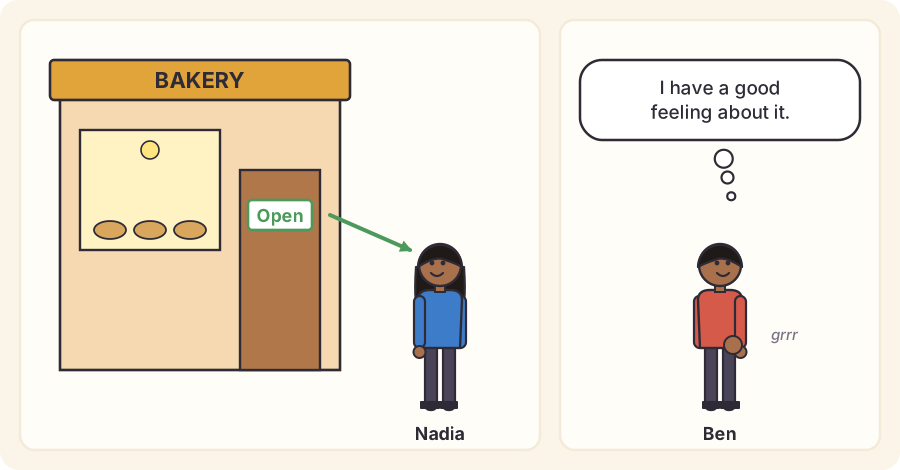
So here is a test you can use for any reason: if the belief were false, would this reason still be there? If it would, it isn't a good reason.
- "I saw the sign say Open" - if the bakery were closed, the sign wouldn't say Open. A good reason.
- "I hope it's open" - you would hope so either way. Not a reason at all.
- "It's open every Sunday" - mostly a good reason, but a little weaker: it could be closed this Sunday for a holiday.
The last one shows that reasons can be more or less good. A large part of this course is about how good a reason is, and the next lesson starts with the first place good reasons come from.
Try it at home
- Pick three things you believe about today - the weather, what's for dinner, whether a friend is home.
- For each, write your reason, and ask: if I were wrong, would this reason still be there?
- Which of your beliefs stand on all three legs?
Words to know
- good reason - a reason that connects a belief to the truth, so it would be missing if the belief were false
Big idea
Knowledge is like a stool with three legs: you believe it, it is true, and you have good reasons. A good reason connects your belief to the truth. Wanting, hoping or a hunch would be there whether the belief was true or not, so they are not good reasons.