Seeing for Yourself
You wake up and hear a soft drumming on the window. You get up, pull back the curtain, and see water running down the glass and puddles in the street. You know it is raining. Nobody told you. You didn't work it out from anything. How do you know?
Your senses
You know it is raining because you heard it and saw it. Your eyes, ears, nose, tongue and skin are always telling you about the world around you: the colour of the sky, the sound of a doorbell, the smell of burning toast, the heat of a cup, the salt in your soup. Taking in the world through your senses is called perception.
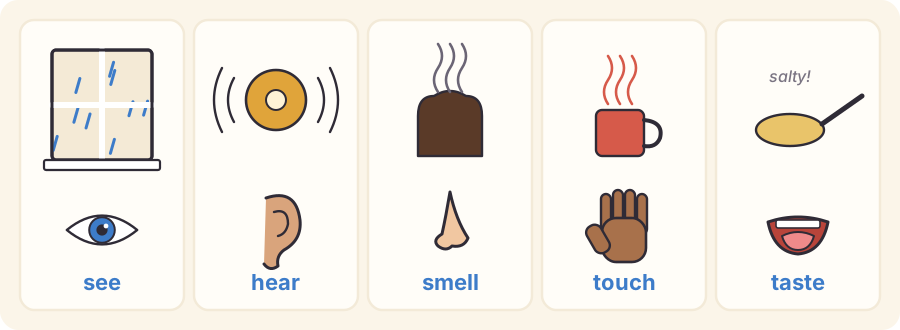
Perception is the first place knowledge comes from. A baby learns about the world by looking, listening, touching and tasting long before it can talk. Seeing something with your own eyes is one of the best reasons there is - the kind of reason the Good Reasons lesson called a connection to the truth. You see rain because there is rain.
When the senses work best
But your senses are not equally good all the time. Imagine seeing something small and dark on the road ahead of you. In daylight, two steps away, you can see at once that it is a cat. At night, from far away, in fog, it could be a cat, a bag or a shoe.
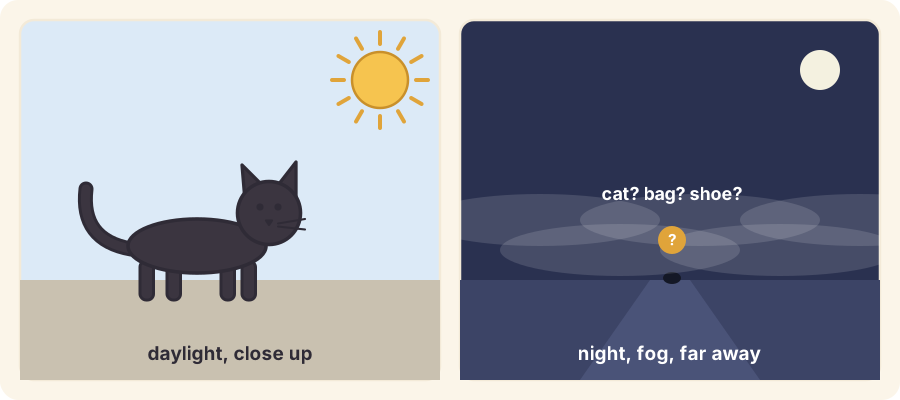
Perception gives the best reasons when:
- you are close enough and the thing is big enough to see or hear;
- the conditions are good: enough light, not too much noise, no fog;
- you are not tired, ill or rushed;
- you looked for long enough, not just a glance.
When the conditions are poor, you still see something. But what you see is a weaker reason, and you should be less sure. The next lesson shows that sometimes the senses go further wrong than that.
Try it at home
- Stand by a window and write down five things you know right now only by your senses.
- Next to each, write which sense told you.
- Pick one and ask: what would make this sense less trustworthy - darkness, distance, noise?
Words to know
- the senses - sight, hearing, touch, smell and taste
- perception - taking in the world through your senses
Big idea
Your senses are the first place knowledge comes from. Seeing, hearing or touching something gives a good reason to believe in it - best when you are close, the conditions are good and you take your time.