Big Claims Need Big Evidence
Your friend runs up to you. "I just saw a dog in the park!" You believe her straight away. The next day she runs up again. "I just saw a lion in the park!" This time you don't believe her - not straight away. But it's the same friend, the same park and the same kind of evidence: her word. Why believe one and not the other?
What else you know
The difference isn't your friend. It is everything else you know. You know that dogs are walked in parks every day. A dog in the park fits with all of it. You also know that lions live in Africa, in zoos and in films, not in your local park. A lion in the park goes against all of that.
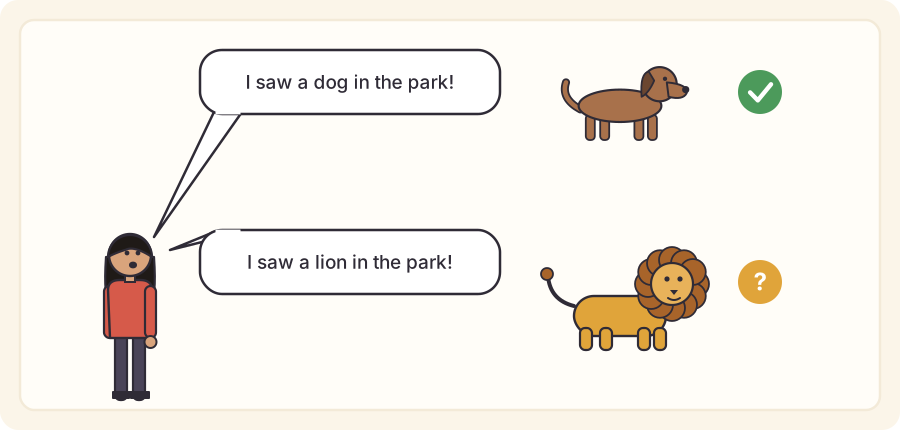
So ask: what is more likely - that there really was a lion, or that your friend made a mistake? Maybe she saw a big yellow dog from far away, or a statue, or she is joking. All of those happen far more often than lions escaping into parks. Her word is enough to beat the small chance of a mistake about a dog. It isn't enough to beat everything you know about lions.
The rule
This gives a simple rule: the more surprising the claim, the more evidence you need. An ordinary claim needs only ordinary evidence. A claim that goes against a lot of what you know needs a lot of evidence before it is reasonable to believe it.
Surprising things can be true
This doesn't mean "never believe anything surprising". Lions do sometimes escape from zoos. If one really had, there would be much more evidence: it would be on the news, the police would warn people to stay indoors, the zoo would say a lion was missing, and many people would have seen it. Together, that would be enough.
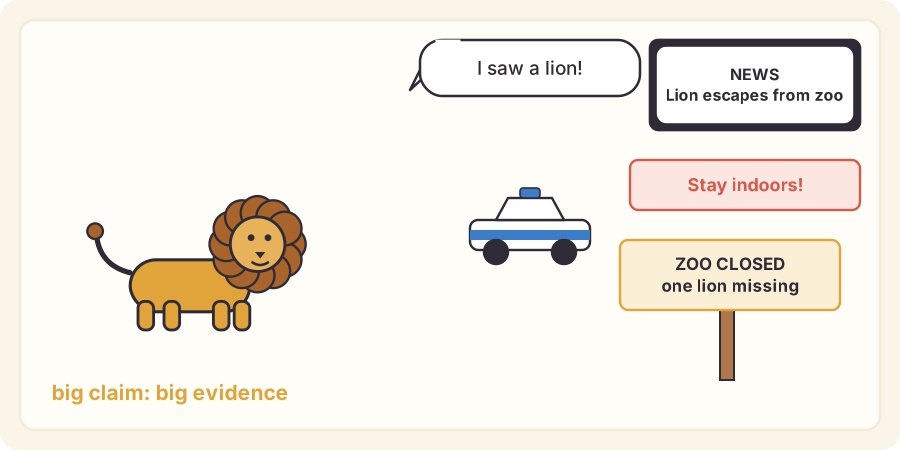
Big claims aren't impossible. They just need big evidence. Until it arrives, the reasonable thing is to say "really? Show me" - in a friendly way.
Try it at home
- Listen for a surprising claim this week: a story, a video, a "did you know".
- Ask: what would I expect to see if it were true? Is that evidence there?
- Compare it with an ordinary claim you believed straight away. What was the difference?
Words to know
- surprising claim - a claim that goes against much of what you already know
- ordinary claim - a claim that fits with what you already know
Big idea
The more surprising a claim is, the more evidence it needs. An ordinary claim can be believed on ordinary evidence, like a friend's word. A claim that goes against much of what you know needs much more - not because it must be false, but because a mistake is more likely than a lion.