Changing Your Mind
For years, the town library has closed at 8 in the evening. Arash knows this; he has been there many times. One afternoon he walks past and sees a new sign on the door: "From 1 March, the library closes at 6 pm." Today is 3 March. Arash had planned to go at seven. What should he believe now?
New evidence, new belief
Before he saw the sign, Arash had good reasons to believe the library closed at 8: years of experience. He knew it - in the way the Knowing Without Being Certain lesson described. But the sign is new evidence, and it is strong: it is on the library's own door, and it is dated. So Arash should change his belief. The library now closes at 6.
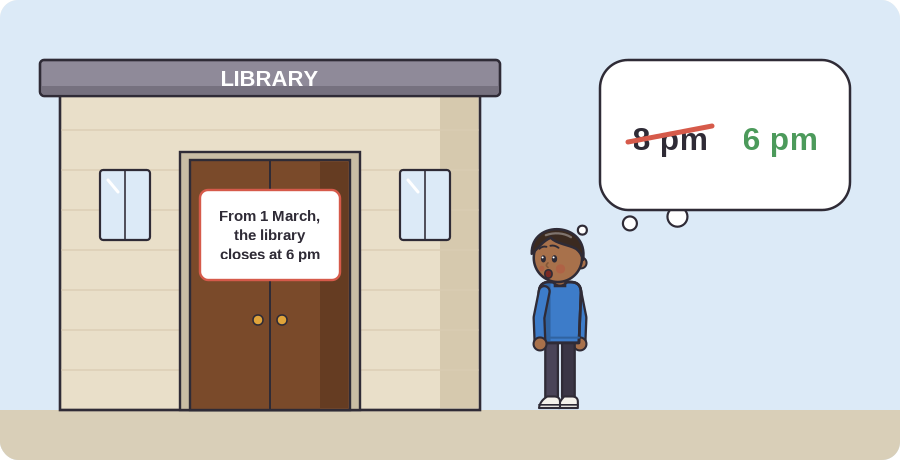
Changing a belief to fit new evidence is called updating it, like updating a map when a new road is built. Arash wasn't wrong before. His old belief fitted the old evidence. Now the evidence has changed, so the belief changes too.
How much to change
Updating isn't all or nothing. Strong evidence should change your mind a lot, and weak evidence only a little.
- The sign on the library door: strong evidence - change your belief completely.
- A friend says "I think I heard the library hours changed": weaker evidence - become less sure that it closes at 8, and maybe check.
- A stranger on the bus says "libraries close early these days": very weak evidence - hardly change at all.
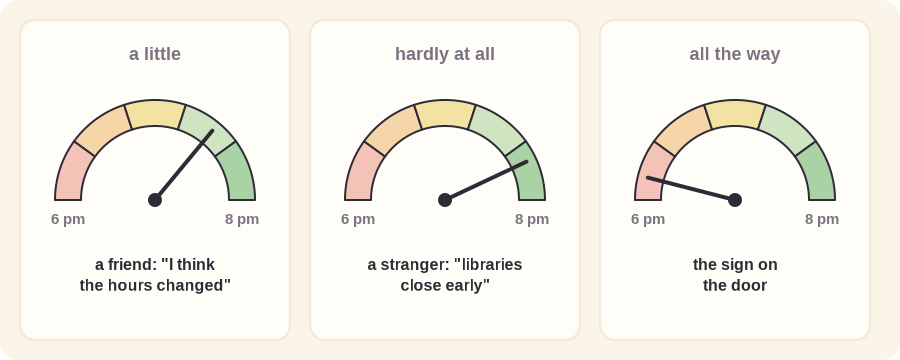
This is the same rule as the How Sure Should You Be? lesson, but over time: as the evidence changes, keep your confidence where the evidence is.
Why it is hard
Changing your mind can feel uncomfortable. It can feel like admitting you were silly, or like losing an argument. And confirmation bias, from the Seeing What You Expect lesson, makes us notice the evidence that fits our old belief and miss the new evidence against it.
But updating is not a weakness. A person who never changes their mind isn't strong - they just stop learning. Someone who says "I see - the evidence has changed, so I've changed my mind" is doing exactly what knowledge needs.
Try it at home
- Think of something you used to believe and don't any more - about a food, a place, a person, how something works.
- What made you change your mind? Was it strong or weak evidence?
- Is there a belief you hold now that you would change if you saw some particular evidence? What evidence?
Words to know
- updating a belief - changing a belief to fit new evidence
- new evidence - evidence you didn't have when you first formed the belief
Big idea
When new evidence arrives, change your belief to fit it - a lot for strong evidence, a little for weak evidence. Updating isn't admitting you were foolish; your old belief fitted the old evidence. It is how knowledge keeps up with the world.