What Counts as Evidence?
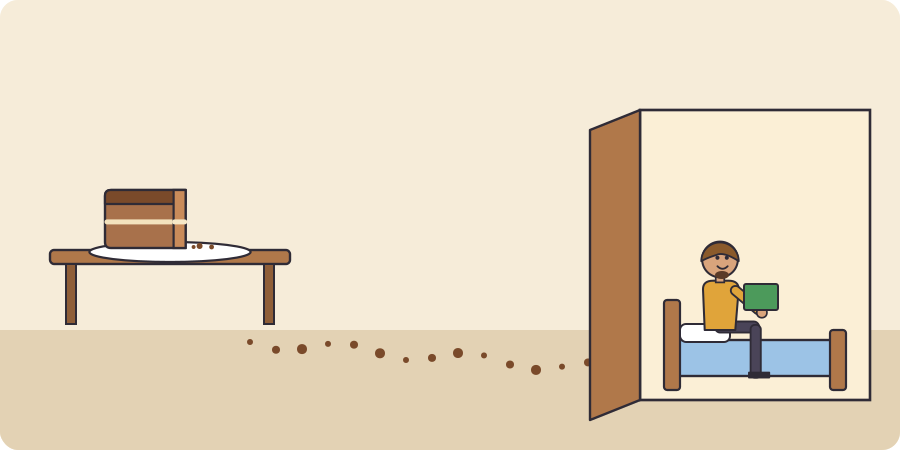
When Mum comes home, the chocolate cake on the kitchen table has a slice missing. There is a trail of crumbs across the floor to the door of Kian's room. Kian is sitting on his bed reading, and there is chocolate on his chin. Nobody saw anyone take the slice. Does Mum know who ate it?
Clues
Mum didn't see it happen, and nobody told her. But she isn't guessing, either. The crumbs, the empty space on the plate and the chocolate on Kian's chin all point the same way. Each of them makes the claim "Kian ate the cake" more likely to be true. Anything that does that is called evidence for the claim.
Evidence is how we know about things we didn't see happen. Detectives use it to find out who did something. Doctors use it to find out what makes a person ill: a temperature, a cough, a rash. Scientists use it to find out about things nobody could ever see - like the dinosaurs, known from their bones.
For and against
Evidence can point the other way, too. Suppose Mum then finds Kian's football boots by the front door, still wet with mud, and his friend's mum sends a message: "Kian has been at ours all afternoon, I've just dropped him home." That is evidence against "Kian ate the cake" - it makes the claim less likely.
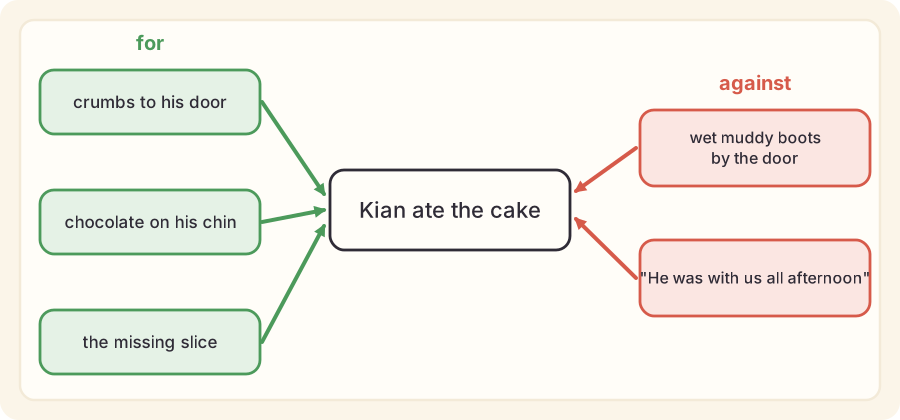
So a good look at the evidence always asks about both sides: what is the evidence for the claim, and what is the evidence against it?
Evidence is not proof
Even all the evidence for Kian doesn't make it certain. Maybe his sister ate the cake and left the crumbs; maybe the chocolate is from a biscuit. Evidence makes a claim more or less likely. It doesn't usually make it certain. (If you have read Logic Level 1, this is the difference between "must be true" and "only likely".)
That is why the next question is always "how strong is this evidence?" - the question of the next lesson.
Try it at home
- Next time something has happened that you didn't see - a broken cup, a message from an unknown number, a light left on - write down the clues.
- For each clue, write what it is evidence for.
- Then look for evidence against: anything that points another way?
Words to know
- evidence - anything that makes a claim more likely to be true, or less likely
- evidence for - evidence that makes a claim more likely
- evidence against - evidence that makes a claim less likely
Big idea
Evidence is anything that makes a claim more likely or less likely to be true. It lets us know about things we didn't see happen. Look at the evidence on both sides - and remember that evidence makes a claim likely, not certain.