What Is a Belief?
Sam is late for school. He grabs his bag, pulls the front door shut behind him, and feels his coat pocket for the keys. Nothing. He was sure they were in his pocket. Through the window he can see them, lying on the kitchen table. Did Sam know where his keys were?
Thinking that something is true
When Sam closed the door, he thought "my keys are in my pocket". He didn't say it aloud, and he didn't wonder about it. He simply took it to be true. Thinking that something is true like this is called a belief.
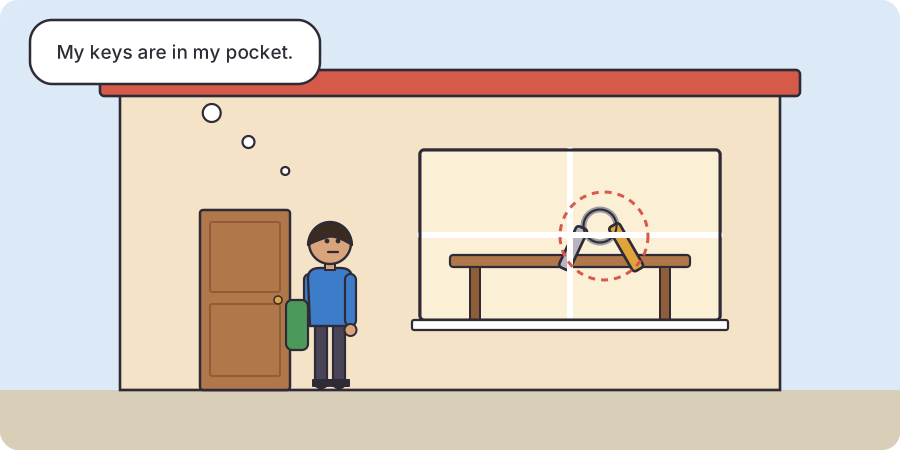
Sam's belief was false. The keys were on the table, not in his pocket. A belief is a kind of claim - something that is either true or false - which a person holds. Whether it is true doesn't depend on the person. It depends on how things really are: where the keys really lie.
You have thousands of beliefs
Most beliefs are not about keys, and you never notice them. Right now you believe that the chair you are sitting on will hold you, that the floor is still there, and that the Sun will come up tomorrow. You believe your friend's name is what you think it is, that water puts out fire, and that the Earth is round.
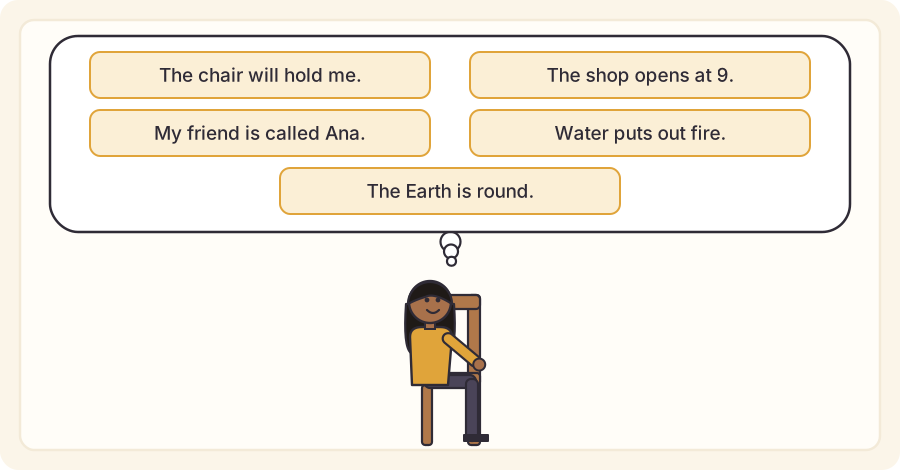
Almost all of these beliefs are true, and you need them. You couldn't sit down, cross a road or eat lunch without trusting thousands of beliefs at once.
Feeling sure is not the same as being right
Sam didn't just believe his keys were in his pocket. He was sure. But being sure didn't move the keys. Feeling sure is something that happens in your head. Being right is about the world outside it.
This is the question the whole course is about. Some of our beliefs are true, and some are false. Some we hold for good reasons, and some only feel right. When do we really know something, and when do we only believe it? Next, in the A Lucky Guess lesson, we start to find out.
Try it at home
- Write down five things you believe right now, without thinking hard. Use simple ones, like "my phone is in the next room".
- Next to each, write how sure you feel.
- Check the ones you can. Was any of them false?
Words to know
- belief - thinking that something is true
- true belief - a belief that matches how things really are
- false belief - a belief that doesn't
Big idea
A belief is thinking that something is true. Most of our beliefs are true, but some are false, and feeling sure of a belief doesn't make it true. Whether it is true depends on the world, not on how we feel.