Four Ways of Knowing
Amir is at the bus stop at 3:48. He reads the timetable on the pole: on weekdays the bus comes every 15 minutes, starting at 6:00, and on Saturdays every 30 minutes. He remembers that today is Saturday. So, he thinks, the next bus is at 4:00 - twelve minutes to wait. How did Amir come to know that?
Working things out
Nobody told Amir "the next bus is at 4:00". He didn't see it, and he didn't remember it. He worked it out from things he already knew: the timetable, the day, and the time. Working out something new from what you already know is called reasoning. (If you have read Logic Level 1, this is what it was about: reasons leading to a conclusion.)
Reasoning is the fourth place knowledge comes from. It is different from the other three. It doesn't bring in anything new from outside - it uses what you already have to find something you didn't know you had.
Four sources
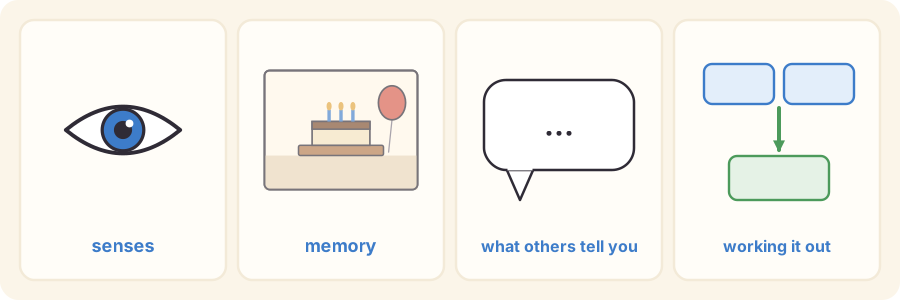
So far this course has found four places knowledge comes from. We call them sources of knowledge:
- perception - your senses (Seeing for Yourself);
- memory - what you perceived before (What You Remember);
- testimony - what others tell you (What Others Tell You);
- reasoning - working things out from what you already know.
They work together
Look at Amir again. To know when the bus is coming, he used all four:
- he saw the timetable and his watch;
- he remembered that today is Saturday;
- the timetable was written by the bus company, who told him the times;
- and he worked out the next bus from all of that.
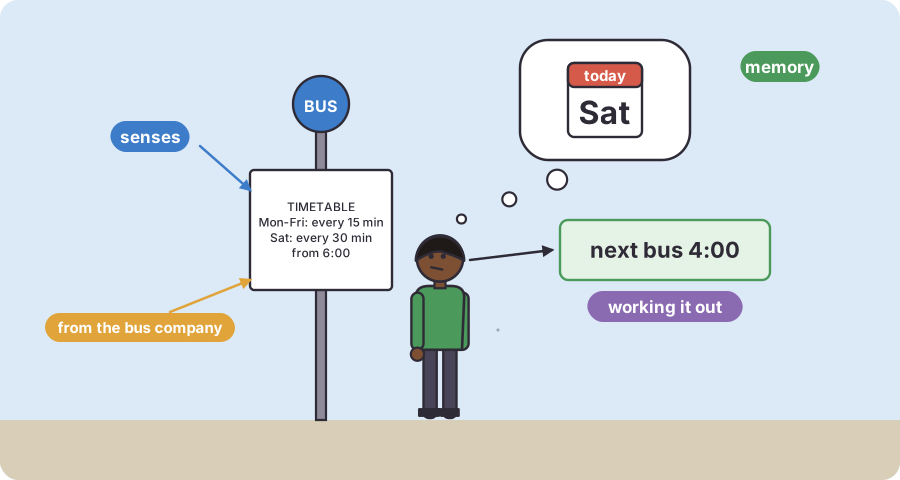
Most knowledge is like this. The sources lean on each other. And each can be weak in its own way: your eyes can be fooled, your memory can rebuild, the person telling you can be wrong, and your reasoning can make a mistake. If Amir's memory was wrong and today is Friday, his reasoning was fine, but his conclusion is wrong.
When you ask "how do I know this?", the first step is to ask which sources it came from. Then you can ask how good each one was. The next module, starting with What Counts as Evidence?, looks at how good.
Try it at home
- Pick one thing you know about today: when a shop closes, what's for dinner, who is home.
- Write down which of the four sources it came from. Often it is more than one.
- Which source is the weakest link?
Words to know
- reasoning - working out something new from what you already know
- sources of knowledge - the places knowledge comes from: perception, memory, testimony and reasoning
Big idea
Knowledge comes from four sources - your senses, your memory, what others tell you, and working things out. They usually work together, and knowledge is only as strong as its weakest source.