Two Sources or One?
On Monday morning, five friends tell Maya the same thing: "There's no school on Friday!" Five people - surely it must be true? Then Maya asks where they heard it. The first heard it from the second. The second heard it from the third. And in the end, all five heard it from one boy, Danny, who heard it from nobody - he "just had a feeling". How many sources did Maya really have?
Five voices, one source
Maya heard the news five times, but it came from one place: Danny. Each friend only passed it on. They didn't check anything. So five friends saying it is no better than Danny saying it - and Danny's reason was a hunch.
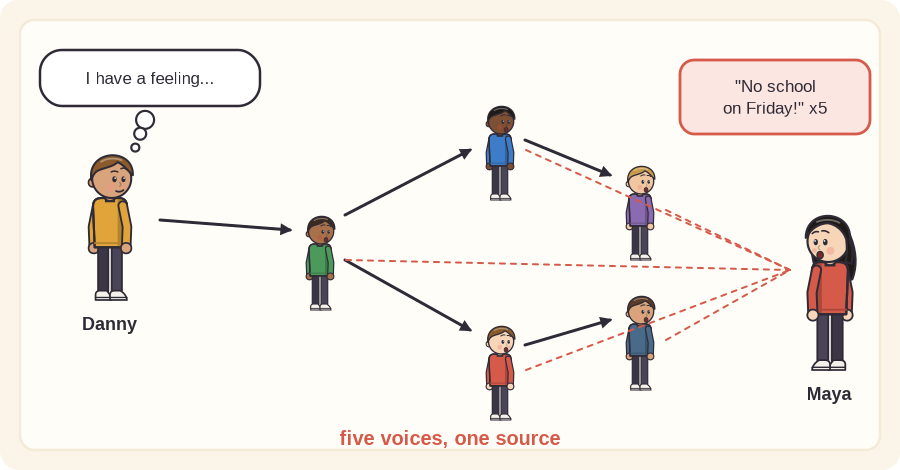
When a claim is passed along a chain, it can't be better than the place it started. Passing it on doesn't add any evidence. Often it takes some away, as the story changes a little at each step.
Independent sources
Now imagine a different Monday. The school website says Friday is a holiday. Maya's teacher says it in class. And a letter comes home in her bag. Three sources - and this time each one found out separately, from the school itself. Sources like that are called independent.
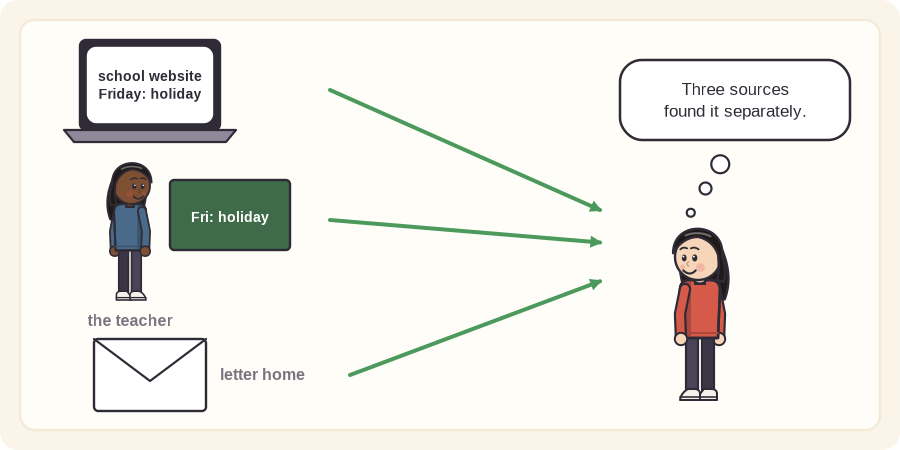
Independent sources really do add up. If one of them made a mistake, the others would not make the same mistake, since they didn't copy each other. So when independent sources agree, that is strong evidence - the same idea as the many pieces of evidence adding up in the Strong and Weak Evidence lesson.
How to tell
The question to ask is: where did each of them get it from? If the answer is "from each other" or "from the same place", count them as one. If each one had its own way of knowing, count them separately.
This matters online, too. Ten websites saying the same thing may all have copied the same first post. That is one source, repeated ten times.
Try it at home
- Next time you hear a piece of news from more than one person, ask each where they heard it.
- Draw the chain: who told whom?
- How many independent sources were there?
Words to know
- independent sources - sources that each found something out separately, not from each other
- passing on - repeating what you heard, without adding any evidence
Big idea
Hearing something many times only adds up if the sources are independent - if each found it out separately. Five people repeating one person's claim are still one source. Ask where each of them got it from.