How Plants Make Food
A cow grows big by eating grass. A tree eats nothing at all, yet an acorn the size of your thumb can become an oak that weighs many tonnes. Where does all that wood come from?
Myth or fact? Plants get their food from the soil.
A tree in a pot
About 400 years ago, the Flemish doctor Jan Baptist van Helmont tested this. He dried about 90 kg of soil in an oven, put it in a large pot and planted a young willow tree that weighed about 2 kg. For five years he gave it nothing but water, and he covered the pot so that no dust could fall in. Then he weighed everything again. The willow now weighed about 77 kg. The soil had lost only about 57 grams.1
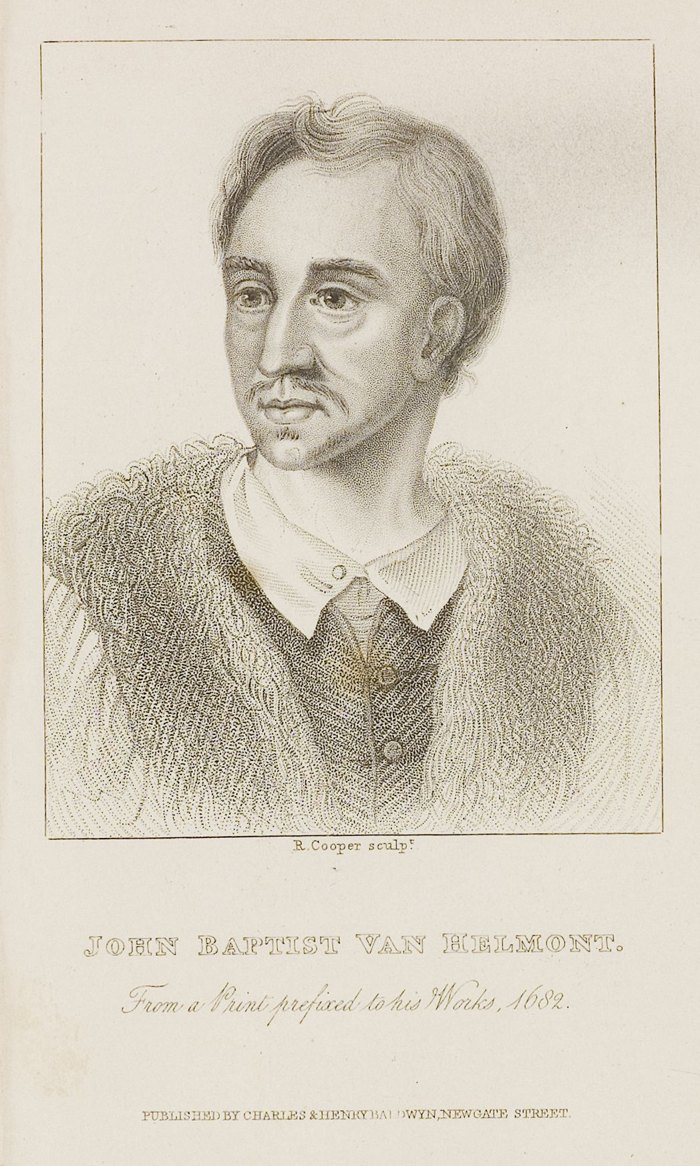
Jan Baptist van Helmont, engraved by Robert Cooper in the early 1800s from an older print. Public domain, via Wikimedia Commons.

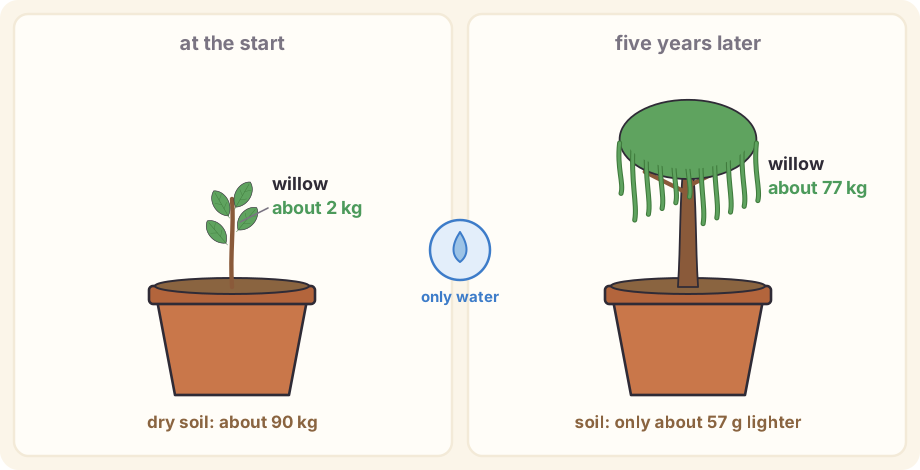
So the tree had not been eating the soil. Van Helmont decided that the whole tree was made of water. He was half right.
Show the answer
Myth. A plant takes water and small amounts of minerals from the soil, but it doesn't eat soil. It makes its own food, and most of what it builds that food from comes out of the air.
Air, water and light
The missing half was found in the 1700s. In August 1771 the English scientist Joseph Priestley put a sprig of mint into a closed jar of air in which a candle had burned until it went out. Ten days later, a new candle could burn in that air again. The plant had "mended" the air.2 In 1779 the Dutch doctor Jan Ingenhousz showed that only the green parts of a plant do this, and only in light.3
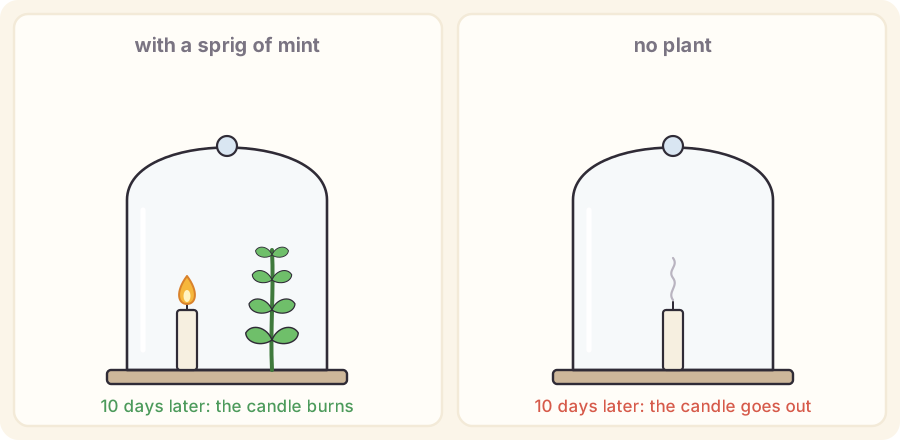
Today we call what the mint was doing photosynthesis, which means "putting together with light". A plant takes carbon dioxide, a gas in the air, and water, and uses the energy of light to turn them into a sugar called glucose. Oxygen is left over and goes out into the air:4
carbon dioxide + water + light energy → glucose + oxygen
Inside the leaf
Photosynthesis happens inside tiny green parts of plant cells called chloroplasts (see Plant and Animal Cells). They are green because they are full of chlorophyll, a green substance that catches light.4 Water comes up from the roots. Carbon dioxide gets in through tiny holes on the leaf, and oxygen leaves through the same holes.
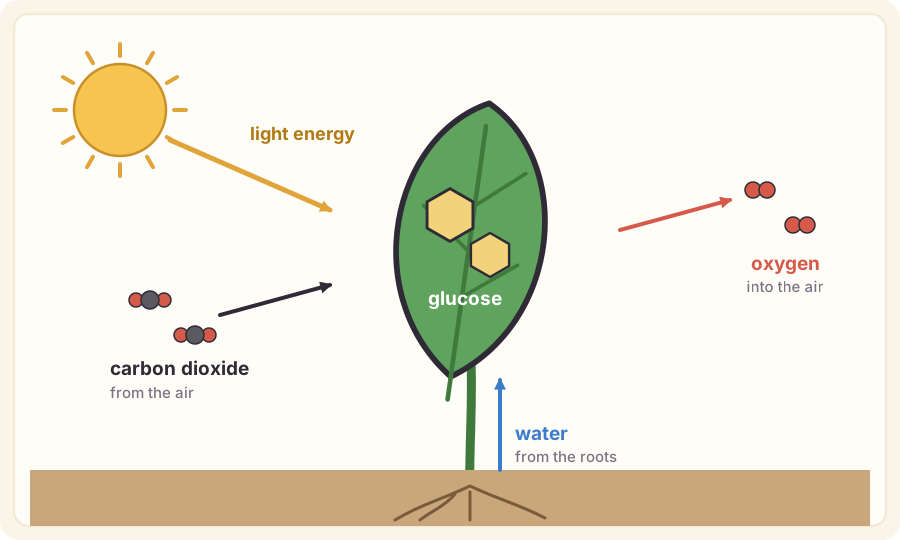
The plant uses the glucose in three ways. It releases its energy to stay alive (see How Cells Release Energy). It stores it as starch, in rice grains, wheat and potatoes. And it joins thousands of glucose units into long chains of cellulose, the stuff of cell walls, wood and paper.5 So the wood of van Helmont's willow was built from water and from carbon dioxide taken out of the air.
Food for almost everyone
Plants, algae (seaweeds and their tiny relatives) and a group of bacteria called cyanobacteria are the only living things that can capture the energy of sunlight this way.4 Almost all other life depends on them: bread, rice and dates come from plants, milk, eggs and meat from animals that ate plants, and much of the oxygen you breathe was given off by them.
Try it yourself
If you can get a water plant from a pond or an aquarium shop, put a sprig in a glass of water in bright sunlight. After a while, tiny bubbles form on its leaves: that is oxygen. Move the glass into the shade and watch the bubbles slow down.
Words to know
- photosynthesis - how plants use the energy of light to make glucose from carbon dioxide and water, giving off oxygen
- chlorophyll - the green substance in plants that catches light
- glucose - a sugar; the food that photosynthesis makes
- carbon dioxide - a gas in the air that plants take in to make their food
Big idea
Plants don't eat soil. They build their food, and themselves, out of air and water, using the energy of sunlight, and almost all other life feeds on what they make.
Sources
-
David R. Hershey, Misconceptions about Helmont's Willow Experiment (Plant Science Bulletin 49(3), 2003; quotes Helmont's own account, first published in 1648; the old pounds and ounces are converted here). ↩
-
Joseph Priestley, "Observations on Different Kinds of Air", Philosophical Transactions of the Royal Society 62 (1772). ↩
-
Jan Ingenhousz, Experiments upon Vegetables, Discovering Their Great Power of Purifying the Common Air in the Sun-shine, and of Injuring It in the Shade and at Night (book, 1779; scan and description by the Smithsonian Libraries). ↩
-
OpenStax, Biology 2e, 8.1 Overview of Photosynthesis (textbook, CC BY 4.0). ↩ ↩2 ↩3
-
OpenStax, Biology 2e, 3.2 Carbohydrates (textbook, CC BY 4.0). ↩