How Cells Release Energy
You run up four flights of stairs. At the top you are breathing hard and your heart is pounding. Your leg muscles have just used a lot of energy, and your body is rushing to bring them more oxygen. Where does that energy come from, and why does it need oxygen?
Myth or fact? Breathing and respiration are two words for the same thing.
A fire without flames
Food holds energy, much like wood does. When wood burns, it combines with oxygen from the air and its energy comes out all at once, as heat and light. Your cells release the energy in food in a similar way, but slowly and gently, with no flames. This is called respiration (or cellular respiration, to make clear that it happens in cells).
In nearly every living thing, the fuel is glucose, a sugar that comes from food.1 The cell combines glucose with oxygen, a gas in the air. What is left over is carbon dioxide, another gas, and water:2
glucose + oxygen → carbon dioxide + water + energy
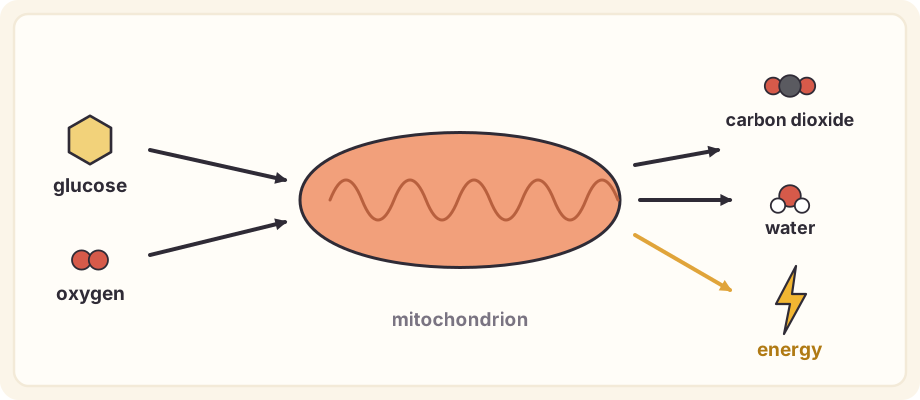
Respiration works in many small steps, not one big burst. That way the cell can catch the energy instead of losing it all as heat. It stores it in small packets of a molecule called ATP, often called the cell's "energy currency", and spends them wherever work needs doing: to make a muscle pull, to build new parts, to send a signal along a nerve.1
Where it happens
Most of respiration takes place inside the mitochondria, the tiny power stations of the cell (see Inside a Cell).2 Busy cells, like muscle cells, have a lot of them. That is why your legs need so much oxygen when you run: more work means more respiration, and more respiration needs more oxygen.
Breathing is not respiration
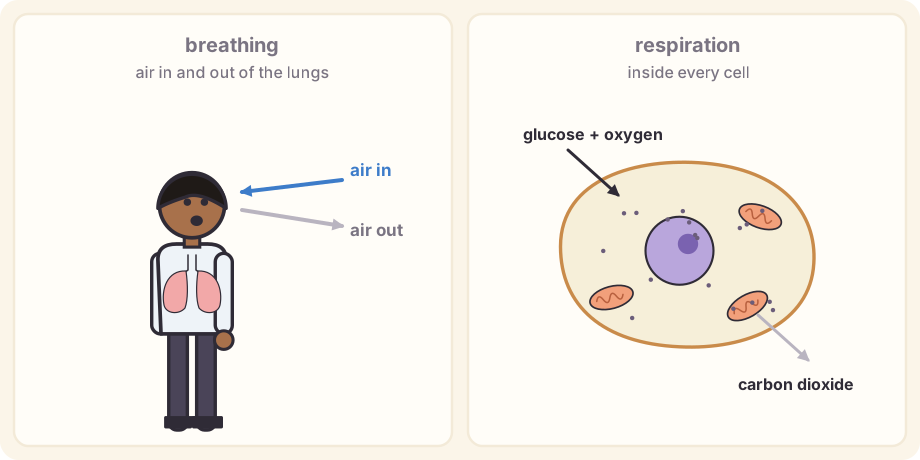
Breathing moves air in and out of your lungs. Respiration is the chemistry that happens inside every one of your cells. The two work as a team. Breathing brings in the oxygen that respiration uses, and carries away the carbon dioxide that respiration makes (see Lungs and Breathing).
Show the answer
Myth. Breathing is moving air in and out of the lungs. Respiration is releasing energy from food inside cells. A plant has no lungs and doesn't breathe, but every living cell in it respires.
Plants respire too
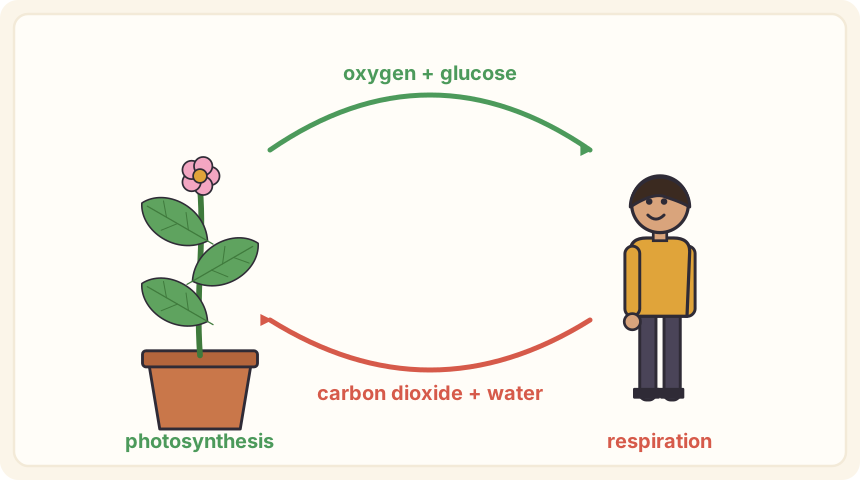
Plants make glucose by photosynthesis (see How Plants Make Food), and then they release its energy by respiration, just as you do. Photosynthesis needs light, so it stops at night. Respiration never stops: every living cell of a plant respires all the time, day and night.3 In good light a green plant makes more oxygen by photosynthesis than it uses, so overall it gives oxygen off. In the dark it only takes oxygen in.
Look at the two word sums together. What photosynthesis makes (glucose and oxygen), respiration uses. What respiration makes (carbon dioxide and water), photosynthesis uses. The two keep the gases of the air going round between living things.
Try it yourself
Sit quietly for a minute and count your breaths. Then march or jog on the spot for one minute and count again. Your muscles are doing more work, so their cells are respiring faster and need more oxygen: you breathe faster to bring it in.
Words to know
- respiration - releasing the energy stored in food, inside cells; also called cellular respiration
- oxygen - a gas in the air that cells use to release energy from food
- carbon dioxide - a gas that cells give off as waste when they release energy
- breathing - moving air in and out of the lungs
Big idea
Every living cell releases the energy in food by combining it with oxygen. Breathing only brings the oxygen in and takes the carbon dioxide out.
Sources
-
OpenStax, Biology 2e, 7.1 Energy in Living Systems (textbook, CC BY 4.0). ↩ ↩2
-
OpenStax, Concepts of Biology, 4.3 Citric Acid Cycle and Oxidative Phosphorylation (textbook, CC BY 4.0). ↩ ↩2
-
Alexandra J. Burgess, Breath of green life: Reduction in plant day and night respiration under elevated CO2 (article in Plant Physiology, 2023). ↩