How Cells Divide
You scrape your knee. A week later, new skin has closed the cut. Every human life also starts as just one cell, a fertilised egg, and ends up as a body of trillions of cells. Where do all the new cells come from?
Myth or fact? When a cell divides in two, each new cell gets half of its DNA.
New cells only come from old cells
A cell can't be built from scratch. New cells come from existing cells splitting in two, called cell division. To grow from one fertilised egg into a whole body, billions of divisions have to happen. Even after we stop growing, cells keep dividing to repair and renew the body's tissues.1
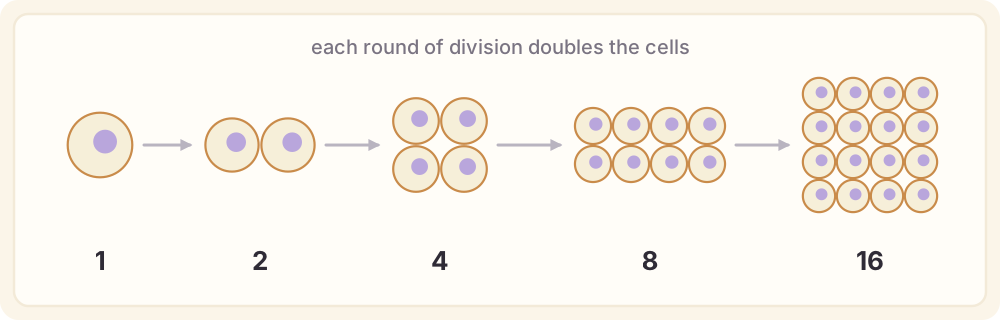
Doubling adds up fast. After four rounds, one cell becomes sixteen. After about 45 rounds of doubling, it would be about 30 trillion, roughly the number of cells in an adult body.2 (Real bodies are messier than that, since cells divide at different rates and many die and are replaced.)
Copy first, then split
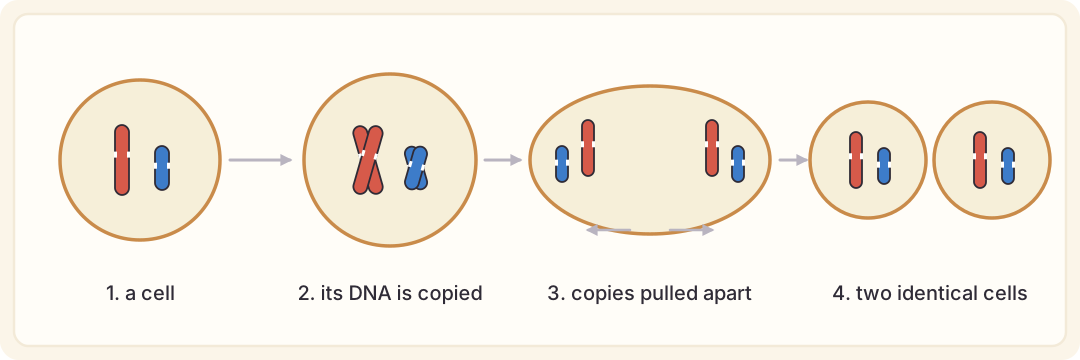
Each new cell needs a full set of instructions, so a cell copies its DNA before it divides. The two strands of each DNA molecule come apart, and each one is used as a pattern to build a new partner, using the pairing rule A with T and C with G. The result is two identical copies.3
Then comes mitosis: the copied chromosomes line up and are pulled apart, one copy of each to opposite ends of the cell. The cell then pinches in two. The result is two new cells, each with a full set of 46 chromosomes, identical to each other and to the cell they came from.4
Show the answer
Myth. Because the DNA was copied first, each new cell gets a complete set of DNA, not half. That is what makes the new skin cells in a healing cut able to do the same job as the old ones.
A different division for eggs and sperm
Your body has a second kind of cell division, called meiosis, which makes egg and sperm cells. It halves the number of chromosomes, from 46 to 23, and shuffles the genes, so that when an egg and a sperm join, the baby has 46 again, half from each parent - and is not a copy of either.5 Mitosis is for growing and repairing; meiosis is for making a new, different person.
Try it yourself
Fold a sheet of paper in half, then in half again, and keep going. Each fold doubles the layers, just as each round of division doubles the cells. Count how many folds you can make before the paper won't fold any more, and how many layers that is.
Words to know
- cell division - one cell splitting into two new cells
- mitosis - the kind of cell division that makes two identical body cells, each with a full copy of the DNA
Big idea
A cell copies all its DNA, then splits in two, so every new body cell carries the same full set of instructions.
Sources
-
OpenStax, Introduction: Cell Reproduction (Biology 2e, chapter 10). ↩
-
Ron Sender, Shai Fuchs and Ron Milo, Revised Estimates for the Number of Human and Bacteria Cells in the Body (PLoS Biology, 2016). ↩
-
OpenStax, The Cell Cycle (Biology 2e, section 10.2). ↩
-
National Human Genome Research Institute, Mitosis (Talking Glossary of Genomic and Genetic Terms). ↩
-
MedlinePlus Genetics, US National Library of Medicine, How do cells divide?. ↩