Plant and Animal Cells
Bend a fresh stick of celery and it snaps with a crunch. Forget to water a houseplant and its leaves go soft and droop. Both have to do with the cells plants are made of, and how they differ from yours.
Myth or fact? Plants have chloroplasts instead of mitochondria, so plant cells don't need mitochondria.
The same basic parts
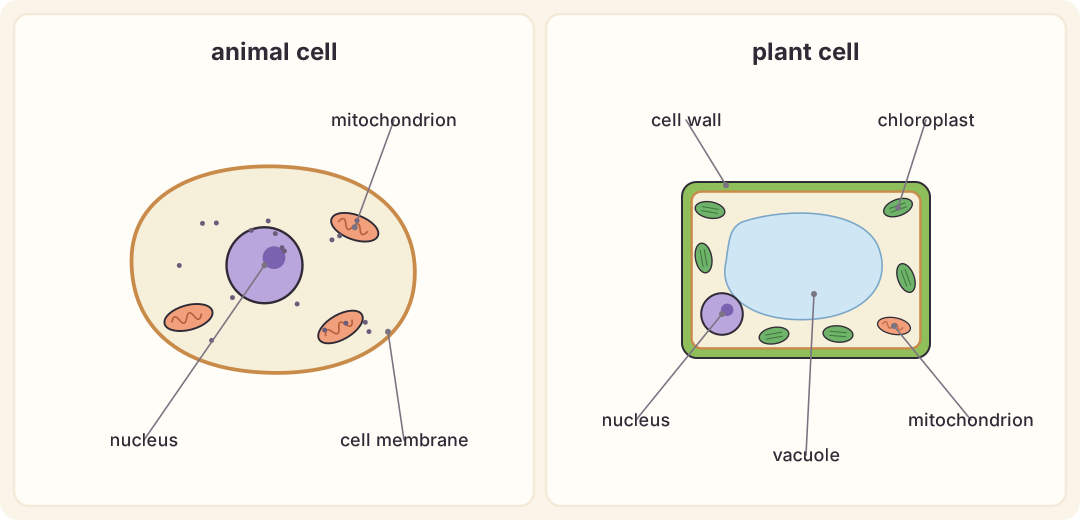
Plant cells and animal cells are built on the same plan. Both have a cell membrane around the edge, cytoplasm inside, a nucleus holding the DNA, mitochondria releasing energy and ribosomes building proteins. (These parts are explained in Inside a Cell.)
Three extras in plant cells
A plant cell has three parts that animal cells don't:1
- A cell wall. Outside the membrane is a stiff wall made mostly of cellulose, a tough material built from sugar. It protects the cell and gives it its shape. Walls are why plant cells look like boxes, and why celery crunches.
- Chloroplasts. These small green parts catch light and use it to make food: sugar, made from water and carbon dioxide, a gas in the air. This is photosynthesis, and it has its own lesson, How Plants Make Food. The green colour of leaves comes from them. Not every plant cell has them: a root cell, underground in the dark, has none.
- A large vacuole. Most of a plant cell is taken up by one big bag of watery liquid, the vacuole. When it is full it presses out against the wall and keeps the cell firm. When a plant is short of water, the vacuoles lose water and the plant wilts.1
Show the answer
Myth. Plant cells have both. Chloroplasts make food from light; mitochondria release the energy stored in that food, day and night, just as they do in your cells.
Here is what real plant cells look like. These come from the leaf of a small pond plant, magnified about 400 times through a school microscope. You can see the walls as dark lines between the cells, and the green chloroplasts inside them.
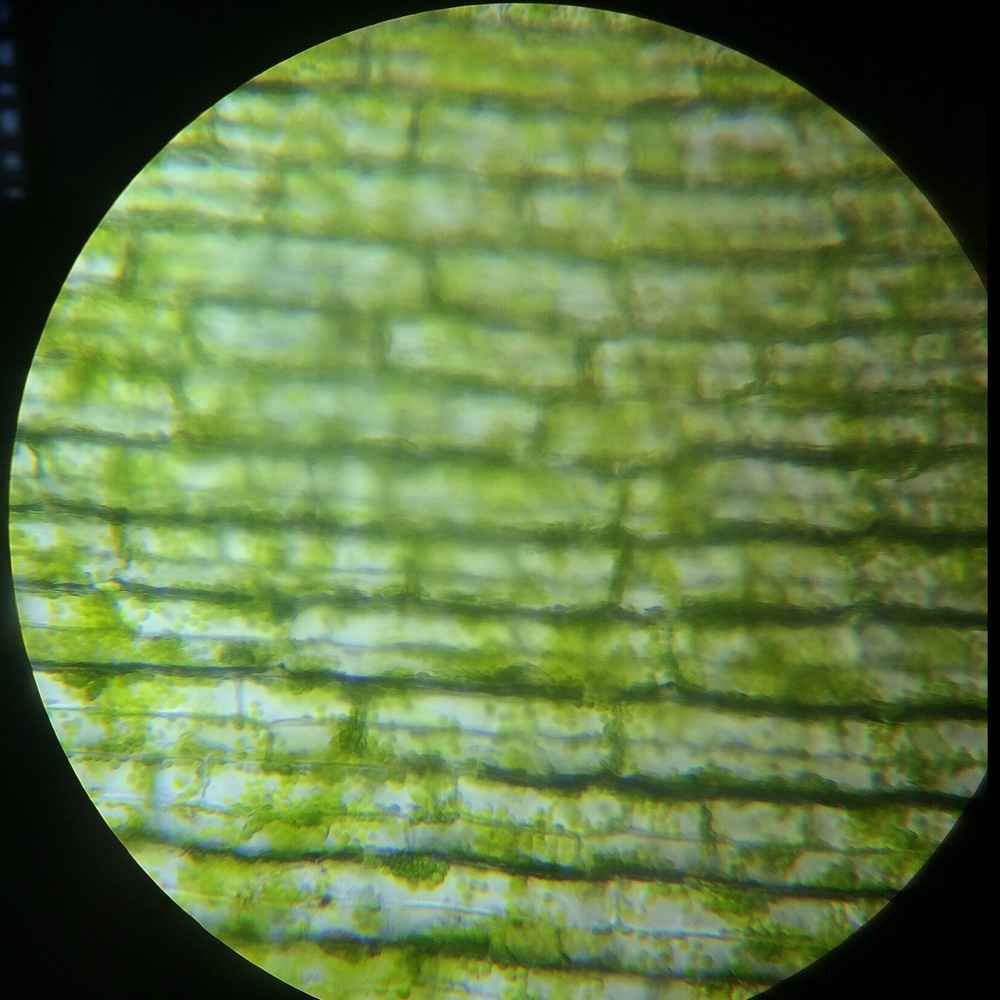
Leaf cells of the pond plant Elodea (anacharis), about 400 times bigger than life. Photo by Lilyviolet, CC BY 4.0, via Wikimedia Commons; cropped.

Bacteria: no nucleus at all
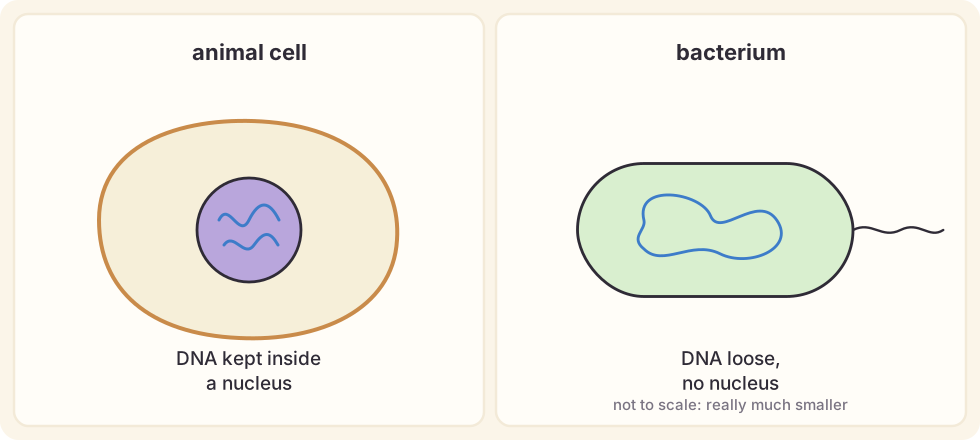
Bacteria are a different kind of cell. A bacterium has a membrane, cytoplasm and ribosomes, and most have a wall too, but it has no nucleus: its DNA lies loose in the cytoplasm. Bacteria are also much smaller, about 0.1 to 5 micrometres across (a micrometre is a thousandth of a millimetre), while plant and animal cells are usually 10 to 100.2 Scientists call cells without a nucleus prokaryotes, and cells with one, like ours and a plant's, eukaryotes.
Try it yourself
Take two sticks of celery: stand one in a glass of water and leave the other on the table overnight. The next day, bend each one. The one in water is firm and snaps; the dry one is soft and bends. You are feeling full and empty vacuoles.
Words to know
- cell wall - a stiff layer outside the membrane of a plant cell, made mostly of cellulose
- chloroplast - a green part of a plant cell that uses light to make food
- vacuole - a large bag of watery liquid that keeps a plant cell firm
- prokaryote - a cell with no nucleus, like a bacterium
Big idea
Plant and animal cells share the same basic parts, but plant cells add a wall, chloroplasts and a big vacuole, and bacteria have no nucleus at all.
Sources
-
OpenStax, Biology 2e, 4.3 Eukaryotic Cells (textbook, 2018). ↩ ↩2
-
OpenStax, Biology 2e, 4.2 Prokaryotic Cells (textbook, 2018). ↩