Brain and Nerves
You touch the handle of a pan that has been on the stove. Before you even think "hot!", your hand has already jumped away. Only a moment later does it start to hurt. How did your hand move before you knew why?
Myth or fact? We use only 10% of our brain.
A network of messengers
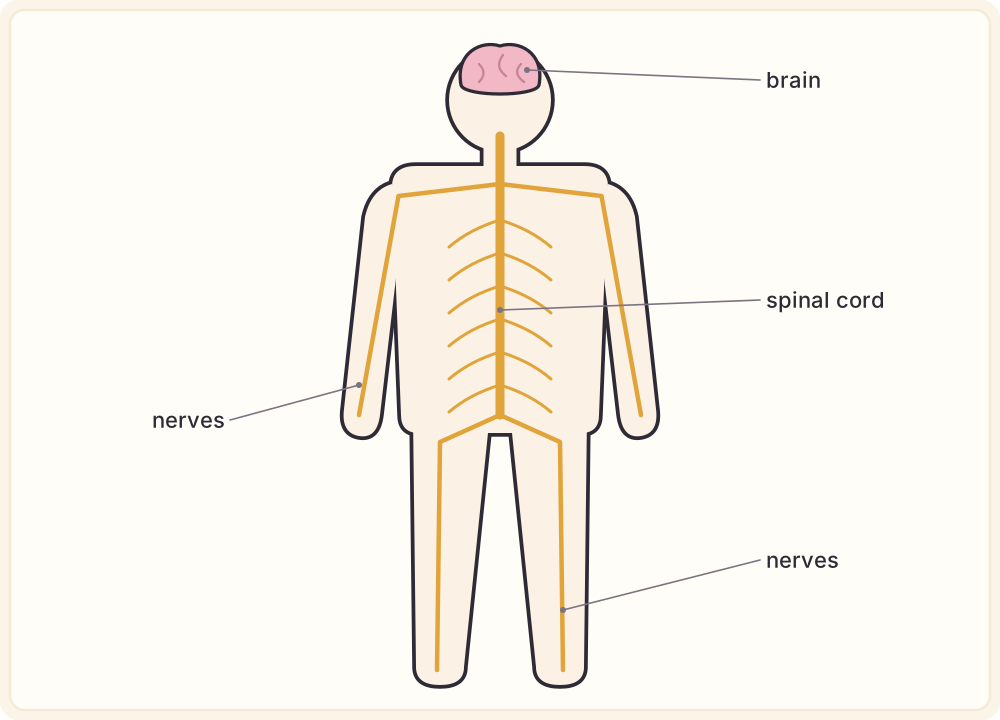
Your nervous system is your body's message network. It does three things: it senses what is happening, inside you and around you; it works out what that means; and it sends orders to muscles and organs.1 It has two parts:1
- The brain and spinal cord - the control centre. The spinal cord runs down the inside of your backbone.
- Nerves - cables that run from the spinal cord and brain to every part of the body. Some carry messages in from the senses; others carry orders out to the muscles.2
Neurons: cells that carry messages
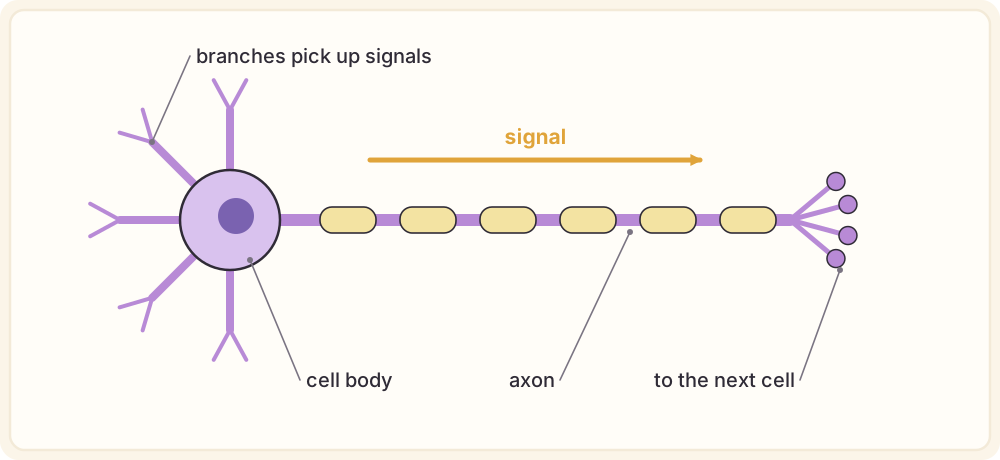
The messages are carried by special cells called neurons (nerve cells). A neuron has short branches that pick up signals from other cells, and one long thread, the axon, that passes the signal on to the next cell.3 The signal is electrical, and it travels very fast. A human brain has about 86 billion neurons.34
Show the answer
Myth. Neuroscientists say it plainly: we use all of our brain.5 Different parts are busy at different moments, as the next section shows, but there is no unused 90% waiting to be switched on.
Different parts, different jobs
Different parts of the brain do different jobs. The big wrinkled part on top handles thinking, language and the senses. At the back, the cerebellum keeps your balance and smooths your movements. At the bottom, where the brain meets the spinal cord, the medulla runs things you never think about: your breathing and your heartbeat.2
Reflexes: the shortcut
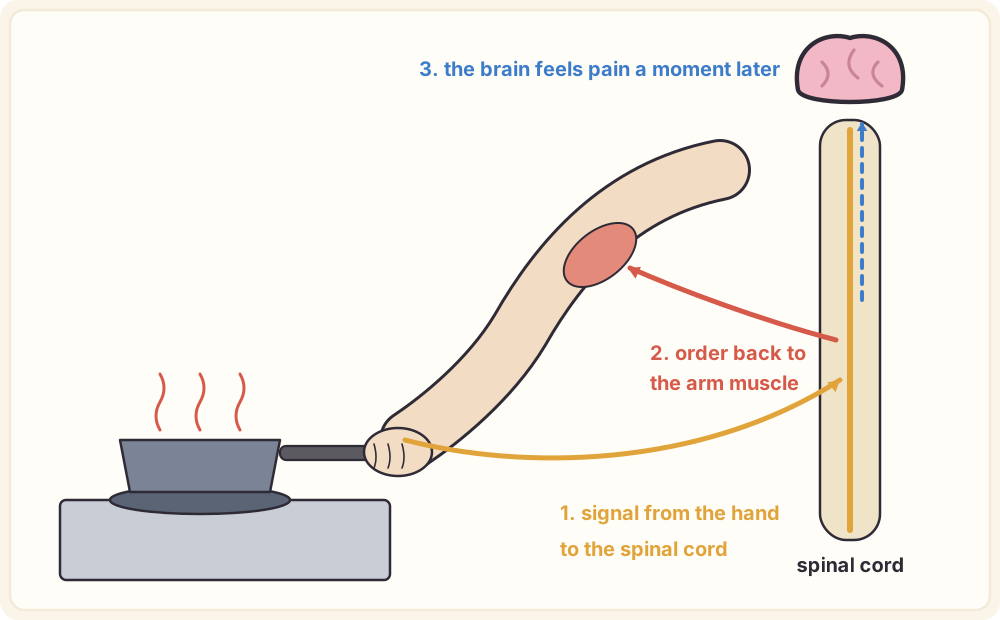
Back to the hot pan. Your skin sends a signal along a nerve to your spinal cord, and the spinal cord sends an order straight back to a muscle in your arm, which pulls your hand away.6 The message doesn't have to travel up to the brain and wait for a decision first. A fast, automatic reaction like this is a reflex.2 The brain hears about it a moment later, and that is when you feel the pain and say "ouch".
Try it yourself
Ask a friend to hold a ruler hanging just above your open fingers, then drop it without warning. Catch it as fast as you can. The lower down you catch it, the slower you were. That catch needs your brain to decide, so it is slower than a reflex.
Words to know
- nervous system - the brain, spinal cord and nerves, which carry messages around the body
- spinal cord - the thick bundle of nerve tissue inside your backbone
- nerve - a cable of nerve fibres carrying messages between the body and the spinal cord or brain
- neuron - a nerve cell, which carries electrical signals
- reflex - a fast, automatic reaction that doesn't wait for the brain to decide
Big idea
Neurons carry messages between your body and your brain and spinal cord, and for some dangers the spinal cord answers on its own, in a reflex.
Sources
-
OpenStax, Anatomy and Physiology 2e, 12.1 Basic Structure and Function of the Nervous System (textbook, CC BY). ↩ ↩2
-
OpenStax, Psychology 2e, 3.4 The Brain and Spinal Cord (textbook, CC BY). ↩ ↩2 ↩3
-
OpenStax, Biology 2e, 35.1 Neurons and Glial Cells (textbook, CC BY). ↩ ↩2
-
F. Azevedo and others, Equal numbers of neuronal and nonneuronal cells make the human brain an isometrically scaled-up primate brain (Journal of Comparative Neurology, 2009). ↩
-
BrainFacts.org (Society for Neuroscience), Debunked: The 10 Percent Brain Myth. ↩
-
OpenStax, Anatomy and Physiology 2e, Chapter 14 Introduction (textbook, CC BY). ↩