What Is a Species?
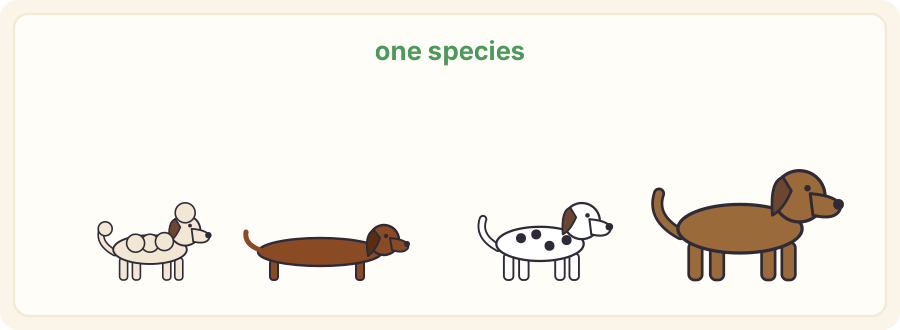
A tiny poodle and a huge shepherd dog look very different. A horse and a donkey look quite alike. Yet the two dogs belong to one species and the horse and donkey to two. What makes a species?
Myth or fact? Living things that look alike are the same species.
One kind of living thing
A species is one kind of living thing. The usual test in biology is breeding: a species is a group of living things that can breed together and have young that can themselves grow up and have young.1
All dogs pass the test. A poodle and a shepherd dog can have puppies, and those puppies can grow up and have puppies of their own. However different they look, all dogs are one species.
When the young can't have young
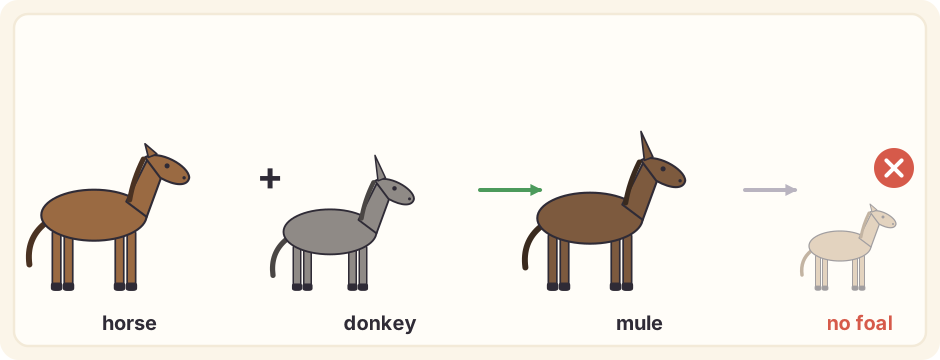
A horse and a donkey can have a baby together: a mule. Mules are strong, healthy animals, but they almost never have young of their own.2 So horses and donkeys fail the test: they are two separate species.
Show the answer
Myth. Looks can fool you. Dogs of very different shapes are one species, because they can breed and have young that breed too. Some birds look almost the same and are still separate species, because they don't have young that can breed together.1
A name in two words
Every species has a scientific name in two words, a system Carl Linnaeus made popular in the 1750s.3 The first word names a small group of close relatives, the genus. The second, together with the first, names the species. The name is written in italics, the genus with a capital letter:
- People are Homo sapiens - genus Homo, "wise human".
- The leopard is Panthera pardus. The lion, its close relative, is Panthera leo.
The same name is used everywhere, in every language. A leopard is "palang" in Persian and "Leopard" in German, but scientists in Tehran and in Berlin both write Panthera pardus. The leopards of Iran's mountains are one subspecies, a group inside a species that lives in one region and looks a little different: the Persian leopard, Panthera pardus tulliana.4
How many species?
Nobody knows. A study in 2011 estimated about 8.7 million species of animals, plants, fungi and other living things whose cells have a nucleus (bacteria not included). Its authors thought that about 86% of them have not yet been found and named.5
Careful
That number is an estimate, and other scientists have made very different ones. The honest answer is that most species on Earth have probably not been named yet.
Try it yourself
Find the scientific name of a plant or animal you see every day: a sparrow, a pigeon, a cat, a pomegranate tree. What does the first word tell you about its relatives?
Words to know
- species - a group of living things that can breed together and have young that can also breed
- scientific name - the two-word name of a species, such as Homo sapiens
- subspecies - a group inside a species that lives in one region and looks a little different
Big idea
A species is a group that can breed together and have young that breed too, and each species has one two-word scientific name used all over the world.
Sources
-
Mary Ann Clark, Matthew Douglas and Jung Choi, Formation of New Species (Biology 2e, OpenStax, section 18.2). ↩ ↩2
-
eXtension Horses, Is there a chance that a mule may reproduce if bred? (US university extension service). ↩
-
University of California Museum of Paleontology, Carl Linnaeus. ↩
-
IUCN SSC Cat Specialist Group, Persian leopard. ↩
-
Camilo Mora and others, How Many Species Are There on Earth and in the Ocean? (PLOS Biology, 2011). ↩