The Tree of Life
You and your cousins share grandparents. Go further back, and you share great-great-grandparents with people you have never met. What if you could keep going back - thousands, millions, billions of years? Who would you share ancestors with then?
Myth or fact? Humans evolved from chimpanzees.
Darwin's sketch
In 1837, soon after his voyage around the world, Charles Darwin was filling notebooks with ideas about how species change. On one page he wrote "I think" and drew a small branching tree.1 Each branch stood for a species. Where two branches meet is the species they both came from.
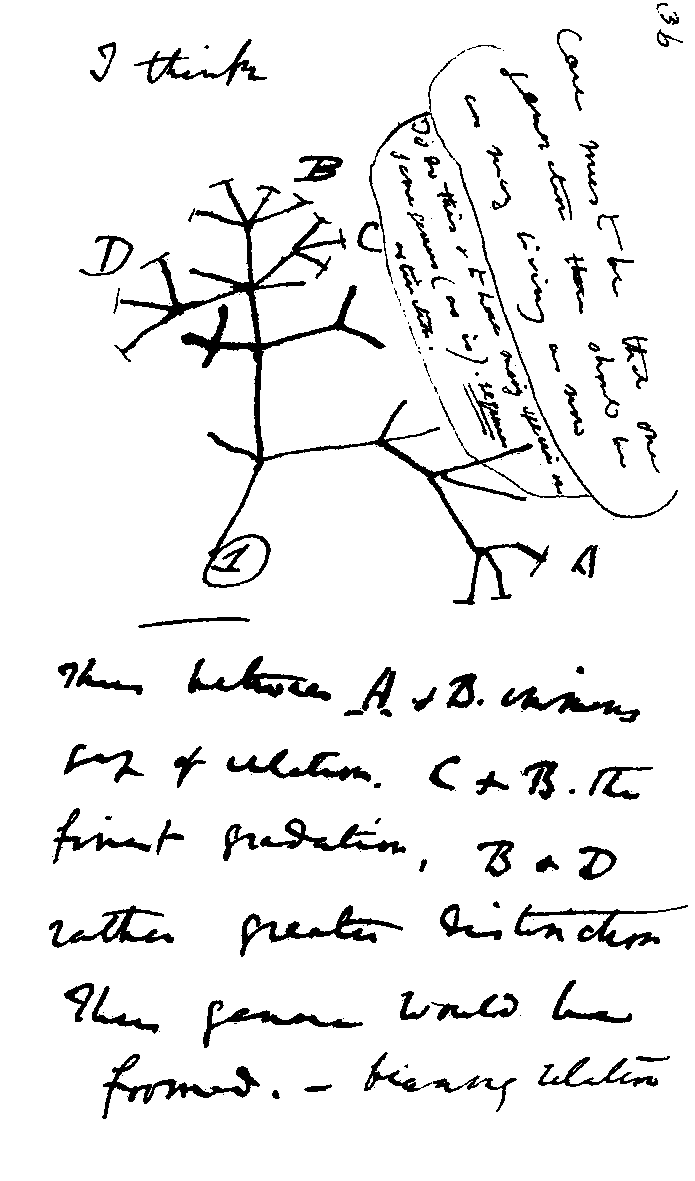
Charles Darwin's "I think" sketch, Notebook B (1837). Public domain, via Wikimedia Commons.

The idea is called common ancestry: all living things are related, because they come from shared ancestors. A common ancestor is a species from which two or more later species came. Over many generations, natural selection and other changes made the branches of one ancestor grow apart into different species.
The tree of all life
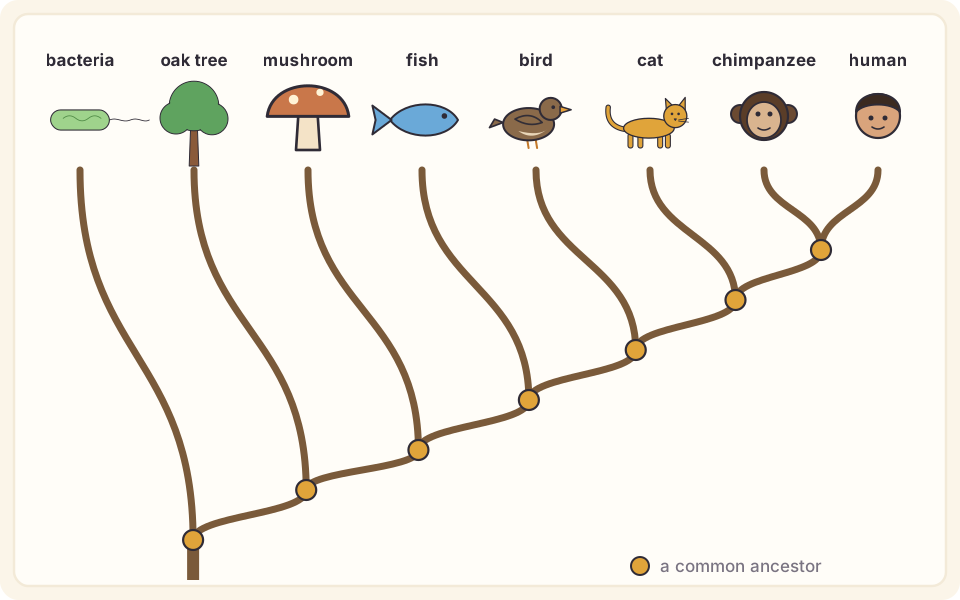
Biologists now draw one great tree of life. Its tips are the species alive today, and its branch points are their common ancestors. Close branches, like lions and leopards, split recently. Distant ones, like people and mushrooms, split very long ago - but they still meet somewhere further down the trunk.
Show the answer
Myth. Humans did not come from chimpanzees, which are still here today. Humans and chimpanzees are cousins: DNA shows that both come from a common ancestor species that lived between about 8 and 6 million years ago.2 Since then, each branch has changed in its own way.
How we know
Three kinds of evidence point the same way.
- Fossils show living things changing over time, layer by layer (see Reading the Fossils).
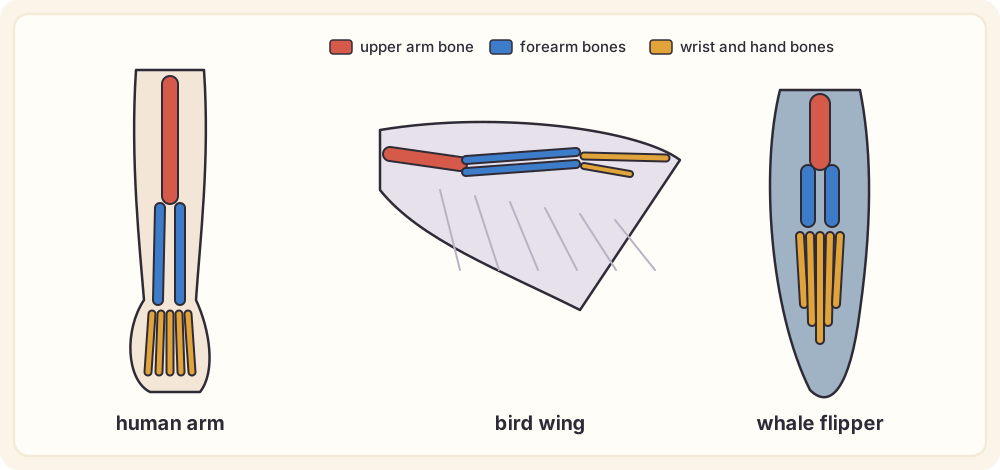
- Shared body plans. The arm of a person, the leg of a dog, the wing of a bird and the flipper of a whale have the same set of bones, just changed in size and shape. They make sense as copies of one ancestor's limb.3
- DNA. All living things use DNA, the chemical code of genes, and read it in almost the same way. That is evidence of one common ancestor for all of life.3 The more closely two species are related, the more alike their DNA is.
Try it yourself
Feel the bones in your own arm: one in the upper arm, two in the forearm, many small ones in the wrist and hand. Next time you eat chicken wings, look at the bones and find the same pattern.
Words to know
- common ancestry - the idea that all living things are related through shared ancestors
- common ancestor - a species from which two or more later species came
- tree of life - a branching diagram of how all species are related
Big idea
All life is one family tree: every two species, however different, share a common ancestor somewhere in the past.
Sources
-
Darwin Correspondence Project, Darwin's species notebooks: 'I think . . .' (University of Cambridge). ↩
-
Smithsonian National Museum of Natural History, Genetics (Human Origins). ↩
-
OpenStax, Biology 2e, 18.1 Understanding Evolution (textbook, 2018). ↩ ↩2