Digestion
You eat a piece of bread with cheese. A few hours later, some of it is fuelling the muscles of your legs and building new skin on your fingers. But your fingers are not made of bread. What happened to it on the way?
Myth or fact? Most of the work of digesting food is done in the stomach.
Breaking food down
Food is made of big, complicated pieces: starch, proteins and fats (see nutrients). They are far too big to get into your blood. Digestion is breaking them down into small, simple pieces that can. It happens in two ways:
- By squashing and mixing - your teeth chew, and the muscular stomach churns food into a soupy mix.
- By chemicals - digestive juices contain enzymes, helpers that cut big food pieces into small ones. Saliva in your mouth already starts breaking down starch.1
The journey
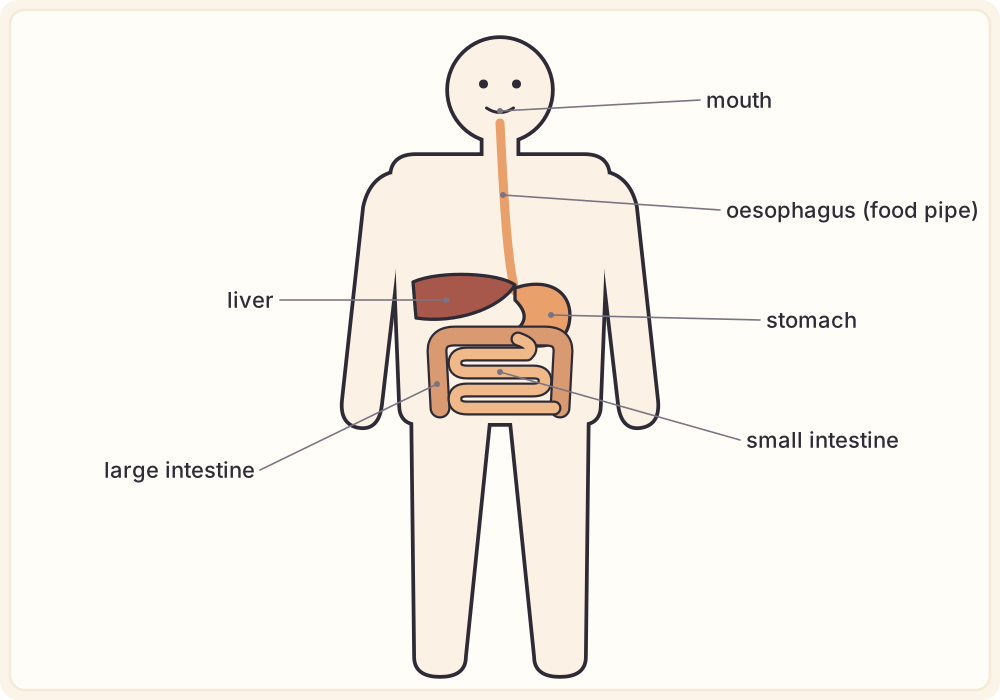
The digestive system is one long tube with helpers along the side. A bite of food passes through it in this order:1
- Mouth - teeth chew, saliva wets the food and starts digesting starch.
- Oesophagus (food pipe) - muscles squeeze the food down to the stomach.
- Stomach - makes acid and enzymes and churns the food.
- Small intestine - finishes digestion, with juices from the liver and pancreas, and takes the small pieces into the blood.
- Large intestine - takes back water, and turns what is left into waste (stool) that leaves the body.
The small intestine: where food gets in
The small intestine is "small" only in width. In an adult it is over 6 metres long, about as long as a bus.23 It does most of the digesting.
Show the answer
Myth. The stomach starts digesting protein and mixes everything, but the small intestine does most of the digesting, and almost all the taking in. That is where the food finally gets into your body.
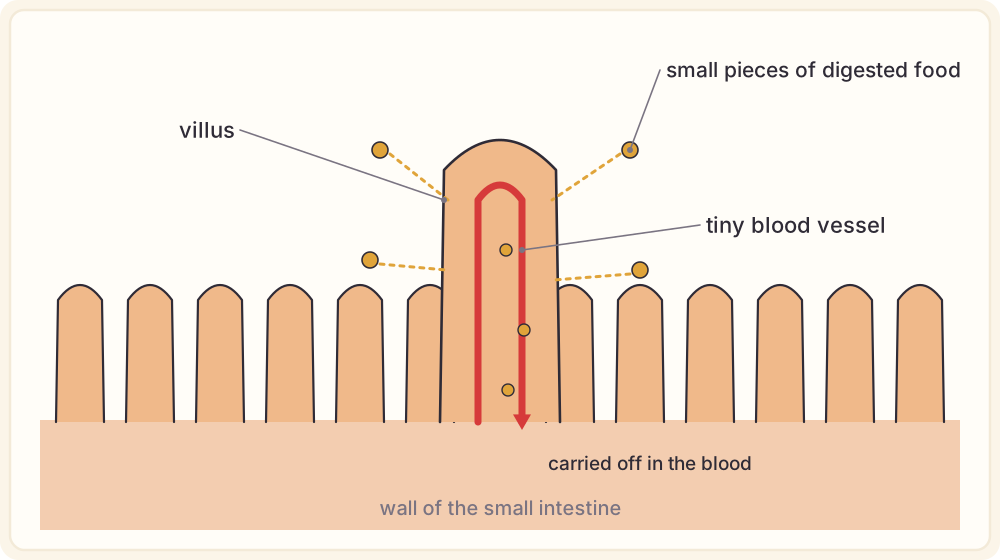
Its inside wall is covered in folds, and the folds are covered in tiny finger-shaped bumps called villi. They give the wall a huge surface. Small pieces of food pass through the thin wall of each villus into tiny blood vessels inside it, and the blood carries them all over the body.2 This is absorption.
Try it yourself
Chew a small piece of plain bread for a full minute without swallowing. Does it start to taste a little sweet? An enzyme in your saliva is cutting starch into sugar.
Words to know
- digestion - breaking food down into pieces small enough to get into the blood
- oesophagus - the food pipe from the mouth to the stomach
- small intestine - the long tube where most food is digested and taken into the blood
- villi - tiny finger-shaped bumps on the small intestine's wall
- absorption - small pieces of food passing through the gut wall into the blood
Big idea
Digestion breaks food into pieces small enough to get through the wall of the small intestine and into your blood.
Sources
-
National Institute of Diabetes and Digestive and Kidney Diseases (NIDDK), Your Digestive System & How It Works. ↩ ↩2
-
OpenStax, Biology 2e, 34.1 Digestive Systems (textbook, CC BY). ↩ ↩2
-
MedlinePlus (US National Library of Medicine), Small Intestine Disorders. ↩