Sorting Life
A supermarket puts thousands of products into aisles, the aisles into shelves, the shelves into rows, so you can find the yoghurt. Biologists face a much bigger job: about two million kinds of living things have been named so far. How do you sort them all?
Groups inside groups
Sorting living things into groups is called classification. The idea most biologists still use comes from a Swedish doctor and botanist, Carl Linnaeus. In 1735 he published Systema Naturae ("The System of Nature"), which put living things into groups inside bigger groups.1
Today the groups, from biggest to smallest, are: domain, kingdom, phylum, class, order, family, genus and species. Each group holds living things that share more features than the group above it. Here is the leopard, which lives in the mountains of Iran among many other places:2
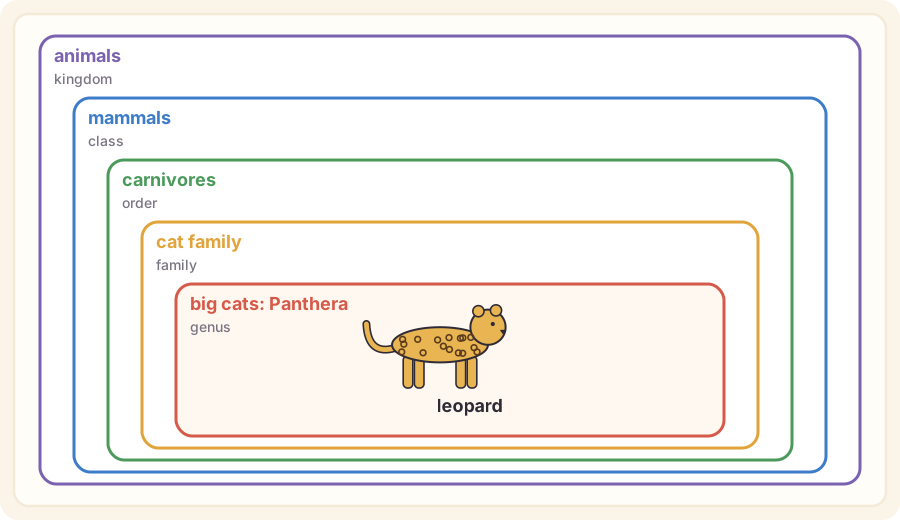
The deeper two living things share a group, the more closely related they are. A leopard and a lion share the smallest group but one, the big cats. A leopard and a house cat share only the cat family.
The three domains
Linnaeus sorted all life into plants and animals. Microscopes later showed many more kinds of tiny living things, and the groups changed. In 1990, the American biologist Carl Woese and two colleagues proposed a new top level, the domain, based on comparing the chemical instructions inside cells. Life, they said, falls into three domains:3
- Bacteria - tiny single cells, found almost everywhere.
- Archaea - also tiny single cells; they look like bacteria but are very different inside. Many live in hot springs or salty lakes.
- Eukarya - everything whose cells have a control centre, a nucleus, inside them: animals, plants, fungi and many single-celled living things.
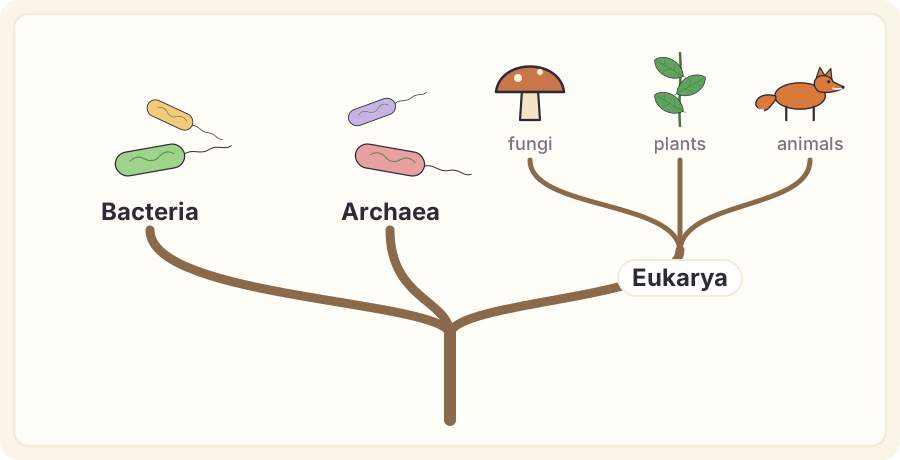
So you, an oak tree and a mushroom are all in the same domain, Eukarya, but in different kingdoms.
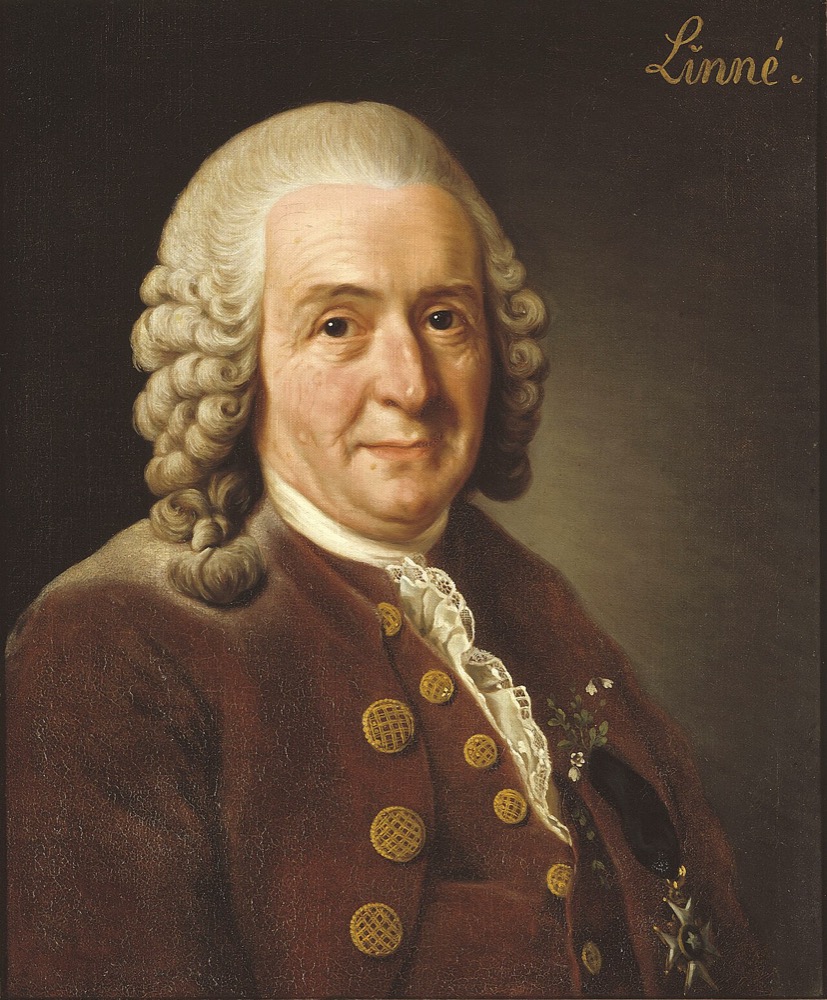
Carl Linnaeus, painted by Alexander Roslin in 1775. Public domain, via Wikimedia Commons.

A growing list
The Catalogue of Life, a list kept by hundreds of experts, counts over two million species named so far, and tens of thousands are added every year.4 The next lesson, What Is a Species?, looks at the smallest group of all.
Try it yourself
Take ten things from a kitchen drawer or a toy box and sort them into groups, then split each group into smaller groups. Did someone else in your home sort them the same way? Biologists had to agree on rules for the same reason.
Words to know
- classification - sorting living things into groups inside bigger groups
- domain - the biggest group of all; there are three: Bacteria, Archaea and Eukarya
- kingdom - a big group inside a domain, such as animals, plants or fungi
- species - the smallest main group: one kind of living thing
Big idea
Biologists sort living things into groups inside groups, and the more groups two living things share, the more closely related they are.
Sources
-
University of California Museum of Paleontology, Carl Linnaeus. ↩
-
Mary Ann Clark, Matthew Douglas and Jung Choi, Organizing Life on Earth (Biology 2e, OpenStax, section 20.1). ↩
-
Carl Woese, Otto Kandler and Mark Wheelis, Towards a natural system of organisms: proposal for the domains Archaea, Bacteria, and Eucarya (PNAS, 1990). ↩
-
Catalogue of Life, Annual release 2025 (2025). ↩