Mendel's Peas
Sometimes a child has a trait that neither parent shows: red hair in a family of dark-haired parents, say, just like a great-grandfather's. Where was it hiding? The first person to explain this with careful counting was a monk who grew peas.
A monk with a garden
Gregor Mendel (1822-1884) was a monk at the Abbey of St Thomas in Brno, a city now in the Czech Republic. Starting in 1856, he spent about ten years crossing pea plants in the abbey garden.1
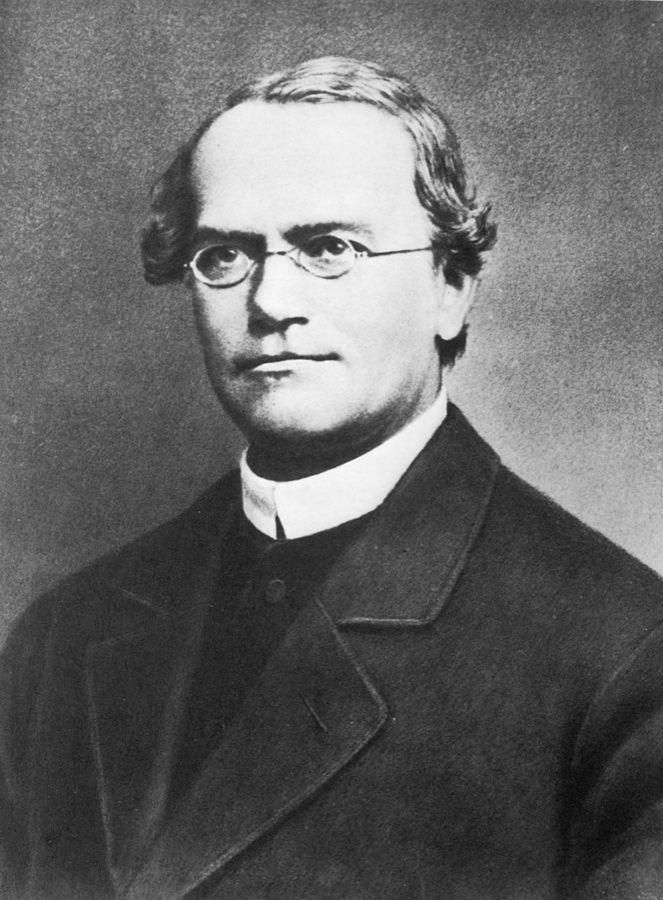
Gregor Mendel, photographed in about 1862. Public domain, via Wikimedia Commons.

Peas were a clever choice. They grow to full size in one season, they can be grown in large numbers, and a pea flower normally pollinates itself, so Mendel could keep "pure" lines that always gave the same trait. He followed seven traits, each with two clear forms, such as flower colour (violet or white), seed shape and plant height. Altogether he studied nearly 30,000 plants.1
A trait that hides and comes back
Mendel crossed pure violet-flowered plants with pure white-flowered ones. Every one of their young had violet flowers. The white seemed to have vanished.
Then he let these violet young pollinate themselves. In the next generation, white flowers came back: he counted 705 violet plants and 224 white ones - about 3 violet for every 1 white.1 He found the same 3 to 1 pattern for all seven traits.
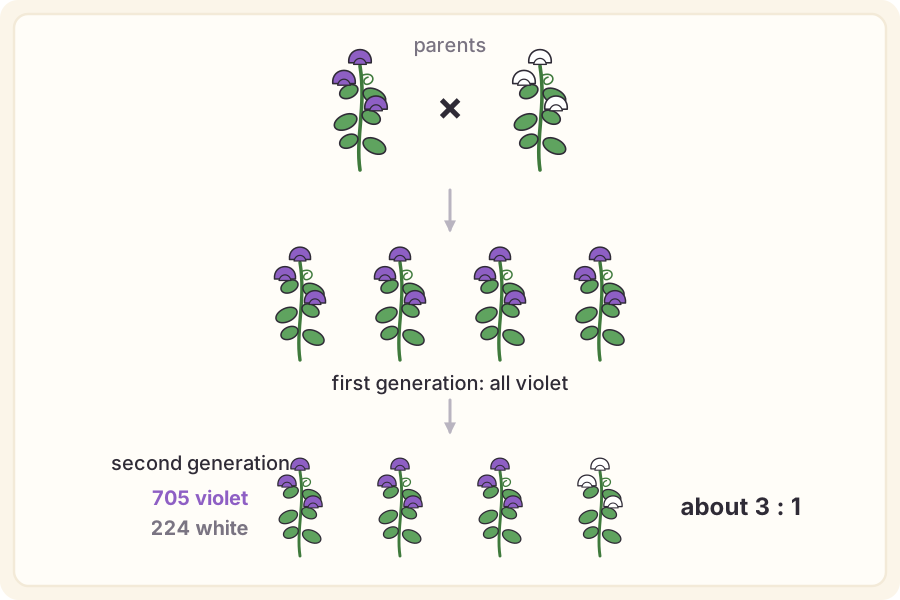
Mendel's explanation: each plant carries two copies of the instruction for a trait, one from each parent, and passes on just one of them to each young plant. Today we call these instructions genes, and the different versions of a gene alleles. When a plant has one violet version and one white, the violet one shows. Violet is dominant; white is recessive - hidden, but still there, and passed on.2
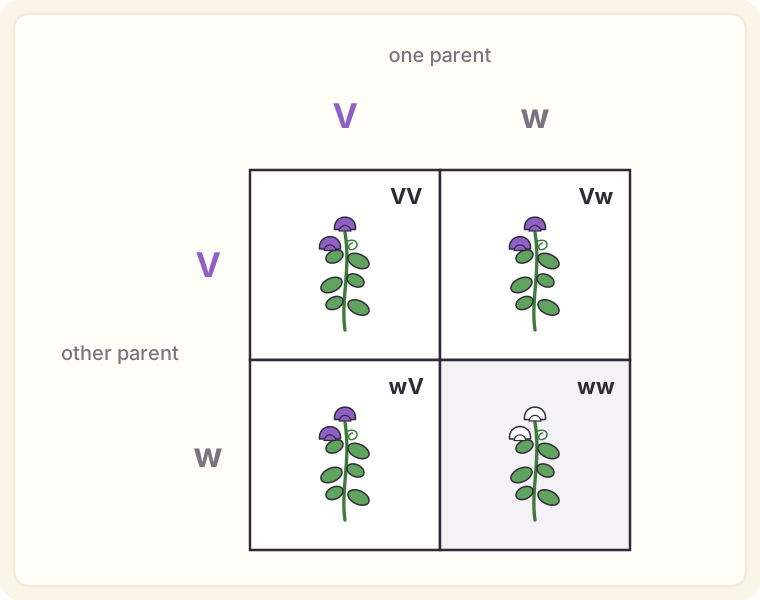
A white flower only shows when a plant gets the white version from both parents: one chance in four. That is the 3 to 1.
Mendel presented his results in 1865 and published them in 1866. Hardly anyone noticed. Only in 1900, sixteen years after his death, did other scientists rediscover his work and see how important it was.1
Myth or fact? A dominant trait is always the most common one.
Show the answer
Myth. "Dominant" only says which version shows when a living thing has one of each. It says nothing about how common it is. Having extra fingers or toes, for example, is usually a dominant trait, yet it is rare.3
Try it yourself
Take two coins. Each coin is a parent with one violet version (heads) and one white version (tails). Toss both together 40 times and count: how often do you get two tails, the "white flower"? You should get roughly 10 - about one in four.
Words to know
- allele - one version of a gene, such as the violet or white version of the flower-colour gene
- dominant - a version of a gene that shows its effect even when there is only one copy
- recessive - a version of a gene that is hidden when a dominant one is there, and shows only when there are two copies
Big idea
Every living thing carries two versions of each gene and passes on one, so a recessive trait can hide for a generation and come back.
Sources
-
OpenStax, Mendel's Experiments and the Laws of Probability (Biology 2e, section 12.1). ↩ ↩2 ↩3 ↩4
-
National Human Genome Research Institute, Dominant (Talking Glossary of Genomic and Genetic Terms). ↩
-
Alisa Lehman, The Tech Interactive, Is having 5 fingers a dominant trait? (Ask a Geneticist, 2012). ↩