Biodiversity
In a market in Iran you can find dozens of kinds of rice, from long, fragrant grains to short, sticky ones, and pomegranates from sour to sweet. Out in the hills, oak forest gives way to desert, and the desert to salt lakes. All of that variety - in the rice, in the living things, in the places - has one name.
Myth or fact? Species have always gone extinct, so losing species today is nothing unusual.
Variety at three levels
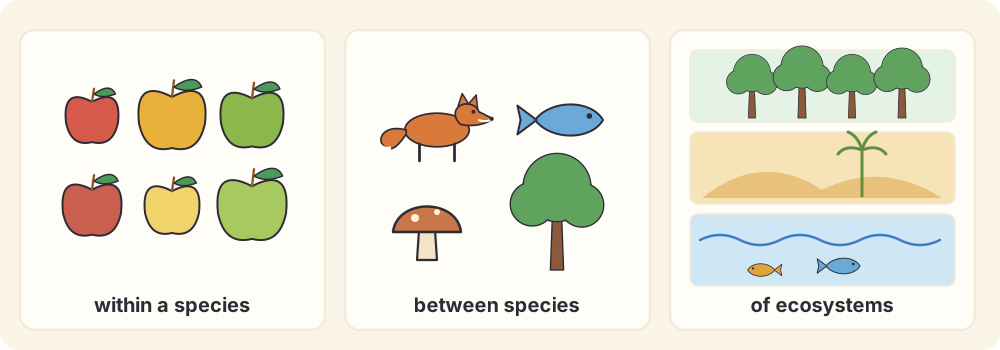
Biodiversity is short for biological diversity: the variety of life. The international treaty that protects it, the Convention on Biological Diversity, describes it at three levels: diversity within species, between species, and of ecosystems.1
- Within a species (a species is one kind of living thing whose members can breed together): no two rice plants, sheep or people carry exactly the same genes, the instructions passed from parents to young. That variety is what lets farmers breed new kinds of crops, and what lets a species cope when its world changes.
- Between species: lions, oak trees, mushrooms, bacteria - the millions of different kinds of living things.
- Of ecosystems: forests, deserts, coral reefs, rivers, grasslands, each with its own community of life.
Some places are especially rich. The Hyrcanian forests along Iran's Caspian coast hold about 44% of the vascular plants known in Iran (plants with tubes that carry water, which is nearly all of them except mosses), and they are the home of the Persian leopard.2
Why it matters
People depend on biodiversity every day. More than three-quarters of the world's kinds of food crops depend, at least partly, on animals such as bees to carry pollen from flower to flower. About 4 billion people rely mainly on natural medicines, and about 70% of cancer drugs are natural or inspired by nature.3 Varied ecosystems also clean water, make soil and store carbon.
Shrinking fast
In 2019, 145 experts from 50 countries reviewed the state of the world's nature for IPBES, the United Nations' science panel on biodiversity. They found that around 1 million kinds of animals and plants are threatened with extinction - dying out completely - many within decades. About three-quarters of the land has been changed a lot by people, and the average number of wild animals and plants of the native kinds in most land habitats has fallen by at least 20%, mostly since 1900.3
Show the answer
Myth. Species have always died out, but the experts found that the rate today is at least tens to hundreds of times higher than the average over the last 10 million years, and it is speeding up.3
They ranked the five biggest direct causes, from the largest:3
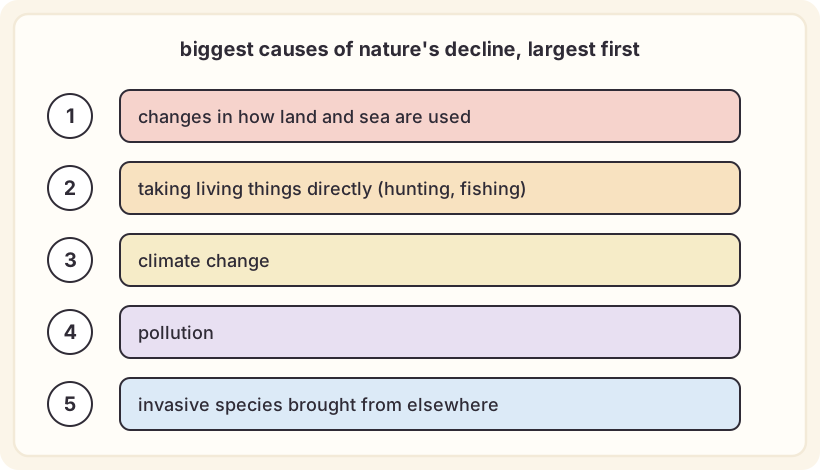
The experts also said it is not too late to make a difference - but only with big changes in how people farm, fish, build and use land, from local to global.3
Try it yourself
Count the different kinds of plants within ten steps of your front door: trees, grasses, weeds in cracks, plants in pots. You don't need their names - just count kinds that look different. Do the same in a park. Which place is more diverse?
Words to know
- biodiversity - the variety of life: within species, between species and of ecosystems
- extinction - when every last member of a species has died, so it is gone for ever
Big idea
Life's variety - in genes, in species, in ecosystems - feeds and heals us, and it is being lost faster than at any time in millions of years.
Sources
-
Convention on Biological Diversity, Article 2. Use of Terms (treaty text, 1992). ↩
-
IUCN World Heritage Outlook, Hyrcanian Forests (site assessment). ↩
-
IPBES, Nature's Dangerous Decline "Unprecedented"; Species Extinction Rates "Accelerating" (media release on the Global Assessment, 2019). ↩ ↩2 ↩3 ↩4 ↩5