Food Chains and Webs
A sparrow pecks at seeds on the ground. A cat watches it from a wall. The seeds grew on a plant that stood in the sun all summer. Follow that line backwards and every meal, the cat's included, starts with sunlight. How does the Sun's energy travel from a plant to a cat?
Who eats whom
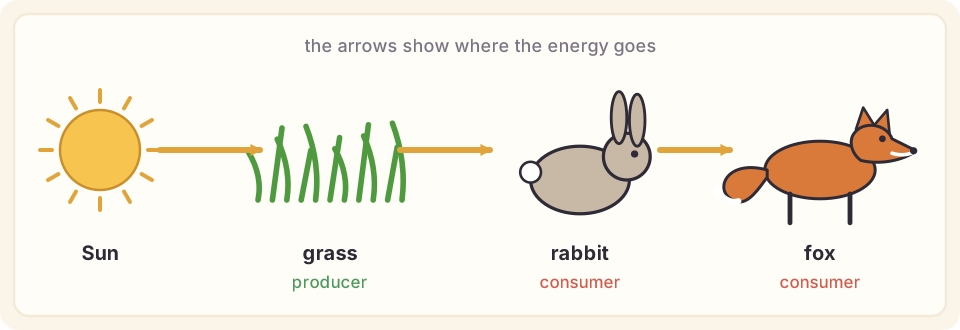
Plants, algae and some bacteria make their own food from light, carbon dioxide and water: photosynthesis. They are the producers, the base of almost every ecosystem. Everything else is a consumer: it gets its energy by eating other living things. A rabbit eats grass (a plant-eater, or herbivore); a fox eats the rabbit (a meat-eater, or carnivore); a person who eats both rice and chicken is an omnivore.1
A food chain is one line of who-eats-whom, from a producer upwards.2 The arrows point the way the energy goes: from the eaten to the eater.
Why chains are short
At every step most of the energy is lost. A rabbit uses most of what it eats to move, keep warm and stay alive; some passes out in its droppings and escapes as heat. On average only about 10% of the energy at one level passes on to the next.1 Real ecosystems vary (about 14% at the first step in one Florida river), but it is always small.3
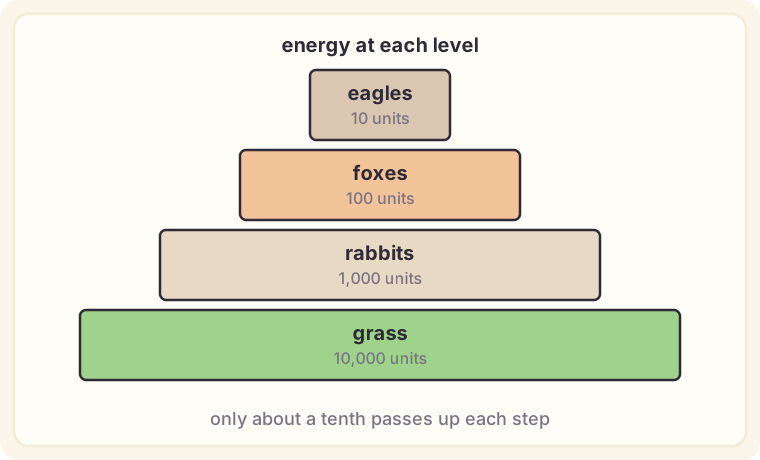
That is why there is far more grass than rabbits, and far more rabbits than foxes, and why food chains rarely go beyond four to six steps: after that there isn't enough energy left to feed another level.3
Webs, not chains
Real animals rarely eat just one thing. A fox eats rabbits, mice, beetles and fruit; a hawk eats mice and small birds. Draw every link in a place and the chains cross into a food web.2
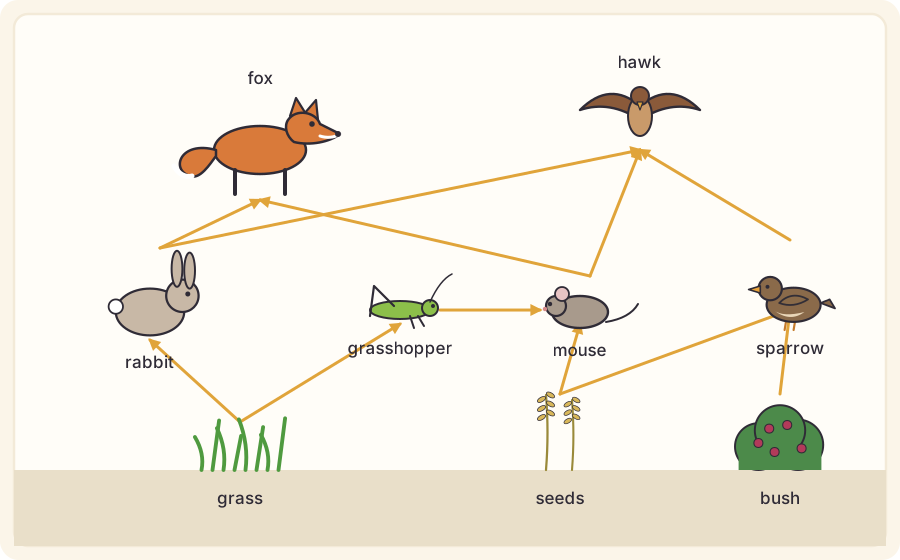
A web shows something a chain hides: change one living thing and the effect spreads along many paths. In the 1960s the ecologist Robert Paine kept pulling starfish off one stretch of rocky shore in Washington State, USA, and left the next stretch alone. The starfish had been eating barnacles and mussels. Without them, barnacles and then mussels spread over the rocks and crowded out other living things: within a year, the cleared rocks had gone from 15 species to 8.4 The short film below tells the story.
Yellowstone National Park's wolves are a famous example. People killed the park's last wolf pack in 1926; in 1995 and 1996, 31 wolves from Canada were brought back.5 Wolves mainly eat elk, and they have made fewer elk calves survive.5
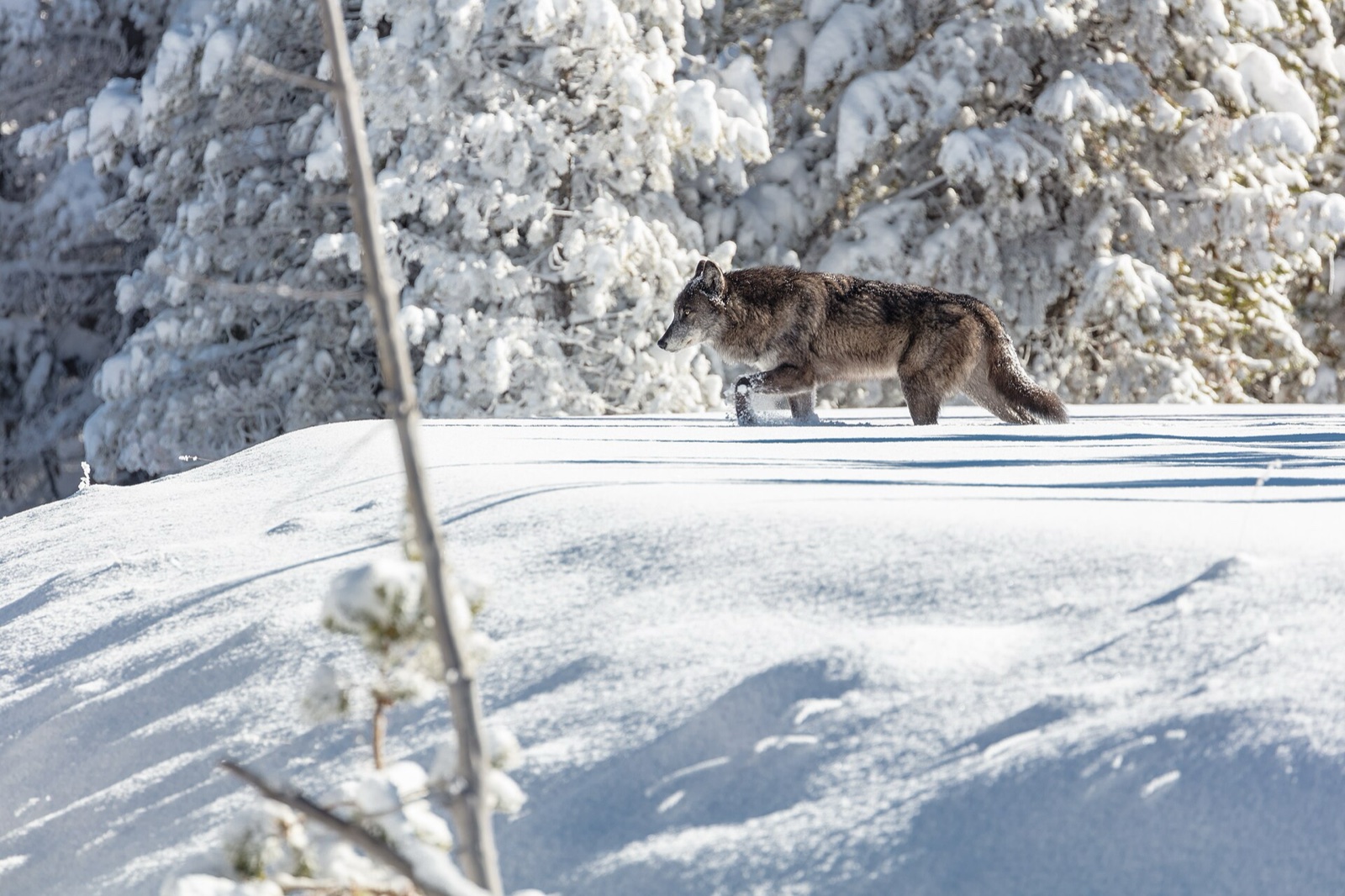
A wolf in Yellowstone National Park. Photo: Yellowstone National Park (US National Park Service), public domain, via Wikimedia Commons.

Careful
You may read that the wolves also made willows and aspens grow back and brought back beavers. Scientists agree the wolves changed the park, but they still argue about how much of the change was the wolves' doing, since cougars came back, bears grew in number, elk were hunted outside the park, and beavers and water mattered too.6
Try it yourself
Write down everything you ate yesterday. For each food, trace it back step by step to a producer: cheese comes from milk, from a cow, from grass. How many of your chains have more than two steps?
Words to know
- producer - a living thing that makes its own food from light, such as a plant or alga
- consumer - a living thing that gets energy by eating other living things
- food chain - one line of who-eats-whom, with arrows pointing from the eaten to the eater
- food web - all the food chains in a place, joined where they cross
Big idea
Energy flows from the Sun to producers and on to consumers, losing most of itself at each step - and in a web, one change travels along many paths.
Sources
-
National Geographic Education, Energy Flow and the 10 Percent Rule (article). ↩ ↩2
-
OpenStax, Biology 2e, 46.1 Ecology of Ecosystems (textbook, CC BY 4.0). ↩ ↩2
-
OpenStax, Biology 2e, 46.2 Energy Flow through Ecosystems (textbook, CC BY 4.0). ↩ ↩2
-
Robert T. Paine, "Food Web Complexity and Species Diversity", The American Naturalist 100 (1966), pages 65-75. ↩
-
US National Park Service, History of Wolf Management (Yellowstone National Park). ↩ ↩2
-
Douglas W. Smith, Rolf O. Peterson, Daniel R. MacNulty and Michel Kohl, The Big Scientific Debate: Trophic Cascades (Yellowstone Science, US National Park Service). ↩