Natural Selection
A pair of house mice can have several litters a year, with several babies in each. If every mouse lived and bred, the world would soon be full of mice. It isn't. Most young animals and plants die before they have young of their own. Which ones make it - and does it matter?
Two naturalists, one idea
In the 1830s to 1850s two British naturalists, Charles Darwin and Alfred Russel Wallace, each travelled far, collected thousands of living things, and asked why species are so well suited to where they live. Each came to the same answer on his own. Their ideas were presented together at the Linnean Society in London in 1858, and the next year Darwin published his book On the Origin of Species.1
The idea is called natural selection, and it rests on three facts anyone can check:1
- Living things vary. No two members of a species are alike (see No Two Alike).
- Many differences are inherited. Young tend to look like their parents.
- More young are born than can survive. Food, water and safe places are limited, so many die young.
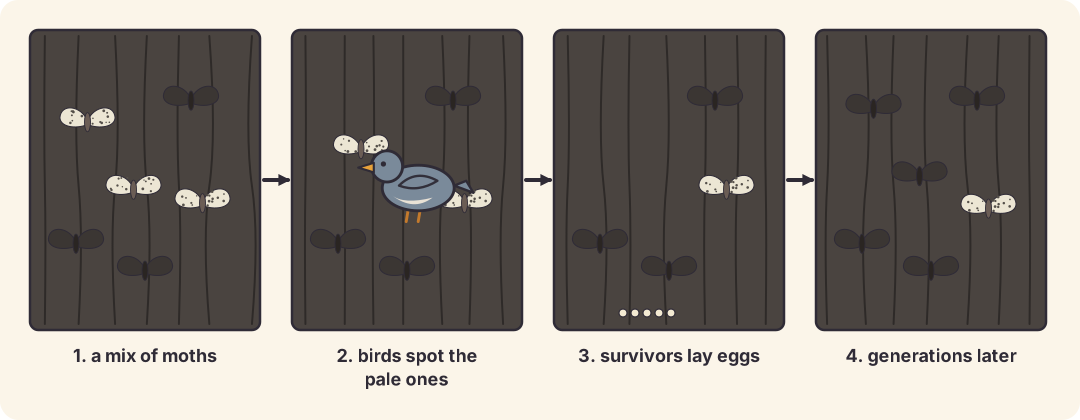
Put these together. The individuals whose inherited differences help them survive and breed in that place leave more young. Their young inherit those differences. So, generation after generation, those traits become more common in the group. This slow change in a species over many generations is evolution.
The peppered moth
The peppered moth of Britain comes in a pale, speckled form and a dark form. Both rest on tree trunks by day, where birds hunt them. During the industrial revolution, soot from factories blackened the trees near cities, and the dark form became common there. Since about 1970, as the air became cleaner and the bark paler, the dark form has become rare again.2
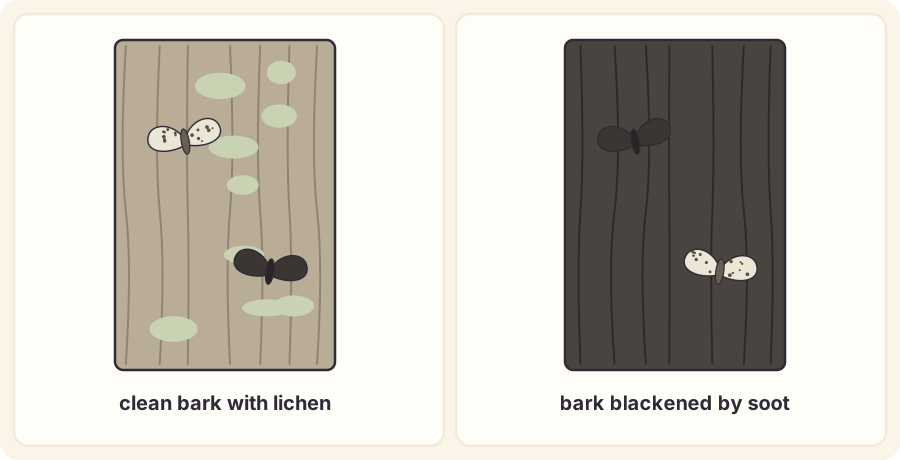
Is that really the work of birds? The biologist Michael Majerus released 4,864 moths over six years and watched what happened to them. Birds ate more dark moths than pale ones on today's cleaner trees, enough to explain why the dark form has been disappearing.2 The moths did not choose their colour, and they did not change it. Birds simply ate more of the moths that were easy to see.
Not a plan, not a fight
Natural selection has no goal. It doesn't aim to make living things bigger, faster or cleverer; it just favours whatever works in that place at that time.1 "Survival of the fittest" does not mean the strongest wins. It means the ones best suited to their surroundings leave the most young. And single animals don't evolve during their lives: a species changes because, over generations, the mix of individuals in it changes.
You can see natural selection today. When people take antibiotics, the few bacteria that happen to resist the medicine survive and multiply (see antibiotic resistance).
Try it yourself
Scatter 20 pieces of white paper and 20 pieces of green paper, all the same size, on a lawn. Ask a friend to pick up as many as they can in 15 seconds. Which colour "survived" better? Try again on a white sheet.
Words to know
- natural selection - living things with inherited traits that suit their surroundings survive and breed more, so those traits become more common
- evolution - the change in a species' inherited traits over many generations
Big idea
When living things vary, pass their traits on, and can't all survive, the traits that help become more common - and species change over generations.
Sources
-
OpenStax, Biology 2e, 18.1 Understanding Evolution (textbook, 2018). ↩ ↩2 ↩3
-
L. M. Cook, B. S. Grant, I. J. Saccheri and J. Mallet, Selective bird predation on the peppered moth: the last experiment of Michael Majerus (paper in Biology Letters, 2012). ↩ ↩2